
Homework Answers
Add Answer to:
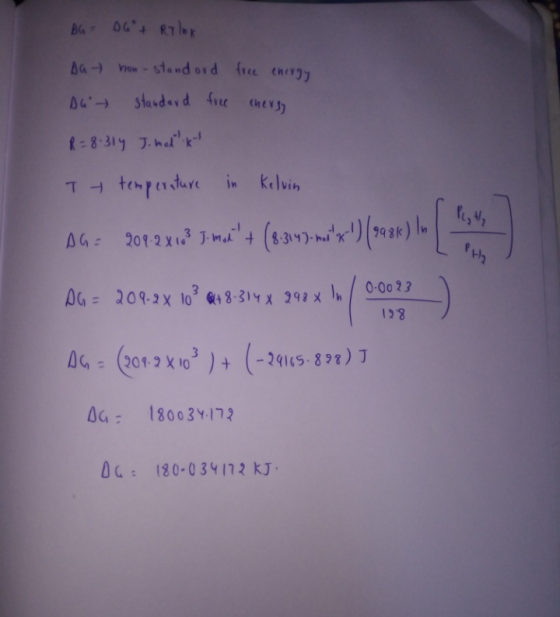
For the reaction 2C(s) + H2(g) + C2H2(g); AG° = 209.2 kJ/mol at 25 °C. If...
Acetylene, C2H2, can be converted to ethane, C2H6, by a process known as hydrogenation. The reaction is C2H2(g)+2H2(g)?...
Acetylene, C2H2, can be converted to ethane, C2H6, by a process known as hydrogenation. The reaction is C2H2(g)+2H2(g)?C2H6(g) Given the following data, what is the value of Kp for this reaction? Substance ?G?f (kJ/mol) C2H2(g) 209.2 H2(g) 0 C2H6(g) ?32.89 In Part A, we saw that ?G?=?242.1 kJ for the hydrogenation of acetylene under standard conditions (all pressures equal to 1 atm and the common reference temperature 298 K ). In Part B, you will determine the ?G for the...
8. The AG for the reaction H2(g) + 12(e) = 2 HI) is 2.60 kJ/mol at...
 8. The AG for the reaction H2(g) + 12(e) = 2 HI) is 2.60 kJ/mol at 25°C. In an experiment, the initial pressures are Pe = 3.98 atm, P = 0.044 atm, and P = 0.29 atm. Calculate AG for the reaction and predict the direction of the net reaction
NOLUL PULS. AGº for the reaction H2(g) +12(8) = 2HI(g) is 2.60 kJ/mol at 25°C. Calculate...
 NOLUL PULS. AGº for the reaction H2(g) +12(8) = 2HI(g) is 2.60 kJ/mol at 25°C. Calculate AG, and predict the direction in which the reaction is spontanec The initial pressures are: PH, = 3.70 atm P1, = 1.5 atm Ph1 = 1.75 atm AG= The reaction is spontaneous in the forward direction. The reaction is spontaneous in the reverse direction. Cannot be determined.
25. Consider the reaction given below: H2 (g)+ F2 (g)2 HF (g) for which AG -541.4...
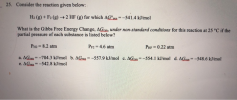 25. Consider the reaction given below: H2 (g)+ F2 (g)2 HF (g) for which AG -541.4 kJ/mol What is the Gibbs Free Energy Change, AGn, under non-standard conditions for this reaction at 25 °C if the partial pressure of each substance is listed below? PH2 8.2 atm Pr2 4.6 atm PHE= 0.22 atm a. AG e. AG -704.3 kJ/mol b. AGr=-557.9 kJ/mol c. AGn=-554.1 kJ/mol d. AGr -548.6 kJ/mol -542.8 kJ/mol
For the reaction CuS(s) + H2(g) → H2S(g) + Cu(s), AG°f (CuS) = -53.6 kJ/mol AG°f...
 For the reaction CuS(s) + H2(g) → H2S(g) + Cu(s), AG°f (CuS) = -53.6 kJ/mol AG°f (H2S) = -33.6 kJ/mol AHºf (Cus) = -53.1 kJ/mol AHºf (H2S) = - 20.6 kJ/mol Calculate the value of the equilibrium constant (Kp) for this reaction at 298 K.
A,) ΔG o for the reaction H2(g) + I2(g) ⇌ 2HI(g) is 2.60 kJ/mol at 25°C....
A,) ΔG o for the reaction H2(g) + I2(g) ⇌ 2HI(g) is 2.60 kJ/mol at 25°C. Calculate ΔG, and predict the direction in which the reaction is spontaneous. The initial pressures are: PH2 = 3.10 atm PI2 = 1.5 atm PHI 1.75 atm ΔG = kJ/mol b.)The reaction is spontaneous in the forward direction. The reaction is spontaneous in the reverse direction. Cannot be determined.
Find AHrxn for: C2H2(g) → 2C(s) + H2(g) given the following information: C2H2(g) + 5/2 O2(g)...
 Find AHrxn for: C2H2(g) → 2C(s) + H2(g) given the following information: C2H2(g) + 5/2 O2(g) → 2002(g) + H2O (1) AH° = -1291 kJ C(s) + O2(g) + CO2(g) AH° = -391 kJ H2(g) + 1/2O2(g) + H2O(1) AH° = -280 kJ kJ
3. Calculate AG ° of the following reaction: 2C(s) + H 2 (g) → C2H 2...
 3. Calculate AG ° of the following reaction: 2C(s) + H 2 (g) → C2H 2 (g) Use Hess' Law, AG ° = AG°ı + AG°2 + AG°3 after manipulating the minor reactions. C2H2 (g) + 5/2 O2 (g) 5/2 O2 (g) → 2 CO2 (g) → 2 CO2 (g) + H20 (1) C(s) + O2 (g) → CO2 (g) H2 (g) + 12 O2 (g) → H20 (1) AG° = -1234 kJ AG° = -394 kJ AG = -237...
1. Calculate AG°for the following reaction at 25°C using AG ° = AH ° - TAS°...
 1. Calculate AG°for the following reaction at 25°C using AG ° = AH ° - TAS° Fe2O3 (s) + 3 H2(g) → 2 Fe (s) + 3 H2O (1) 2. Calculate AG ° for the same reaction using AG°f values Fe2O3 (s) 3 H2(g) → 2 Fe (s) + + 3 H20 (1) + 3. Calculate AGº of the following reaction: 2C (s) H 2 (g) → C2H 2 (g) Use Hess' Law, AG° = AG°1 + AG°2 + AG°3...
The value of AG° at 25 °C for the following reaction: C2H4 (g) + H2 (g)...
 The value of AG° at 25 °C for the following reaction: C2H4 (g) + H2 (g) → C2H6 (g) is kJ/mol. At 298 K, AH° for this reaction is -137.5 kJ/mol, and ASº is +120.5 J/K. 35800 A. -101.7 B. -173.4 C. -35800 D. 0 E.
 8. The AG for the reaction H2(g) + 12(e) = 2 HI) is 2.60 kJ/mol at 25°C. In an experiment, the initial pressures are Pe = 3.98 atm, P = 0.044 atm, and P = 0.29 atm. Calculate AG for the reaction and predict the direction of the net reaction
 NOLUL PULS. AGº for the reaction H2(g) +12(8) = 2HI(g) is 2.60 kJ/mol at 25°C. Calculate AG, and predict the direction in which the reaction is spontanec The initial pressures are: PH, = 3.70 atm P1, = 1.5 atm Ph1 = 1.75 atm AG= The reaction is spontaneous in the forward direction. The reaction is spontaneous in the reverse direction. Cannot be determined.
 25. Consider the reaction given below: H2 (g)+ F2 (g)2 HF (g) for which AG -541.4 kJ/mol What is the Gibbs Free Energy Change, AGn, under non-standard conditions for this reaction at 25 °C if the partial pressure of each substance is listed below? PH2 8.2 atm Pr2 4.6 atm PHE= 0.22 atm a. AG e. AG -704.3 kJ/mol b. AGr=-557.9 kJ/mol c. AGn=-554.1 kJ/mol d. AGr -548.6 kJ/mol -542.8 kJ/mol
 For the reaction CuS(s) + H2(g) → H2S(g) + Cu(s), AG°f (CuS) = -53.6 kJ/mol AG°f (H2S) = -33.6 kJ/mol AHºf (Cus) = -53.1 kJ/mol AHºf (H2S) = - 20.6 kJ/mol Calculate the value of the equilibrium constant (Kp) for this reaction at 298 K.
 Find AHrxn for: C2H2(g) → 2C(s) + H2(g) given the following information: C2H2(g) + 5/2 O2(g) → 2002(g) + H2O (1) AH° = -1291 kJ C(s) + O2(g) + CO2(g) AH° = -391 kJ H2(g) + 1/2O2(g) + H2O(1) AH° = -280 kJ kJ
 3. Calculate AG ° of the following reaction: 2C(s) + H 2 (g) → C2H 2 (g) Use Hess' Law, AG ° = AG°ı + AG°2 + AG°3 after manipulating the minor reactions. C2H2 (g) + 5/2 O2 (g) 5/2 O2 (g) → 2 CO2 (g) → 2 CO2 (g) + H20 (1) C(s) + O2 (g) → CO2 (g) H2 (g) + 12 O2 (g) → H20 (1) AG° = -1234 kJ AG° = -394 kJ AG = -237...
 1. Calculate AG°for the following reaction at 25°C using AG ° = AH ° - TAS° Fe2O3 (s) + 3 H2(g) → 2 Fe (s) + 3 H2O (1) 2. Calculate AG ° for the same reaction using AG°f values Fe2O3 (s) 3 H2(g) → 2 Fe (s) + + 3 H20 (1) + 3. Calculate AGº of the following reaction: 2C (s) H 2 (g) → C2H 2 (g) Use Hess' Law, AG° = AG°1 + AG°2 + AG°3...
 The value of AG° at 25 °C for the following reaction: C2H4 (g) + H2 (g) → C2H6 (g) is kJ/mol. At 298 K, AH° for this reaction is -137.5 kJ/mol, and ASº is +120.5 J/K. 35800 A. -101.7 B. -173.4 C. -35800 D. 0 E.
Most questions answered within 3 hours.
-
Where is the error in this code sequence?
String s1 = "Hello";
String s2 = "ello";...
asked 11 months ago -
Financial data for Joel de Paris, Inc., for last year
follow:
Joel de Paris, Inc.
Balance...
asked 11 months ago -
Consider this reaction:
Al2(SO4)3 (aq)+ BaCl3
(aq) Al2Cl6 (aq)- +
3BaSO4(s) . What is the...
asked 11 months ago -
Suppose that Savneet is considering increasing her
recent random sample from 20 car rentals to 40...
asked 11 months ago -
Trucks arrive at an unloading terminal at an average rate of 120
per hour.
Trucks arrive...
asked 11 months ago -
Why are methanol and ethanol completely soluble in water while
octanol is not very little soluble....
asked 11 months ago -
A facilities manager at a university reads in a research report
that the mean amount of...
asked 11 months ago -
When the CuSO4 is rehydrated by adding water to the anhydrous
compound, is this an endothermic...
asked 11 months ago -
A ray of sunlight is passing from diamond into crown glass; the
angle of incidence is...
asked 11 months ago -
A block of mass 0.249 kg is placed on top of a light, vertical
spring of...
asked 11 months ago -
how do the kidneys compensate in the presences of acidosis
a) trigger hyperventilate
b) reserve acid...
asked 11 months ago -
Question 501 pts
The rental rate of capital to the firm increases. Which of the
following...
asked 11 months ago