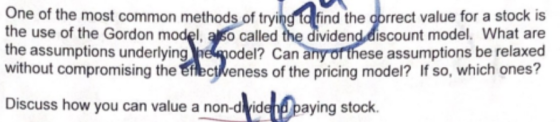
one of the most common methods of trying to find the correct value for a stock is the use of the Gordon model also called the dividend discount model. what are the assumptions underlying he model? can any these assumptions be relaxed without compromising the effectiveness of the pricing model? if so which ones?
discuss how you can value a non-dividend paying stock
Homework Answers
(1): The assumptions that are used in the Gordon model are:
- The dividend will have a stable growth rate
- The rate of return will also be stable
- Rate of return>growth rate
Yes, the first 2 assumptions can be relaxed without compromising the effectiveness of the pricing model. The dividends need not have a stable growth rate and even if dividends have different growth rates in different years the present value concept can be applied easily to compute the present value of all future dividend payouts. Same is the case with the second assumption which states that rate of return should be stable. Even if rate of return is different in different years then the present value concept can easily be applied and present value of all future dividends can be computed easily.
(2): To value a non-dividend paying stock we can use either the
free cash flow valuation model or the residual income based
model.
In the free cash flow valuation model: intrinsic value of a stock = present value of its free cash flow. Free cash flow is the net cash flow that is left over for distribution to stockholders and debt-holders in each period. For discounting WACC (weighted average cost of capital) is used.
In the residual income valuation method: intrinsic value of a stock = present value of future residual incomes that are discounted at the appropriate cost of equity.
Residual income = net income – (equity capital * cost of equity)
Add Answer to:
one of the most common methods of trying to find the correct
value for a stock...
Common stock value - Constant growth Use the constant growth model (Gordon growth model) to find...
Common stock value - Constant growth Use the constant growth model (Gordon growth model) to find the value of the firm shown in the following Dividend expected next year $1.13 Dividend growth rate 7.5% Required return 13.3% The value of the firm's stock is
The value of a share of common stock depends on the cash flows it is expected...
 The value of a share of common stock depends on the cash flows it is expected to provide, and those flows consist of the dividends the investor receives each year while holding the stock and the price the investor receives when the stock is sold. The final price includes the original price paid plus an expected capital gain. The actions of the marginal investor determine the equilibrium stock price. Market equilibrium occurs when the stock's price is Select- its Intrinsic...
The value of a share of common stock depends on the cash flows it is expected...
 The value of a share of common stock depends on the cash flows it is expected to provide, and those flows consist of the dividends the investor receives each year while holding the stock and the price the investor receives when the stock is sold. The final price includes the original price paid plus an expected capital ghin. The actions of the marginal investor determine the equilibrium stock price Market equilibrium occurs when the stock's price is Select its intrinsic...
Common stock value-Constant growth Use the constant-growth model (Gordon model) to find the value of each...
 Common stock value-Constant growth Use the constant-growth model (Gordon model) to find the value of each firm shown in the following table: (Click on the icon located on the top-right corner of the data table below in order to copy its contents into a spreadsheet.) Firm Dividend expected next year $1.20 4.00 0.65 6.00 2.25 Dividend growth rate 8.0% 5.0 10.0 8.0 8.0 Required return 13.0% 15.0 14.0 9.0 20.0 The value of firm A's stock is $ 24. (Round...
Can the dividend discount method ever be used to value a non dividend paying stock and...
 Can the dividend discount method ever be used to value a non dividend paying stock and why? Select one: a. Yes, DDM can calculate the value of a firm by making future assumptions about cash flows to the firm b. Yes, DDM can calculate the value of a company's stock by making an educated guess of the future dividends and applying a margin of error c. No, because DDM can calculate only the firm value but not its future dividend...
1. Fundamentals of the free cash flow corporate valuation model Several methods can be used to...
 1. Fundamentals of the free cash flow corporate valuation model Several methods can be used to compute the intrinsic value of a share of a company's common stock. One method uses the free cash flow (FCF) valuation model, while the another method uses the dividend discount model value-as the sum of the value of its operating The FCF valuation model computes a firm's activities (Vop) and the value of firm's nonoperating value-also called its where: • From a manager's perspective,...
5.Use your words or examples to explain why the value of a call option increases as...
5.Use your words or examples to explain why the value of a call option increases as the market interest rate increases, and why the value of a put option increases as the market interest rate decreases. (8 points) 6.6. European options can only be exercised on the expiration date, while American options can be exercised on any date before the expiration. Intuitively, American options should be more popular among investors. However, we rarely see American options being traded on today’s...
1. Which of the following variables does NOT affect the value of a stock option? The...
1. Which of the following variables does NOT affect the value of a stock option? The predicted future price of the underlying stock The current price of the underlying stock The option’s time to maturity The option’s strike price The interest rate 2. Zack owns a bond that will pay him $35 each year in interest plus a $1,000 principal payment at maturity. The $1,000 principal payment is called the coupon. par value. discount. yield. call premium. None of the...
1A) Which statements are CORRECT? Check all that apply: a) Shortselling is a lot riskier than...
1A) Which statements are CORRECT? Check all that apply: a) Shortselling is a lot riskier than regular ‘buy and sell’. b) The immediate market reaction to cash dividend distribution is the company’s stock declining c) By paying cash dividend, the true value per share of the firm decreases by the cash dividend amount per share d) Shortsales make stock prices more informative e) Security and Exchange Commission (SEC) prohibit shortselling f) Shortselling is one of the mechanisms that keep the...
Question 1 a. A stock price is currently $30. It is known that at the end...
 Question 1 a. A stock price is currently $30. It is known that at the end of two months it will be either $33 or $27. The risk-free interest rate is 10% per annum with continuous compounding. What is the value of a two-month European put option with a strike price of $31? b. What is meant by the delta of a stock option? A stock price is currently $100. Over each of the next two three-month periods it is...
 The value of a share of common stock depends on the cash flows it is expected to provide, and those flows consist of the dividends the investor receives each year while holding the stock and the price the investor receives when the stock is sold. The final price includes the original price paid plus an expected capital gain. The actions of the marginal investor determine the equilibrium stock price. Market equilibrium occurs when the stock's price is Select- its Intrinsic...
 The value of a share of common stock depends on the cash flows it is expected to provide, and those flows consist of the dividends the investor receives each year while holding the stock and the price the investor receives when the stock is sold. The final price includes the original price paid plus an expected capital ghin. The actions of the marginal investor determine the equilibrium stock price Market equilibrium occurs when the stock's price is Select its intrinsic...
 Common stock value-Constant growth Use the constant-growth model (Gordon model) to find the value of each firm shown in the following table: (Click on the icon located on the top-right corner of the data table below in order to copy its contents into a spreadsheet.) Firm Dividend expected next year $1.20 4.00 0.65 6.00 2.25 Dividend growth rate 8.0% 5.0 10.0 8.0 8.0 Required return 13.0% 15.0 14.0 9.0 20.0 The value of firm A's stock is $ 24. (Round...
 Can the dividend discount method ever be used to value a non dividend paying stock and why? Select one: a. Yes, DDM can calculate the value of a firm by making future assumptions about cash flows to the firm b. Yes, DDM can calculate the value of a company's stock by making an educated guess of the future dividends and applying a margin of error c. No, because DDM can calculate only the firm value but not its future dividend...
 1. Fundamentals of the free cash flow corporate valuation model Several methods can be used to compute the intrinsic value of a share of a company's common stock. One method uses the free cash flow (FCF) valuation model, while the another method uses the dividend discount model value-as the sum of the value of its operating The FCF valuation model computes a firm's activities (Vop) and the value of firm's nonoperating value-also called its where: • From a manager's perspective,...
 Question 1 a. A stock price is currently $30. It is known that at the end of two months it will be either $33 or $27. The risk-free interest rate is 10% per annum with continuous compounding. What is the value of a two-month European put option with a strike price of $31? b. What is meant by the delta of a stock option? A stock price is currently $100. Over each of the next two three-month periods it is...
Most questions answered within 3 hours.
-
Where is the error in this code sequence?
String s1 = "Hello";
String s2 = "ello";...
asked 11 months ago -
Financial data for Joel de Paris, Inc., for last year
follow:
Joel de Paris, Inc.
Balance...
asked 11 months ago -
Consider this reaction:
Al2(SO4)3 (aq)+ BaCl3
(aq) Al2Cl6 (aq)- +
3BaSO4(s) . What is the...
asked 11 months ago -
Suppose that Savneet is considering increasing her
recent random sample from 20 car rentals to 40...
asked 11 months ago -
Trucks arrive at an unloading terminal at an average rate of 120
per hour.
Trucks arrive...
asked 11 months ago -
Why are methanol and ethanol completely soluble in water while
octanol is not very little soluble....
asked 11 months ago -
A facilities manager at a university reads in a research report
that the mean amount of...
asked 11 months ago -
When the CuSO4 is rehydrated by adding water to the anhydrous
compound, is this an endothermic...
asked 11 months ago -
A ray of sunlight is passing from diamond into crown glass; the
angle of incidence is...
asked 11 months ago -
A block of mass 0.249 kg is placed on top of a light, vertical
spring of...
asked 11 months ago -
how do the kidneys compensate in the presences of acidosis
a) trigger hyperventilate
b) reserve acid...
asked 11 months ago -
Question 501 pts
The rental rate of capital to the firm increases. Which of the
following...
asked 11 months ago