
Homework Answers
Given is :-

 or
or 

 or
or 
Volume is constant throughout the process,
using Ideal gas equation, we get

by plugging all the values we get
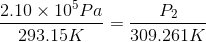
which gives us

This is the required gauge pressure at the elevated temperature.
Add Answer to:
5. A steel-belted radial automobile tire is inflated to a gauge pressure of 2.10 x 10°...
5. A steel-belted radial automobile tire is inflated to a gauge pressure of 1.85 x 10°...
 5. A steel-belted radial automobile tire is inflated to a gauge pressure of 1.85 x 10° Pa when the temperature is 69 °F. Later in the day, the temperature rises to 96 °F. Assuming the volume of the tire remains constant, what is the gauge pressure at the elevated temperature? [Hint: Remember that the ideal gas law uses absolute pressure.] 3.01e5 Pa
A steel-belted radial automobile tire is inflated to a gauge pressure of 2.15×10^5 Pa when the...
A steel-belted radial automobile tire is inflated to a gauge pressure of 2.15×10^5 Pa when the temperature is 65 °F. Later in the day, the temperature rises to 95 °F. Assuming the volume of the tire remains constant, what is the gauge pressure at the elevated temperature? [Hint: Remember that the ideal gas law uses absolute pressure.]
5. A steel-belted radial automobile tire is inflated to a gauge pressure of 1.75 10 Pa when the temperature is 61 °F. L...
 5. A steel-belted radial automobile tire is inflated to a gauge pressure of 1.75 10 Pa when the temperature is 61 °F. Later in the day, the temperature rises to 101 °F. Assuming the volume of the tire remains constant, what is the gauge pressure at the elevated temperature? (Hint: Remember that the ideal gas law uses absolute pressure.] Pa
5. A steel-belted radial automobile tire is inflated to a gauge pressure of 2.00 × 10 5 Pa when the temperature is 62 °F...
5. A steel-belted radial automobile tire is inflated to a gauge pressure of 2.00 × 10 5 Pa when the temperature is 62 °F. Later in the day, the temperature rises to 101 °F. Assuming the volume of the tire remains constant, what is the gauge pressure at the elevated temperature? [Hint: Remember that the ideal gas law uses absolute pressure.]
An automobile tire is inflated with air originally at 10.0degreesC and normal atmospheric pressure. During the...
 An automobile tire is inflated with air originally at 10.0degreesC and normal atmospheric pressure. During the process, the air is compressed to 31.0% of its original volume and the temperature is increased to 33.0degreesC. What is the tire pressure? ___ Pa After the car is driven at high speed, the tire's air temperature rises to 85.0degreesC and the tire's interior volume increases by 2.00%. What is the new tire pressure (absolute)? ____ Pa
An automobile tire has a maximum rating of 38.0 psi (gauge pressure). The tire is inflated (while cold) to a volume of 1...
An automobile tire has a maximum rating of 38.0 psi (gauge pressure). The tire is inflated (while cold) to a volume of 11.8 L and a gauge pressure of 36.0 psi at a temperature of 12.0 °C. Driving on a hot day, the tire warms to 65.0 °C and its volume expands to 12.2 L. Does the pressure in the tire exceed its maximum rating? (Note: the gauge pressure is the difference between the total pressure and atmospheric pressure. In...
1) An automobile tire is inflated with air originally at 10.0°C and normal atmospheric pressure. During...
1) An automobile tire is inflated with air originally at 10.0°C and normal atmospheric pressure. During the process, the air is compressed to 31.0% of its original volume and the temperature is increased to 39.0°C. (a) What is the tire pressure in pascals? Pa (b) After the car is driven at high speed, the tire's air temperature rises to 85.0°C and the tire's interior volume increases by 3.00%. What is the new tire pressure (absolute) in pascals? Pa
The four tires of an automobile are inflated to a gauge pressure of 2.0x10^5 Pa
The four tires of an automobile are inflated to a gauge pressure of 2.0x10^5 Pa. Each tire has an area of 0.024m^2 in contact with the ground. Determine the weight of the automobile.
+ 12 points Ser.P10 10 PO MI F My Note An automobile tire is inflated with...
 + 12 points Ser.P10 10 PO MI F My Note An automobile tire is inflated with air originally at 10.0°C and normal atmospheric pressure. During the process, the air is compressed to 24.0% of its original volume and the temperature is increased to 47,0C (a) What is the tire pressure in pa scals? Pa (b) After the car is driven at high speed, the tire's air temperature rises to 85.0°C and the tire's interior volume increases by J.00%. What is...
An automobile tire has a maximum rating of 38.0 psi (gauge pressure).
An automobile tire has a maximum rating of 38.0 psi (gauge pressure). Part A The tire is inflated (while cold) to a volume of 11.8 L and a gauge pressure of 36.0 psi (Note: The gauge pressure is the difference between the total pressure and atmospheric pressure. In this case, assume that atmospheric pressure is 14.7 psi.) at a temperature of 12.0°C. While driving on a hot day, the tire warms to 65.0°C and its volume expands to 12.2 L. What is the total...
 5. A steel-belted radial automobile tire is inflated to a gauge pressure of 1.85 x 10° Pa when the temperature is 69 °F. Later in the day, the temperature rises to 96 °F. Assuming the volume of the tire remains constant, what is the gauge pressure at the elevated temperature? [Hint: Remember that the ideal gas law uses absolute pressure.] 3.01e5 Pa
 5. A steel-belted radial automobile tire is inflated to a gauge pressure of 1.75 10 Pa when the temperature is 61 °F. Later in the day, the temperature rises to 101 °F. Assuming the volume of the tire remains constant, what is the gauge pressure at the elevated temperature? (Hint: Remember that the ideal gas law uses absolute pressure.] Pa
 An automobile tire is inflated with air originally at 10.0degreesC and normal atmospheric pressure. During the process, the air is compressed to 31.0% of its original volume and the temperature is increased to 33.0degreesC. What is the tire pressure? ___ Pa After the car is driven at high speed, the tire's air temperature rises to 85.0degreesC and the tire's interior volume increases by 2.00%. What is the new tire pressure (absolute)? ____ Pa
 + 12 points Ser.P10 10 PO MI F My Note An automobile tire is inflated with air originally at 10.0°C and normal atmospheric pressure. During the process, the air is compressed to 24.0% of its original volume and the temperature is increased to 47,0C (a) What is the tire pressure in pa scals? Pa (b) After the car is driven at high speed, the tire's air temperature rises to 85.0°C and the tire's interior volume increases by J.00%. What is...
Most questions answered within 3 hours.
-
Where is the error in this code sequence?
String s1 = "Hello";
String s2 = "ello";...
asked 11 months ago -
Financial data for Joel de Paris, Inc., for last year
follow:
Joel de Paris, Inc.
Balance...
asked 11 months ago -
Consider this reaction:
Al2(SO4)3 (aq)+ BaCl3
(aq) Al2Cl6 (aq)- +
3BaSO4(s) . What is the...
asked 11 months ago -
Suppose that Savneet is considering increasing her
recent random sample from 20 car rentals to 40...
asked 11 months ago -
Trucks arrive at an unloading terminal at an average rate of 120
per hour.
Trucks arrive...
asked 11 months ago -
Why are methanol and ethanol completely soluble in water while
octanol is not very little soluble....
asked 11 months ago -
A facilities manager at a university reads in a research report
that the mean amount of...
asked 11 months ago -
When the CuSO4 is rehydrated by adding water to the anhydrous
compound, is this an endothermic...
asked 11 months ago -
A ray of sunlight is passing from diamond into crown glass; the
angle of incidence is...
asked 11 months ago -
A block of mass 0.249 kg is placed on top of a light, vertical
spring of...
asked 11 months ago -
how do the kidneys compensate in the presences of acidosis
a) trigger hyperventilate
b) reserve acid...
asked 11 months ago -
Question 501 pts
The rental rate of capital to the firm increases. Which of the
following...
asked 11 months ago