

Homework Answers
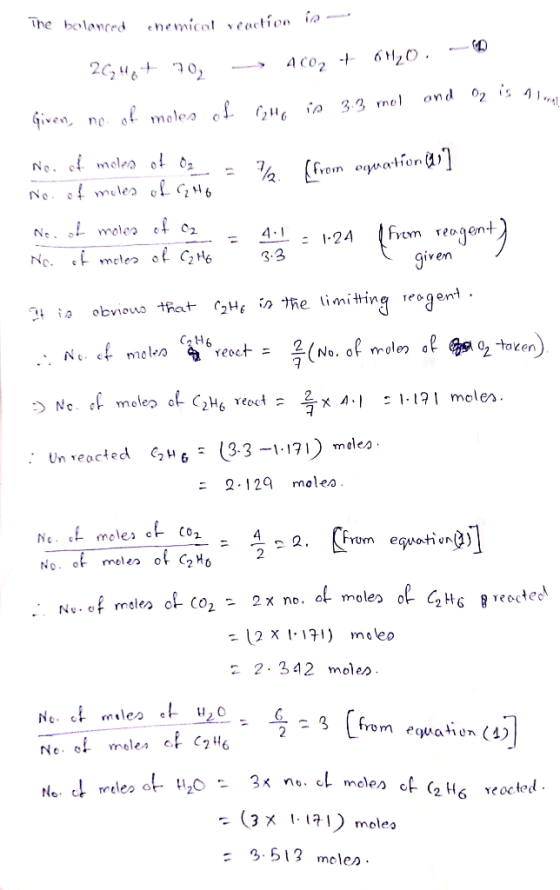
The solution is attached below:

Add Answer to:
Part The balanced reaction for the combustion of ethane is shown in the table. You allow...
Part The balanced reaction for the combustion of ethane is shown in the table. You allow 3.3 mol of ethane (CH) to...
 Part The balanced reaction for the combustion of ethane is shown in the table. You allow 3.3 mol of ethane (CH) to react with 4.1 mol oxygen (O2). using the Simulation, to indicate the amounts of all chemical species for the initial, change, and final conditions Drag the appropriate amounts to their respective targets. View Available Hint(s) We were unable to transcribe this image
Part C The balanced reaction for the combustion of ethane is shown in the table. You...
Part C The balanced reaction for the combustion of ethane is shown in the table. You allow 2.7 mol of ethane (C2H6) to react with 3.9 mol oxygen (O2). Complete the following ICF table, which may be done using the Simulation, to indicate the amounts of all chemical species for the initial, change, and final conditions. Drag the appropriate amounts to their respective targets. View Available Hint(s) ResetHelp 1.1 mol1.1 m o l 8.1 mol8.1 m o l 2.7 mol2.7...
Drag the appropriate amounts to their respective targets. View Available Hint(s) Reset Help 10.5 mol 7.0...
 Drag the appropriate amounts to their respective targets. View Available Hint(s) Reset Help 10.5 mol 7.0 mol 3.7 mol 3.5 mol 12 mol 12.3 mol 4.3 mol 25 mol 0.0 mol 23 mol 2CH.(g) + 702(g) → 4CO2(g) 6H2O(g) Initial Change OOO Final Submit Part C The balanced reaction for the combustion of the shown in the table you slow 35 mol of the Cle) to read with 43 molagen () Complete the following of table, which may be done...
Balanced chemical equations, which represent reactions, include coefficients that describe the ratio between the reactants and...
Balanced chemical equations, which represent reactions, include coefficients that describe the ratio between the reactants and products. A balanced chemical equation not only describes how many molecules or moles react with each other, but it also embodies the fact that matter and mass are conserved in a reaction. This means that all of the atoms present among the reactants will be present in the same amount among the products. For example, the combustion reaction between methane and oxygen can be...
You are studying the combustion of ethane by the following unbalanced chemical reaction: a C2H6(g) +...
 You are studying the combustion of ethane by the following unbalanced chemical reaction: a C2H6(g) + b O2(g) --> C CO2(g) + d H2O(g) How many kilojoules of Gibb's Free Energy are liberated by burning 19.419g of ethane in excess oxygen? Substance AG°f(kJ/mol C2H6(g) -32.04 O2(g) 0 CO2(g) -394.36 H2O(g) -228.59
When solving problems involving stoichiometric coefficients, the first step is to make sure you have a...
When solving problems involving stoichiometric coefficients, the first step is to make sure you have a balanced chemical equation. Then, you determine the limiting reagent by using the coefficients from the balanced equation. You can keep track of the amounts of all reactant and products before and after a reaction using an ICF table (as shown in the Simulation). Completing the ICF table will also allow you to determine the limiting reagent, and the amount of product formed is based...
p1 P1. Write a balanced chemical equation for each combustion reaction. Assume that combustion is complete. The fo...
 p1
P1. Write a balanced chemical equation for each combustion reaction. Assume that combustion is complete. The formulas and the line-bond structures for the compounds are given on the previous page. Write your equations so that liquid water is one of the products. Ethanol: Ethyl acetate: mm For onoh fuol'c combuetion reaction fill in the tables belo for the number of each AHr = [(4 x 413 kJ/mol for the C-H bonds in one mole of methane)+ (2 x 495...
p1
P1. Write a balanced chemical equation for each combustion reaction. Assume that combustion is complete. The formulas and the line-bond structures for the compounds are given on the previous page. Write your equations so that liquid water is one of the products. Ethanol: Ethyl acetate: mm For onoh fuol'c combuetion reaction fill in the tables belo for the number of each AHr = [(4 x 413 kJ/mol for the C-H bonds in one mole of methane)+ (2 x 495...
2. In the ICE table below, a balanced chemical equation is shown. Initial amounts are given...
 2. In the ICE table below, a balanced chemical equation is shown. Initial amounts are given for the reactants, and a final observed concentration for the product. The volume of the vessel is 1.0 L (a) (0.5 pts) Show by calculation if there is enough Pa s) to permit that amount of the product PH to form, with some P4(s) left over. (Ps has to be present in excess for the equilibirum to be established) (b) (0.5 pts) Complete this...
The enthalpy change for a chemical reaction is the sum of the energy consumed in breaking...
 The enthalpy change for a chemical reaction is the sum of the energy consumed in breaking bonds and the energy released during bond formation. One way to determine the overall energy change for a chemical reaction is to apply Hess's law to add together a group of reactions which can be arranged such that the chemical equations, when combined, give the overall equation we are trying to characterize 3rd attempt See Hint Ad See Periodic Table Part 1 (1 point)...
Gaseous methane (CH4) will react with gaseous oxygen (O2) to produce gaseous carbon dioxide (CO2 ...
 PART ONE:
PART TWO:
PART THREE:
PART FOUR:
Gaseous methane (CH4) will react with gaseous oxygen (O2) to produce gaseous carbon dioxide (CO2 and gaseous water (H20). Suppose 13. g of methane is mixed with 13.8 g of oxygen. Calculate the minimum mass of methane that could be left over by the chemical reaction. Round your answer to 2 significant digits A 1.32-g sample of a compound is burned in a bomb calorimeter, producing a temperature change from 20.85 °C...
PART ONE:
PART TWO:
PART THREE:
PART FOUR:
Gaseous methane (CH4) will react with gaseous oxygen (O2) to produce gaseous carbon dioxide (CO2 and gaseous water (H20). Suppose 13. g of methane is mixed with 13.8 g of oxygen. Calculate the minimum mass of methane that could be left over by the chemical reaction. Round your answer to 2 significant digits A 1.32-g sample of a compound is burned in a bomb calorimeter, producing a temperature change from 20.85 °C...
 Part The balanced reaction for the combustion of ethane is shown in the table. You allow 3.3 mol of ethane (CH) to react with 4.1 mol oxygen (O2). using the Simulation, to indicate the amounts of all chemical species for the initial, change, and final conditions Drag the appropriate amounts to their respective targets. View Available Hint(s) We were unable to transcribe this image
 Drag the appropriate amounts to their respective targets. View Available Hint(s) Reset Help 10.5 mol 7.0 mol 3.7 mol 3.5 mol 12 mol 12.3 mol 4.3 mol 25 mol 0.0 mol 23 mol 2CH.(g) + 702(g) → 4CO2(g) 6H2O(g) Initial Change OOO Final Submit Part C The balanced reaction for the combustion of the shown in the table you slow 35 mol of the Cle) to read with 43 molagen () Complete the following of table, which may be done...
 You are studying the combustion of ethane by the following unbalanced chemical reaction: a C2H6(g) + b O2(g) --> C CO2(g) + d H2O(g) How many kilojoules of Gibb's Free Energy are liberated by burning 19.419g of ethane in excess oxygen? Substance AG°f(kJ/mol C2H6(g) -32.04 O2(g) 0 CO2(g) -394.36 H2O(g) -228.59
 p1
P1. Write a balanced chemical equation for each combustion reaction. Assume that combustion is complete. The formulas and the line-bond structures for the compounds are given on the previous page. Write your equations so that liquid water is one of the products. Ethanol: Ethyl acetate: mm For onoh fuol'c combuetion reaction fill in the tables belo for the number of each AHr = [(4 x 413 kJ/mol for the C-H bonds in one mole of methane)+ (2 x 495...
p1
P1. Write a balanced chemical equation for each combustion reaction. Assume that combustion is complete. The formulas and the line-bond structures for the compounds are given on the previous page. Write your equations so that liquid water is one of the products. Ethanol: Ethyl acetate: mm For onoh fuol'c combuetion reaction fill in the tables belo for the number of each AHr = [(4 x 413 kJ/mol for the C-H bonds in one mole of methane)+ (2 x 495...
 2. In the ICE table below, a balanced chemical equation is shown. Initial amounts are given for the reactants, and a final observed concentration for the product. The volume of the vessel is 1.0 L (a) (0.5 pts) Show by calculation if there is enough Pa s) to permit that amount of the product PH to form, with some P4(s) left over. (Ps has to be present in excess for the equilibirum to be established) (b) (0.5 pts) Complete this...
 The enthalpy change for a chemical reaction is the sum of the energy consumed in breaking bonds and the energy released during bond formation. One way to determine the overall energy change for a chemical reaction is to apply Hess's law to add together a group of reactions which can be arranged such that the chemical equations, when combined, give the overall equation we are trying to characterize 3rd attempt See Hint Ad See Periodic Table Part 1 (1 point)...
 PART ONE:
PART TWO:
PART THREE:
PART FOUR:
Gaseous methane (CH4) will react with gaseous oxygen (O2) to produce gaseous carbon dioxide (CO2 and gaseous water (H20). Suppose 13. g of methane is mixed with 13.8 g of oxygen. Calculate the minimum mass of methane that could be left over by the chemical reaction. Round your answer to 2 significant digits A 1.32-g sample of a compound is burned in a bomb calorimeter, producing a temperature change from 20.85 °C...
PART ONE:
PART TWO:
PART THREE:
PART FOUR:
Gaseous methane (CH4) will react with gaseous oxygen (O2) to produce gaseous carbon dioxide (CO2 and gaseous water (H20). Suppose 13. g of methane is mixed with 13.8 g of oxygen. Calculate the minimum mass of methane that could be left over by the chemical reaction. Round your answer to 2 significant digits A 1.32-g sample of a compound is burned in a bomb calorimeter, producing a temperature change from 20.85 °C...
Most questions answered within 3 hours.
-
Where is the error in this code sequence?
String s1 = "Hello";
String s2 = "ello";...
asked 10 months ago -
Financial data for Joel de Paris, Inc., for last year
follow:
Joel de Paris, Inc.
Balance...
asked 10 months ago -
Consider this reaction:
Al2(SO4)3 (aq)+ BaCl3
(aq) Al2Cl6 (aq)- +
3BaSO4(s) . What is the...
asked 10 months ago -
Suppose that Savneet is considering increasing her
recent random sample from 20 car rentals to 40...
asked 10 months ago -
Trucks arrive at an unloading terminal at an average rate of 120
per hour.
Trucks arrive...
asked 10 months ago -
Why are methanol and ethanol completely soluble in water while
octanol is not very little soluble....
asked 10 months ago -
A facilities manager at a university reads in a research report
that the mean amount of...
asked 10 months ago -
When the CuSO4 is rehydrated by adding water to the anhydrous
compound, is this an endothermic...
asked 10 months ago -
A ray of sunlight is passing from diamond into crown glass; the
angle of incidence is...
asked 10 months ago -
A block of mass 0.249 kg is placed on top of a light, vertical
spring of...
asked 10 months ago -
how do the kidneys compensate in the presences of acidosis
a) trigger hyperventilate
b) reserve acid...
asked 10 months ago -
Question 501 pts
The rental rate of capital to the firm increases. Which of the
following...
asked 10 months ago