
Homework Answers
Business inventories tend to decrease and signals firms to increase production if total expenditure (TE) is higher than total product (TP).
Business inventories tend to rise and signals firms to decrease production if total expenditure (TE) is smaller than total product (TP)
The economy is in equilibrium if total expenditure (TE) = total product (TP)
(1) The economy is in equilibrium (TE=TP)
(2) unexpected business inventory depletion signals firms to increase production (TE>TP)
(3) unexpected business inventory accumulation signals firms to decrease production (TE<TP)
Add Answer to:
Complete the following table by identifying the three states of the economy in terms of total...
The economy is in equilibrium, TP = TE, and Real GDP is $2,000 billion. The MPC...
The economy is in equilibrium, TP = TE, and Real GDP is $2,000 billion. The MPC is 0.75, the multiplier is operative, and idle resources exist at each expenditure round. Autonomous investment spending falls by $10 billion. As a result, the TE curve shifts __________, inventory levels unexpectedly __________, business firms __________ the quantity of goods and services they produce, and Real GDP __________ by __________. downward; rise; decrease; falls; $7.5 billion downward; fall; increase; rises; $40 billion downward; rise;...
Question 37 Supply-side economics emphasizes: long-run effects on aggregate supply rather than short-run effects on aggregate...
Question 37 Supply-side economics emphasizes: long-run effects on aggregate supply rather than short-run effects on aggregate demand. all of the above. low marginal tax rates. increasing incentives to work, save, and invest. ---------------------- A progressive tax system is one for which: each tax payer pays an equal dollar amount in taxes. taxes as a percentage of income decreases as income increases. taxes as a percentage of income are the same for all income levels. taxes as a percentage of income...
Suppose an economy produces cell phones and GPS devices in perfectly competitive industries. The economy is...
 Suppose an economy produces cell phones and GPS devices in perfectly competitive industries. The economy is currently operating at a point on its production possibility frontier. The economy will most likely move to a less-desirable point on the production possibility frontier if more firms enter the GPS device industry. O a single firm gains control over the production of cell phones. more firms enter the cell phone industry. more firms enter both the GPS device industry and the cell phone...
The following table presents forecasted returns for three companies under various potential states of the economy:...
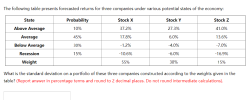 The following table presents forecasted returns for three companies under various potential states of the economy: State Probability Stock X Stock Z Stock Y 27.3% Above Average 10% 37.2% 41.0% Average 45% 17.8% 6.0% 13.6% Below Average 30% -1.2% -4.0% -7.0% Recession 15% -10.6% -16.9% -6.0% 30% Weight 55% 15% What is the standard deviation on a portfolio of these three companies constructed according to the weights given in the table? (Report answer in percentage terms and round to 2...
Given the following information about a nation’s economy, answer the questions below. C = 250 +...
Given the following information about a nation’s economy, answer the questions below. C = 250 + .8 Yd T = 100 I = 275 G = 175 X = 65 M = 70 Use algebra to solve for equilibrium. (You must show ALL of your work.) Recall that in equilibrium, TE = TP =Y. Calculate the multiplier. Refer to part (a) and simplify the TE equation into standard slope-intercept form: TE = A + MPC*Y If you can not easily...
Question 5 Use the following table of states of the economy and stock returns to calculate...
 Question 5 Use the following table of states of the economy and stock returns to calculate the expected return on a portfolio of 58 percent Roll and the rest in Ross. Security Returns if State Occurs Prob of State of Economy 0.5 Bust Boom Roll -18% 41 Ross 34% 12
9. Refer to the below table. For the open economy, the equilibrium GDP is domestic output...
9. Refer to the below table. For the open economy, the equilibrium GDP is domestic output AE, closed economy exports imports 200 230 30 20 250 270 30 20 300 310 30 20 350 350 30 20 400 390 30 20 450 430 30 20 500 470 30 20 A) $300 B) $350 C) $400 D) $450 10. If net exports decline from zero to some negative amount, the aggregate expenditures schedule would A) shift upward B) shift downward C)...
please answer asap. i will rate Use the following table of states of the economy and...
 please answer asap. i will rate
Use the following table of states of the economy and stock returns to calculate the percentage standard deviation of a portfolio of a portfolio of 81 percent Roll and the rest in Ross. Security Returns if State Occurs Roll Ross Prob of State of Economy 0.7 ? Bust Boom -9% 44 32% 11
please answer asap. i will rate
Use the following table of states of the economy and stock returns to calculate the percentage standard deviation of a portfolio of a portfolio of 81 percent Roll and the rest in Ross. Security Returns if State Occurs Roll Ross Prob of State of Economy 0.7 ? Bust Boom -9% 44 32% 11
Complete the following table showing the impact of each transaction on total assets, total liabilities and...
Complete the following table showing the impact of each transaction on total assets, total liabilities and total equity. Use (+) to show an increase, (–) to show a decrease and ‘NC’ if there is no change. Assets Liabilities Shareholders’ Equity 1. Issued common shares in exchange for a building 2. Purchased inventory on account 3. Paid the utility bill for that month 4. Paid a cash dividend to common shareholders 5. Borrowed money from the bank
2. Assume the economy is initially in equilibrium, and then firms expect future total factor productivity,...
 2. Assume the economy is initially in equilibrium, and then firms expect future total factor productivity, z', to decrease. Using the New Keynesian Model framework, what are the implications on the following outcomes. For the money market, use the framework with interest rates on the vertical axis. f) Wages (increase / decrease / indeterminate / no change)? g) Money supply increase / decrease / indeterminate / no change)? h) Money demand increase / decrease / indeterminate / no change)? i)...
 Suppose an economy produces cell phones and GPS devices in perfectly competitive industries. The economy is currently operating at a point on its production possibility frontier. The economy will most likely move to a less-desirable point on the production possibility frontier if more firms enter the GPS device industry. O a single firm gains control over the production of cell phones. more firms enter the cell phone industry. more firms enter both the GPS device industry and the cell phone...
 The following table presents forecasted returns for three companies under various potential states of the economy: State Probability Stock X Stock Z Stock Y 27.3% Above Average 10% 37.2% 41.0% Average 45% 17.8% 6.0% 13.6% Below Average 30% -1.2% -4.0% -7.0% Recession 15% -10.6% -16.9% -6.0% 30% Weight 55% 15% What is the standard deviation on a portfolio of these three companies constructed according to the weights given in the table? (Report answer in percentage terms and round to 2...
 Question 5 Use the following table of states of the economy and stock returns to calculate the expected return on a portfolio of 58 percent Roll and the rest in Ross. Security Returns if State Occurs Prob of State of Economy 0.5 Bust Boom Roll -18% 41 Ross 34% 12
 please answer asap. i will rate
Use the following table of states of the economy and stock returns to calculate the percentage standard deviation of a portfolio of a portfolio of 81 percent Roll and the rest in Ross. Security Returns if State Occurs Roll Ross Prob of State of Economy 0.7 ? Bust Boom -9% 44 32% 11
please answer asap. i will rate
Use the following table of states of the economy and stock returns to calculate the percentage standard deviation of a portfolio of a portfolio of 81 percent Roll and the rest in Ross. Security Returns if State Occurs Roll Ross Prob of State of Economy 0.7 ? Bust Boom -9% 44 32% 11
 2. Assume the economy is initially in equilibrium, and then firms expect future total factor productivity, z', to decrease. Using the New Keynesian Model framework, what are the implications on the following outcomes. For the money market, use the framework with interest rates on the vertical axis. f) Wages (increase / decrease / indeterminate / no change)? g) Money supply increase / decrease / indeterminate / no change)? h) Money demand increase / decrease / indeterminate / no change)? i)...
Most questions answered within 3 hours.
-
Where is the error in this code sequence?
String s1 = "Hello";
String s2 = "ello";...
asked 10 months ago -
Financial data for Joel de Paris, Inc., for last year
follow:
Joel de Paris, Inc.
Balance...
asked 10 months ago -
Consider this reaction:
Al2(SO4)3 (aq)+ BaCl3
(aq) Al2Cl6 (aq)- +
3BaSO4(s) . What is the...
asked 10 months ago -
Suppose that Savneet is considering increasing her
recent random sample from 20 car rentals to 40...
asked 10 months ago -
Trucks arrive at an unloading terminal at an average rate of 120
per hour.
Trucks arrive...
asked 10 months ago -
Why are methanol and ethanol completely soluble in water while
octanol is not very little soluble....
asked 10 months ago -
A facilities manager at a university reads in a research report
that the mean amount of...
asked 10 months ago -
When the CuSO4 is rehydrated by adding water to the anhydrous
compound, is this an endothermic...
asked 10 months ago -
A ray of sunlight is passing from diamond into crown glass; the
angle of incidence is...
asked 10 months ago -
A block of mass 0.249 kg is placed on top of a light, vertical
spring of...
asked 10 months ago -
how do the kidneys compensate in the presences of acidosis
a) trigger hyperventilate
b) reserve acid...
asked 10 months ago -
Question 501 pts
The rental rate of capital to the firm increases. Which of the
following...
asked 10 months ago