
Homework Answers
Add Answer to:
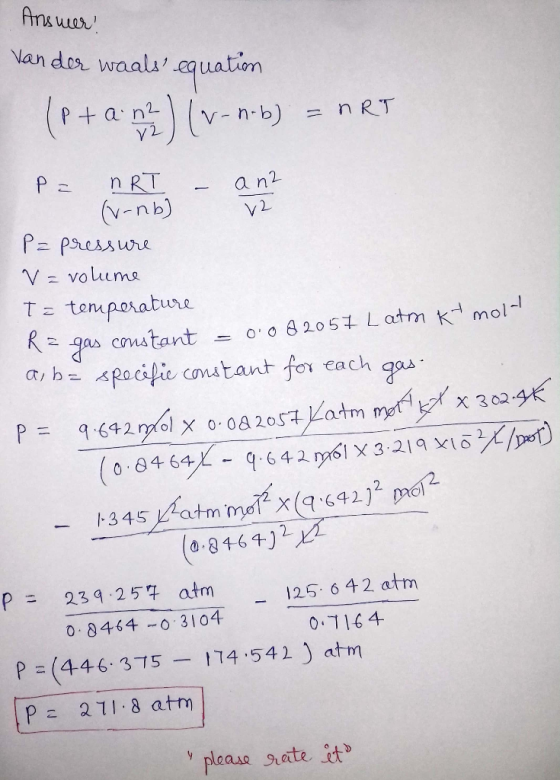
ant 8-8: The Behavior of Real (Non-Ideal) Gases A 9.642 mol sample of argon gas is...
According to the ideal gas law, a 1.001 mol sample of argon gas in a 1.589...
According to the ideal gas law, a 1.001 mol sample of argon gas in a 1.589 L container at 270.1 K should exert a pressure of 13.96 atm. What is the percent difference between the pressure calculated using the van der Waals' equation and the ideal pressure? For Ar gas, a = 1.345 L2atm/mol2 and b = 3.219×10⁻² L/mol.
A 10.83 mol sample of argon gas is maintained in a 0.7598 L container at 295.6...
 A 10.83 mol sample of argon gas is maintained in a 0.7598 L container at 295.6 K. What is the pressure in atm calculated using the van der Waals' equation for Ar gas under these conditions? For Ar, a = 1.345 Llatm/mol2 and b = 3.219x10⁻² L/mol. atm USE LIIC CICICULUS LU al USS IITIPUI lalil va The rate of effusion of H2 gas through a porous barrier is observed to be 1.17 x 10⁻⁴ mol/h. Under the same conditions,...
According to the ideal gas law, a 0.9469 mol sample of argon gas in a 1.474...
According to the ideal gas law, a 0.9469 mol sample of argon gas in a 1.474 L container at 273.1 K should exert a pressure of 14.40 atm. What is the percent difference between the pressure calculated using the van der Waals' equation and the ideal pressure? For Ar gas, a = 1.345 L^2atm/mol^2 and b = 3.219 x 10^-2 L/mol.
According to the ideal gas law, a 9.843 mol sample of argon gas in a 0.8425 L container at 502.0 K should exert a pressure of 481.3 atm
Hint: % difference = 100×(P ideal - Pvan der Waals) / P idealAccording to the ideal gas law, a 9.843 mol sample of argon gas in a 0.8425 L container at 502.0 K should exert a pressure of 481.3 atm. By what percent does the pressure calculated using the van der Waals' equation differ from the ideal pressure? For Ar gas, a =1.345L2 atm/mol2 and b = 3.219×10⁻² L/mol.
If 1.00 mol of argon is placed in a 0.500-L container at 30.0 ∘C , what...
If 1.00 mol of argon is placed in a 0.500-L container at 30.0 ∘C , what is the difference between the ideal pressure (as predicted by the ideal gas law) and the real pressure (as predicted by the van der Waals equation)? For argon, a=1.345(L2⋅atm)/mol2 and b=0.03219L/mol.
A 9.386 mol sample of methane gas is maintained in a 0.7854 L container at 302.4...
A 9.386 mol sample of methane gas is maintained in a 0.7854 L container at 302.4 K. What is the pressure in atm calculated using the van der Waals' equation for CH4 gas under these conditions? For CH4, a = 2.253 L2atm/mol2 and b = 4.278×10⁻² L/mol.
According to the ideal gas law, a 1.003 mol sample of carbon dioxide gas in a...
 According to the ideal gas law, a 1.003 mol sample of carbon dioxide gas in a 1.561 L container at 270.6 K should exert a pressure of 14.27 atm. What is the percent difference between the pressure calculated using the van der Waals' equation and the ideal pressure? For CO2 gas, a = 3.592 L'atm/mol2 and b = 4.267x10⁻² L/mol.
A 9.594 mol sample of xenon gas is maintained in a 0.7694 L container at 300.4...
A 9.594 mol sample of xenon gas is maintained in a 0.7694 L container at 300.4 K. What is the pressure in atm calculated using the van der Waals' equation for Xe gas under these conditions? For Xe, a = 4.194 L2atm/mol2 and b = 5.105×10⁻² L/mol. atm According to the ideal gas law, a 1.013 mol sample of methane gas in a 1.996 L container at 267.7 K should exert a pressure of 11.15 atm. What is the percent...
If 1.00 mol of argon is placed in a 0.500-L container at 30.0 ∘C , what...
If 1.00 mol of argon is placed in a 0.500-L container at 30.0 ∘C , what is the difference between the ideal pressure (as predicted by the ideal gas law) and the real pressure (as predicted by the van der Waals equation)? For argon, a=1.345(L2⋅atm)/mol2 and b=0.03219L/mol. Express your answer to two significant figures and include the appropriate units.
If 1.00 mol of argon is placed in a 0.500-L container at 22.0 ∘C , what...
If 1.00 mol of argon is placed in a 0.500-L container at 22.0 ∘C , what is the difference between the ideal pressure (as predicted by the ideal gas law) and the real pressure (as predicted by the van der Waals equation)? For argon, a=1.345(L2⋅atm)/mol2 and b=0.03219L/mol. Express your answer to two significant figures and include the appropriate units.
 A 10.83 mol sample of argon gas is maintained in a 0.7598 L container at 295.6 K. What is the pressure in atm calculated using the van der Waals' equation for Ar gas under these conditions? For Ar, a = 1.345 Llatm/mol2 and b = 3.219x10⁻² L/mol. atm USE LIIC CICICULUS LU al USS IITIPUI lalil va The rate of effusion of H2 gas through a porous barrier is observed to be 1.17 x 10⁻⁴ mol/h. Under the same conditions,...
 According to the ideal gas law, a 1.003 mol sample of carbon dioxide gas in a 1.561 L container at 270.6 K should exert a pressure of 14.27 atm. What is the percent difference between the pressure calculated using the van der Waals' equation and the ideal pressure? For CO2 gas, a = 3.592 L'atm/mol2 and b = 4.267x10⁻² L/mol.
Most questions answered within 3 hours.
-
Where is the error in this code sequence?
String s1 = "Hello";
String s2 = "ello";...
asked 11 months ago -
Financial data for Joel de Paris, Inc., for last year
follow:
Joel de Paris, Inc.
Balance...
asked 11 months ago -
Consider this reaction:
Al2(SO4)3 (aq)+ BaCl3
(aq) Al2Cl6 (aq)- +
3BaSO4(s) . What is the...
asked 11 months ago -
Suppose that Savneet is considering increasing her
recent random sample from 20 car rentals to 40...
asked 11 months ago -
Trucks arrive at an unloading terminal at an average rate of 120
per hour.
Trucks arrive...
asked 11 months ago -
Why are methanol and ethanol completely soluble in water while
octanol is not very little soluble....
asked 11 months ago -
A facilities manager at a university reads in a research report
that the mean amount of...
asked 11 months ago -
When the CuSO4 is rehydrated by adding water to the anhydrous
compound, is this an endothermic...
asked 11 months ago -
A ray of sunlight is passing from diamond into crown glass; the
angle of incidence is...
asked 11 months ago -
A block of mass 0.249 kg is placed on top of a light, vertical
spring of...
asked 11 months ago -
how do the kidneys compensate in the presences of acidosis
a) trigger hyperventilate
b) reserve acid...
asked 11 months ago -
Question 501 pts
The rental rate of capital to the firm increases. Which of the
following...
asked 11 months ago