
Homework Answers
Add Answer to:
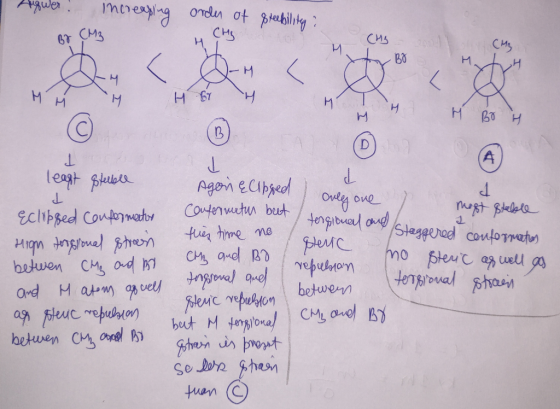
11. Indicate the order of stability CH3 CH3 H CH3 Br CH3 HON Br HV Br
11. Indicate the order of stability CH н сн. Br CH сH, На н н. Br H H н н" Br н H н н н' Br н A В C D 12. Which of...
 11. Indicate the order of stability CH н сн. Br CH сH, На н н. Br H H н н" Br н H н н н' Br н A В C D 12. Which of the following structures does NOT have tetrahedral geometry around any of its central central atoms. Use resonance to help explain A. В. с. D. = NH2 13. Is it theoretically possible to separate the pair of compounds below by distillation? Explain briefly CH CHs Br...
have a specific rotation ap = 0? CH3 H -Br H -Br CHE CH3 Br -H...
 have a specific rotation ap = 0? CH3 H -Br H -Br CHE CH3 Br -H H-Br CH3 b CH3 H -Br Br -H CH3 CH3 Br -Н Br -H CH2CH3 a с d Select one: 0 а.а obb Ос. с o d.d Question 29 Not yet answered Marked out of 3.00 Hay question Which compound would correspond to the IR spectrum shown below? 1:03:15 ОН OH
11) Predict the product of the following transformation: HC H H2O CH2CH2 CH3 Br2 Br H...
 11) Predict the product of the following transformation: HC H H2O CH2CH2 CH3 Br2 Br H H2C Br CH3 H,Ca A) CH,CH, OH CH3CH, OH B) OH H OH H H2C CH,CH2 Br Br CH,CH, CH' D)
. Complete the reactions (2 points each) a) CH3 NBS/hv CH3 h)
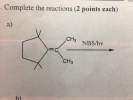 . Complete the reactions (2 points each) a) CH3 NBS/hv CH3 h)
Q3.8 2 Points Which is more stable? H3CH өОСНа 17 Br H vs. H H CH3...
 Q3.8 2 Points Which is more stable? H3CH өОСНа 17 Br H vs. H H CH3 Br H3C CH30 'CH3 A B Compound A (LEFT) Compound B (RIGHT) They're equal stability Why is that substance lower energy? Enter your answer here Q3.9 2 Points Which is more stable? CH, + + VS. CH3 + HF A B Compound A (LEFT) Compound B (RIGHT) They're equal stability Why is that substance lower energy? Enter your answer here
Name 03.101 example of a reaction having an Eact = 0 would Br• + Br-Br - > Br-Br + Br. F. + CH - > H-F + CH3....
 Name 03.101 example of a reaction having an Eact = 0 would Br• + Br-Br - > Br-Br + Br. F. + CH - > H-F + CH3. . CH. + CH, CH2 - CH + CH3 CH2 • .. Br + H-Br - > H-Br + Br. -. CH. + CH3 - > CH3-CH3 Which of the following is true of any (S)-enantiomer? 4. It rotates plane-polarized light to the right. b. It rotates plane-polarized light to the left....
83. Propose a mechanism for each of the following reactions: HBr a. Hon OH H₂SO, O + H₂O Br + H₂O
 83. Propose a mechanism for each of the following reactions: HBr a. Hon OH H₂SO, O + H₂O Br + H₂O
QUESTION 8 CH,-Br Br Rank these of compounds in order of the stability of the carbocation...
 QUESTION 8 CH,-Br Br Rank these of compounds in order of the stability of the carbocation that forms (1 -most stable, 4 - least stable) Structure A Structure B: Structure C Structure D:
Which of the following are possible products of the reaction shown? hv NBS Br Br Br...
 Which of the following are possible products of the reaction shown? hv NBS Br Br Br Br III IV a) I, III and IV b) I and 11 C) I, II, III and IV d) I, II and III
Predict the major product(s) of the following reaction. 2 hv X ? Brz Br Br Br...
 Predict the major product(s) of the following reaction. 2 hv X ? Brz Br Br Br III IV a) 11 Ob) v c) 110 d) I and II e)
 11. Indicate the order of stability CH н сн. Br CH сH, На н н. Br H H н н" Br н H н н н' Br н A В C D 12. Which of the following structures does NOT have tetrahedral geometry around any of its central central atoms. Use resonance to help explain A. В. с. D. = NH2 13. Is it theoretically possible to separate the pair of compounds below by distillation? Explain briefly CH CHs Br...
 have a specific rotation ap = 0? CH3 H -Br H -Br CHE CH3 Br -H H-Br CH3 b CH3 H -Br Br -H CH3 CH3 Br -Н Br -H CH2CH3 a с d Select one: 0 а.а obb Ос. с o d.d Question 29 Not yet answered Marked out of 3.00 Hay question Which compound would correspond to the IR spectrum shown below? 1:03:15 ОН OH
 11) Predict the product of the following transformation: HC H H2O CH2CH2 CH3 Br2 Br H H2C Br CH3 H,Ca A) CH,CH, OH CH3CH, OH B) OH H OH H H2C CH,CH2 Br Br CH,CH, CH' D)
 . Complete the reactions (2 points each) a) CH3 NBS/hv CH3 h)
 Q3.8 2 Points Which is more stable? H3CH өОСНа 17 Br H vs. H H CH3 Br H3C CH30 'CH3 A B Compound A (LEFT) Compound B (RIGHT) They're equal stability Why is that substance lower energy? Enter your answer here Q3.9 2 Points Which is more stable? CH, + + VS. CH3 + HF A B Compound A (LEFT) Compound B (RIGHT) They're equal stability Why is that substance lower energy? Enter your answer here
 Name 03.101 example of a reaction having an Eact = 0 would Br• + Br-Br - > Br-Br + Br. F. + CH - > H-F + CH3. . CH. + CH, CH2 - CH + CH3 CH2 • .. Br + H-Br - > H-Br + Br. -. CH. + CH3 - > CH3-CH3 Which of the following is true of any (S)-enantiomer? 4. It rotates plane-polarized light to the right. b. It rotates plane-polarized light to the left....
 83. Propose a mechanism for each of the following reactions: HBr a. Hon OH H₂SO, O + H₂O Br + H₂O
 QUESTION 8 CH,-Br Br Rank these of compounds in order of the stability of the carbocation that forms (1 -most stable, 4 - least stable) Structure A Structure B: Structure C Structure D:
 Which of the following are possible products of the reaction shown? hv NBS Br Br Br Br III IV a) I, III and IV b) I and 11 C) I, II, III and IV d) I, II and III
 Predict the major product(s) of the following reaction. 2 hv X ? Brz Br Br Br III IV a) 11 Ob) v c) 110 d) I and II e)
Most questions answered within 3 hours.
-
Where is the error in this code sequence?
String s1 = "Hello";
String s2 = "ello";...
asked 11 months ago -
Financial data for Joel de Paris, Inc., for last year
follow:
Joel de Paris, Inc.
Balance...
asked 11 months ago -
Consider this reaction:
Al2(SO4)3 (aq)+ BaCl3
(aq) Al2Cl6 (aq)- +
3BaSO4(s) . What is the...
asked 11 months ago -
Suppose that Savneet is considering increasing her
recent random sample from 20 car rentals to 40...
asked 11 months ago -
Trucks arrive at an unloading terminal at an average rate of 120
per hour.
Trucks arrive...
asked 11 months ago -
Why are methanol and ethanol completely soluble in water while
octanol is not very little soluble....
asked 11 months ago -
A facilities manager at a university reads in a research report
that the mean amount of...
asked 11 months ago -
When the CuSO4 is rehydrated by adding water to the anhydrous
compound, is this an endothermic...
asked 11 months ago -
A ray of sunlight is passing from diamond into crown glass; the
angle of incidence is...
asked 11 months ago -
A block of mass 0.249 kg is placed on top of a light, vertical
spring of...
asked 11 months ago -
how do the kidneys compensate in the presences of acidosis
a) trigger hyperventilate
b) reserve acid...
asked 11 months ago -
Question 501 pts
The rental rate of capital to the firm increases. Which of the
following...
asked 11 months ago