
Homework Answers
![du = dq + dw dų = da Lav [C), av + (24), ar + Çav = ds 3 [(@), av] + Lav = as [(7), --] av + Lav = as as = ( ), av as = f*](http://img.homeworklib.com/questions/55866910-7494-11ea-aecf-036a6a27ef80.png?x-oss-process=image/resize,w_560)
Add Answer to:
Consider gases described by the following two equations of state: a) Perfect: p = b)par to...
Physical Chemistry 8. Consider gases described by the following two equations of state: a) Perfect: p b) p = Von i)...
 Physical Chemistry
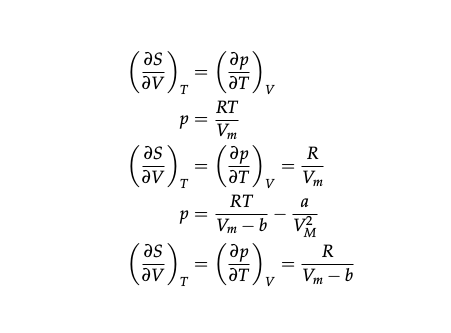
8. Consider gases described by the following two equations of state: a) Perfect: p b) p = Von i) Use Maxwell Equation to derive an expression for C) for each equation of state ii) for an isothermal expansion, compare the change in entropy expected for a perfect gas and for a gas obeying the Van der Waals equation of state (Equations a and b), iii) Which has the greatest change in entropy and how can this conclusion be...
Physical Chemistry
8. Consider gases described by the following two equations of state: a) Perfect: p b) p = Von i) Use Maxwell Equation to derive an expression for C) for each equation of state ii) for an isothermal expansion, compare the change in entropy expected for a perfect gas and for a gas obeying the Van der Waals equation of state (Equations a and b), iii) Which has the greatest change in entropy and how can this conclusion be...
Please explain as much as possible Consider gases described by the following two equations of state:...
 Please explain as much as possible
Consider gases described by the following two equations of state: RT RT b) p a) Perfect: p m 2 Vm -b as ) Use Maxwell Equation to derive an expression for for each equation of state т ii) for an isothermal expansion, compare the change in entropy expected for a perfect gas and for a gas obeying the Van der Waals equation of state (Equations a and b) ii Which has the greatest change...
Please explain as much as possible
Consider gases described by the following two equations of state: RT RT b) p a) Perfect: p m 2 Vm -b as ) Use Maxwell Equation to derive an expression for for each equation of state т ii) for an isothermal expansion, compare the change in entropy expected for a perfect gas and for a gas obeying the Van der Waals equation of state (Equations a and b) ii Which has the greatest change...
Explain (each step) and Answer please One empirical equations of state of a real gas is:...
 Explain (each step) and Answer please
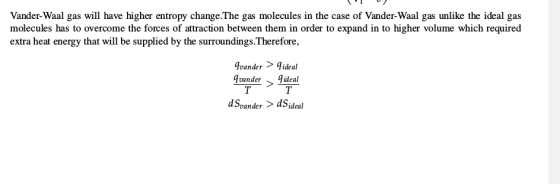
One empirical equations of state of a real gas is: van der Waals: P = RT/V_m - b - a/V_m^2 Evaluate (partial differential s/partial differential V)_T, for a van der Waals and a perfect gas. (A Maxwell relation might help!) For an isothermal expansion, for which kind of gas (vdW or perfect gas) will delta S be greatest? Explain your conclusion.
Explain (each step) and Answer please
One empirical equations of state of a real gas is: van der Waals: P = RT/V_m - b - a/V_m^2 Evaluate (partial differential s/partial differential V)_T, for a van der Waals and a perfect gas. (A Maxwell relation might help!) For an isothermal expansion, for which kind of gas (vdW or perfect gas) will delta S be greatest? Explain your conclusion.
A gas obeying the van der Waals equation of state undergoes isothermal expansion from vi to...
A gas obeying the van der Waals equation of state undergoes isothermal expansion from vi to vf. Determine the entropy change of the gas.
Calculate the isothermal compressibility and the expansion coefficient of a perfect gas and a van der...
 Calculate the isothermal compressibility and the expansion coefficient of a perfect gas and a van der Waals ga:s (ii) Show, using Euler's chain relation, that KTR α(Vin-b) (iii) Make use of the definitions of the coefficient of thermal expansion, α, and 1. (i) (15) the isothermal compressibility, KT, and start from the expression for the total differential dV in terms of T and P to show that: OT
(30pts) Derive expressions for a gas that obeys the Van der Waals equation of state of...
(30pts) Derive expressions for a gas that obeys the Van der Waals equation of state of (P+a⁄v²)(v-b)=RT where v is specific volume and a and b are constants. For an isothermal process derive expressions to calculate change in enthalpy (h), change in internal energy(u), change in entropy (s),
(a) One mole of a monoatomic van der Waals gas obeys the equation of state A3. ) (V-b)=RT (p+ and its internal energy is expressed as U CvT where Cv is the molar isochoric heat capacity of an ideal g...
 (a) One mole of a monoatomic van der Waals gas obeys the equation of state A3. ) (V-b)=RT (p+ and its internal energy is expressed as U CvT where Cv is the molar isochoric heat capacity of an ideal gas. The gas is initially at pressure p and volume V (i) Explain the physical meaning of the parameters a and b in the equation of state of the gas (ii) Write down the equation that defines entropy in thermodynamics. Define...
c) Show that dVm by working from the total differential of the state function entropy S(T,...
 c) Show that dVm by working from the total differential of the state function entropy S(T, Vm) and us- ing one of the Maxwell relations and the relationship linking the differential entropy dS and the heat capacity cv d) Using the differential entropy dS given or derived above, show that the reversible 2] isothermal expansion of a gas causes a change of the internal energy of the gas of by working from the differential form of the internal energy, e)...
Parts iii) and iv) are the ones I need help with please :) (a) One mole of a monoatomic van der Waals gas obeys the equ...
 Parts iii) and iv) are the ones I need help with please :)
(a) One mole of a monoatomic van der Waals gas obeys the equation of state and its internal energy is expressed as U where Cv is the molar apacity of an ideal gas. The gas is initially at pr isochoric heat c essure p and volume V Explain the physical meaning of the parameters a and b in the equation of state of the gas (ii) Write...
Parts iii) and iv) are the ones I need help with please :)
(a) One mole of a monoatomic van der Waals gas obeys the equation of state and its internal energy is expressed as U where Cv is the molar apacity of an ideal gas. The gas is initially at pr isochoric heat c essure p and volume V Explain the physical meaning of the parameters a and b in the equation of state of the gas (ii) Write...
Problem 1 CH7/5pts Warm up. Show that: 1. PK 1- P ()where is the isothermal compressibility 2. PB 1+T (n)pwhere B i...
 Problem 1 CH7/5pts Warm up. Show that: 1. PK 1- P ()where is the isothermal compressibility 2. PB 1+T (n)pwhere B is the thermal expansion. р' 3. Show that Te, Pe and Vm.e in a system described by a van der Waals equation of state depend only on a and b parameters.
 Physical Chemistry
8. Consider gases described by the following two equations of state: a) Perfect: p b) p = Von i) Use Maxwell Equation to derive an expression for C) for each equation of state ii) for an isothermal expansion, compare the change in entropy expected for a perfect gas and for a gas obeying the Van der Waals equation of state (Equations a and b), iii) Which has the greatest change in entropy and how can this conclusion be...
Physical Chemistry
8. Consider gases described by the following two equations of state: a) Perfect: p b) p = Von i) Use Maxwell Equation to derive an expression for C) for each equation of state ii) for an isothermal expansion, compare the change in entropy expected for a perfect gas and for a gas obeying the Van der Waals equation of state (Equations a and b), iii) Which has the greatest change in entropy and how can this conclusion be...
 Please explain as much as possible
Consider gases described by the following two equations of state: RT RT b) p a) Perfect: p m 2 Vm -b as ) Use Maxwell Equation to derive an expression for for each equation of state т ii) for an isothermal expansion, compare the change in entropy expected for a perfect gas and for a gas obeying the Van der Waals equation of state (Equations a and b) ii Which has the greatest change...
Please explain as much as possible
Consider gases described by the following two equations of state: RT RT b) p a) Perfect: p m 2 Vm -b as ) Use Maxwell Equation to derive an expression for for each equation of state т ii) for an isothermal expansion, compare the change in entropy expected for a perfect gas and for a gas obeying the Van der Waals equation of state (Equations a and b) ii Which has the greatest change...
 Explain (each step) and Answer please
One empirical equations of state of a real gas is: van der Waals: P = RT/V_m - b - a/V_m^2 Evaluate (partial differential s/partial differential V)_T, for a van der Waals and a perfect gas. (A Maxwell relation might help!) For an isothermal expansion, for which kind of gas (vdW or perfect gas) will delta S be greatest? Explain your conclusion.
Explain (each step) and Answer please
One empirical equations of state of a real gas is: van der Waals: P = RT/V_m - b - a/V_m^2 Evaluate (partial differential s/partial differential V)_T, for a van der Waals and a perfect gas. (A Maxwell relation might help!) For an isothermal expansion, for which kind of gas (vdW or perfect gas) will delta S be greatest? Explain your conclusion.
 Calculate the isothermal compressibility and the expansion coefficient of a perfect gas and a van der Waals ga:s (ii) Show, using Euler's chain relation, that KTR α(Vin-b) (iii) Make use of the definitions of the coefficient of thermal expansion, α, and 1. (i) (15) the isothermal compressibility, KT, and start from the expression for the total differential dV in terms of T and P to show that: OT
 (a) One mole of a monoatomic van der Waals gas obeys the equation of state A3. ) (V-b)=RT (p+ and its internal energy is expressed as U CvT where Cv is the molar isochoric heat capacity of an ideal gas. The gas is initially at pressure p and volume V (i) Explain the physical meaning of the parameters a and b in the equation of state of the gas (ii) Write down the equation that defines entropy in thermodynamics. Define...
 c) Show that dVm by working from the total differential of the state function entropy S(T, Vm) and us- ing one of the Maxwell relations and the relationship linking the differential entropy dS and the heat capacity cv d) Using the differential entropy dS given or derived above, show that the reversible 2] isothermal expansion of a gas causes a change of the internal energy of the gas of by working from the differential form of the internal energy, e)...
 Parts iii) and iv) are the ones I need help with please :)
(a) One mole of a monoatomic van der Waals gas obeys the equation of state and its internal energy is expressed as U where Cv is the molar apacity of an ideal gas. The gas is initially at pr isochoric heat c essure p and volume V Explain the physical meaning of the parameters a and b in the equation of state of the gas (ii) Write...
Parts iii) and iv) are the ones I need help with please :)
(a) One mole of a monoatomic van der Waals gas obeys the equation of state and its internal energy is expressed as U where Cv is the molar apacity of an ideal gas. The gas is initially at pr isochoric heat c essure p and volume V Explain the physical meaning of the parameters a and b in the equation of state of the gas (ii) Write...
 Problem 1 CH7/5pts Warm up. Show that: 1. PK 1- P ()where is the isothermal compressibility 2. PB 1+T (n)pwhere B is the thermal expansion. р' 3. Show that Te, Pe and Vm.e in a system described by a van der Waals equation of state depend only on a and b parameters.
Most questions answered within 3 hours.
-
Where is the error in this code sequence?
String s1 = "Hello";
String s2 = "ello";...
asked 10 months ago -
Financial data for Joel de Paris, Inc., for last year
follow:
Joel de Paris, Inc.
Balance...
asked 10 months ago -
Consider this reaction:
Al2(SO4)3 (aq)+ BaCl3
(aq) Al2Cl6 (aq)- +
3BaSO4(s) . What is the...
asked 10 months ago -
Suppose that Savneet is considering increasing her
recent random sample from 20 car rentals to 40...
asked 10 months ago -
Trucks arrive at an unloading terminal at an average rate of 120
per hour.
Trucks arrive...
asked 10 months ago -
Why are methanol and ethanol completely soluble in water while
octanol is not very little soluble....
asked 10 months ago -
A facilities manager at a university reads in a research report
that the mean amount of...
asked 10 months ago -
When the CuSO4 is rehydrated by adding water to the anhydrous
compound, is this an endothermic...
asked 10 months ago -
A ray of sunlight is passing from diamond into crown glass; the
angle of incidence is...
asked 10 months ago -
A block of mass 0.249 kg is placed on top of a light, vertical
spring of...
asked 10 months ago -
how do the kidneys compensate in the presences of acidosis
a) trigger hyperventilate
b) reserve acid...
asked 10 months ago -
Question 501 pts
The rental rate of capital to the firm increases. Which of the
following...
asked 10 months ago