A thin, flat disk rotates at 12.9 rev/min around a vertical axis at its center. (a)...
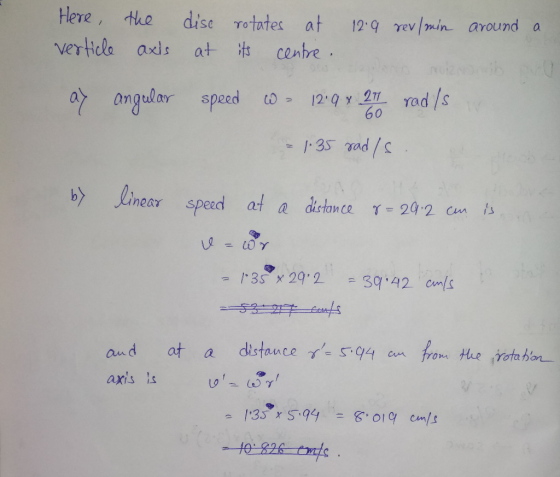
A thin, flat disk rotates at 12.9 rev/min around a vertical axis at its center. (a) What is its angular speed in radians per second? What is the linear speed (in centimeter per second) of a point on the disk (b)29.2 cm and (c)5.94 cm from the rotation axis?
Homework Answers
Add Answer to:
A thin, flat disk rotates at 12.9 rev/min around a vertical axis
at its center. (a)...
disk 7.96 cm in radius rotates at a constant rate of 1 280 rev/min about its central axis. (a) Determine its...
disk 7.96 cm in radius rotates at a constant rate of 1 280 rev/min about its central axis. (a) Determine its angular speed. rad/s (b) Determine the tangential speed at a point 3.08 cm from its center. m/s (c) Determine the radial acceleration of a point on the rim. magnitude km/s2direction ---Select--- toward the center away from the center (d) Determine the total distance a point on the rim moves in 1.98 s. m
Problem 1 A disk 25.00 cm in radius rotates at a constant rate of 1 200...
 Problem 1 A disk 25.00 cm in radius rotates at a constant rate of 1 200 rev/min about its central axis. Determine; (a) its angular speed in radians per second and the tangential speed at a point 15.00 cm from its center. (b) the radial acceleration of a point on the rim, and the total distance a point on the rim moves in 6.00 S.
An ordinary workshop grindstone has a radius of 7.50 cm and rotates at 6500 rev/min. (a)...
An ordinary workshop grindstone has a radius of 7.50 cm and rotates at 6500 rev/min. (a) What is its angular velocity in radians per second? (b) Calculate the centripetal acceleration at its edge in meters per second squared (c) What is the linear speed of a point on its edge?
A thin disk rotates about an axis that goes through its center perpendicular to its plane....
 A thin disk rotates about an axis that goes through its center perpendicular to its plane. The disk is rotating clockwise and speeding up. What can be said about the angular speed and acceleration of the disk? Angular speed is positive, angular acceleration is negative Angular speed is negative, angular acceleration is positive Angular speed is positive, angular acceleration is positive Angular speed is negative, angular acceleration is negative
A disk 7.90 cm in radius rotates at a constant rate of 1 210 rev/min about...
 A disk 7.90 cm in radius rotates at a constant rate of 1 210 rev/min about its central axis. (a) Determine its angular speed. rad/s (b) Determine the tangential speed at a point 2.96 cm from its center. m/s (c) Determine the radial acceleration of a point on the rim. magnitude directionSelect km/s (d) Determine the total distance a point on the rim moves in 1.92 s.
A disk 8.04 cm in radius rotates at a constant rate of 1 210 rev/min about...
A disk 8.04 cm in radius rotates at a constant rate of 1 210 rev/min about its central axis. (a) Determine its angular speed. _____rad/s (b) Determine the tangential speed at a point 2.92 cm from its center. _____m/s (c) Determine the radial acceleration of a point on the rim. magnitude ______km/s2 direction_____ (d) Determine the total distance a point on the rim moves in 1.90 s. ______m
The disk shown in Fig 1 spins about its own axis at 1200 rev/min as the...
 The disk shown in Fig 1 spins about its own axis at 1200 rev/min as the system rotates about the vertical axis at 20 rev/min. The angle of inclination is constant at ? 30°. Determine the velocity and acceleration of point D on the disk when it is at its lowest osition, as shown
A potter's wheel is rotating around a vertical axis through its center at a frequency of 1.7 rev/s. The wheel can be co...
A potter's wheel is rotating around a vertical axis through its center at a frequency of 1.7 rev/s. The wheel can be considered a uniform disk of mass 5.8 kg and diameter 0.40 m. The potter then throws a 3.1 kg chunk of clay that is shaped like a flat disk of radius 8.0 cm, onto the center of the rotating wheel. What is the frequency of the wheel after the clay sticks to it?
A disk rotates around an axis through its center that is perpendicular to the plane of...
A disk rotates around an axis through its center that is perpendicular to the plane of the disk. The disk has a line drawn on it that extends from the axis of the disk to the rim. At t = 0 this line lies along the x-axis and the disk is rotating with positive angular velocity ω0z. The disk has constant positive angular acceleration αz. At what time after t = 0 has the line on the disk rotated through...
A potter's wheel is rotating around a vertical axis through its center at a frequency of 2.0 rev/s. The wheel can be co...
A potter's wheel is rotating around a vertical axis through its center at a frequency of 2.0 rev/s. The wheel can be considered a uniform disk of mass 4.9 kg and diameter 0.40m. The potter then throws a 2.7 kg chucnk of clay, approximately shaped as a flat disk of radius 8.0 cm, onto the center of the rotating wheel. What is the frequency of the wheel after the clay sticks to it? Ignore friction/.
 Problem 1 A disk 25.00 cm in radius rotates at a constant rate of 1 200 rev/min about its central axis. Determine; (a) its angular speed in radians per second and the tangential speed at a point 15.00 cm from its center. (b) the radial acceleration of a point on the rim, and the total distance a point on the rim moves in 6.00 S.
 A thin disk rotates about an axis that goes through its center perpendicular to its plane. The disk is rotating clockwise and speeding up. What can be said about the angular speed and acceleration of the disk? Angular speed is positive, angular acceleration is negative Angular speed is negative, angular acceleration is positive Angular speed is positive, angular acceleration is positive Angular speed is negative, angular acceleration is negative
 A disk 7.90 cm in radius rotates at a constant rate of 1 210 rev/min about its central axis. (a) Determine its angular speed. rad/s (b) Determine the tangential speed at a point 2.96 cm from its center. m/s (c) Determine the radial acceleration of a point on the rim. magnitude directionSelect km/s (d) Determine the total distance a point on the rim moves in 1.92 s.
 The disk shown in Fig 1 spins about its own axis at 1200 rev/min as the system rotates about the vertical axis at 20 rev/min. The angle of inclination is constant at ? 30°. Determine the velocity and acceleration of point D on the disk when it is at its lowest osition, as shown
Most questions answered within 3 hours.
-
Where is the error in this code sequence?
String s1 = "Hello";
String s2 = "ello";...
asked 10 months ago -
Financial data for Joel de Paris, Inc., for last year
follow:
Joel de Paris, Inc.
Balance...
asked 10 months ago -
Consider this reaction:
Al2(SO4)3 (aq)+ BaCl3
(aq) Al2Cl6 (aq)- +
3BaSO4(s) . What is the...
asked 10 months ago -
Suppose that Savneet is considering increasing her
recent random sample from 20 car rentals to 40...
asked 10 months ago -
Trucks arrive at an unloading terminal at an average rate of 120
per hour.
Trucks arrive...
asked 10 months ago -
Why are methanol and ethanol completely soluble in water while
octanol is not very little soluble....
asked 10 months ago -
A facilities manager at a university reads in a research report
that the mean amount of...
asked 10 months ago -
When the CuSO4 is rehydrated by adding water to the anhydrous
compound, is this an endothermic...
asked 10 months ago -
A ray of sunlight is passing from diamond into crown glass; the
angle of incidence is...
asked 10 months ago -
A block of mass 0.249 kg is placed on top of a light, vertical
spring of...
asked 10 months ago -
how do the kidneys compensate in the presences of acidosis
a) trigger hyperventilate
b) reserve acid...
asked 10 months ago -
Question 501 pts
The rental rate of capital to the firm increases. Which of the
following...
asked 10 months ago