Calculate the WACC which represents the “hurdle rate” for a typical project with average risk using...
Calculate the WACC which represents the “hurdle rate” for a typical project with average risk using the average of the range of the marginal cost of common equity using retained earnings or new earnings.
Data:
A 15-year, 12% coupon, semiannual payment non-callable bonds sell for $1,153.72. New bonds will be privately placed with no flotation cost.
A 10%, $1,000 par value, annually dividend, perpetual preferred stock sells for $1,111.
Both an existing common stock and a new common stock issue, which incurs a flotation cost of 15% of the proceeds, sells for $50. D1 = $4.3995 and g = 5%. b = 1.2; rRF = 7%; RPM = 6%.
Bond-Yield Risk Premium = 4%.
Target capital structure: 20% debt, 20% preferred, 60% common equity.
The tax rate is 35%.
Homework Answers
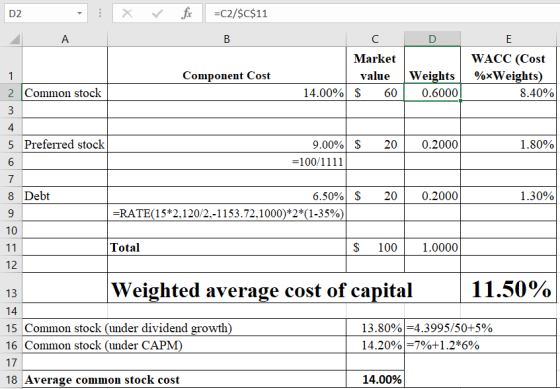
.*Please rate thumbs up
Add Answer to:
Calculate the WACC which
represents the “hurdle rate” for a typical project with average
risk using...
Calculate the WACC which represents the "hurdle rate" for a typical project with average risk using...
 Calculate the WACC which represents the "hurdle rate" for a typical project with average risk using the average of the range of the marginal cost of common equity using retained earnings or new earnings. Data: A 15-year, 12% coupon, semiannual payment non-callable bonds sell for $1,153.72. New bonds will be privately placed with no flotation cost.. A 10%, $1,000 par value, annually dividend, perpetual preferred stock sells for $1,111. Both an existing common stock and a new common stock issue,...
1. Show your work with the data below. (40 points) Calculate the WACC which represents the...
 1. Show your work with the data below. (40 points) Calculate the WACC which represents the hurdle rate foratypical project with average risk using the average rate of the range of the marginal cost of common equity using retained earnings or new earnings. Data: A 15-year, 12% coupon, semiannual payment non-callable bonds sell for $1,153.72. New bonds will be privately placed with no flotation cost A 10%, $1,000 par value, annually dividend, perpetual preferred stock sells for $1,111. Both an...
calculate the Wacc which represses the Show your work with the data below. (40 points) Calculate...
 calculate the Wacc which represses the
Show your work with the data below. (40 points) Calculate the WACC which represents the hurdle rate for a typical project with averagerisk using the average ratc of therange ofthe marginal cost of common equity using retained carnings or new earnings. 1. Data: A 15-year, 12% coupon, semiannual payment non-callable bonds sell for $1,153.72. New bonds will be privately placed with no flotation cost A 10%, $1,000 par value, annually dividend, perpetual preferred stock...
calculate the Wacc which represses the
Show your work with the data below. (40 points) Calculate the WACC which represents the hurdle rate for a typical project with averagerisk using the average ratc of therange ofthe marginal cost of common equity using retained carnings or new earnings. 1. Data: A 15-year, 12% coupon, semiannual payment non-callable bonds sell for $1,153.72. New bonds will be privately placed with no flotation cost A 10%, $1,000 par value, annually dividend, perpetual preferred stock...
(1) A firm's weighted average cost of capital (WACC) is sometimes referred to as the hurdle...
(1) A firm's weighted average cost of capital (WACC) is sometimes referred to as the hurdle rate. What is the purpose of calculating the firm's WACC? Why is the WACC referred to as the hurdle rate? (2) Based on your opinion, which component cost (cost of debt, cost of preferred stock, cost of retained earnings, or cost of new common stock) is easier to calculate? Which component cost is more difficult to calculate? Why?
Based upon the following facts calculate the Weighted Average Cost of Capital (WACC) for Student Success...
 Based upon the following facts calculate the Weighted Average Cost of Capital (WACC) for Student Success Corporation (SSC): PART 1 WACC Tax rate 40 % Debt Financing: $10,000 Face Value 10-Year, 5 % Coupon, Semiannual Non-Callable Bonds Selling for $11,040 New bonds will be privately placed with no flotation cost. >Common Stock: Current Price $40; Current Dividend $3.00 and Growth Rate 5 %. >Common Stock: Beta 1.1; Risk Free Rate 2.0 %; Required Return of the Market 7% Capital structure:...
15 . Solving for the WACC The weighted average cost of capital (WACC) is used as...
15 . Solving for the WACC The weighted average cost of capital (WACC) is used as the discount rate to evaluate various capital budgeting projects. However, it is important to realize that the WACC is an appropriate discount rate only for a project of average risk. Consider the case of Turnbull Company. Turnbull Company has a target capital structure of 58% debt, 6% preferred stock, and 36% common equity. It has a before-tax cost of debt of 11.10%, and its...
7. Solving for the WACC The weighted average cost of capital (WACC) is used as the...
 7. Solving for the WACC The weighted average cost of capital (WACC) is used as the discount rate to evaluate various capital budgeting projects. However, it is important to realize that the WACC is an appropriate discount rate only for a project of average risk. Consider the case of Turnbull Company, Turnbull Company has a target capital structure of 45% debt, 4% preferred stock, and 51% common equity. It has a before-tax cost of debt of 11.10%, and its cost...
5. Solving for the WACC Aa Aa The WACC is used as the discount rate to...
 5. Solving for the WACC Aa Aa The WACC is used as the discount rate to evaluate various capital budgeting projects. However, it is important to realize that the WACC is an appropriate discount rate only for a project of average risk. Analyze the cost of capital situations of the following company cases, and answer the specific questions that finance professionals need to address Consider the case of Turnbull Co. Turnbull Co. has a target capital structure of 58% debt,...
7. Solving for the WACC А. Аа The WACC is used as the discount rate to...
 7. Solving for the WACC А. Аа The WACC is used as the discount rate to evaluate various capital budgeting projects. However, it is important to realize that the WACC is an appropriate discount rate only for a project of average risk Analyze the cost of capital situations of the following company cases, and answer the specific questions that finance professionals need to address Consider the case of Turnbull Co. Turnbull Co. has a target capital structure of 45% debt,...
6. Solving for the WACC The WACC is used as the discount rate to evaluate various...
6. Solving for the WACC The WACC is used as the discount rate to evaluate various capital budgeting projects. However, it is important to realize that the WACC is an appropriate discount rate only for a project of average risk. Analyze the cost of capital situations of the following company cases, and answer the specific questions that finance professionals need to address. Consider the case of Turnbull Co. Turnbull Co. has a target capital structure of 45% debt, 4% preferred...
 Calculate the WACC which represents the "hurdle rate" for a typical project with average risk using the average of the range of the marginal cost of common equity using retained earnings or new earnings. Data: A 15-year, 12% coupon, semiannual payment non-callable bonds sell for $1,153.72. New bonds will be privately placed with no flotation cost.. A 10%, $1,000 par value, annually dividend, perpetual preferred stock sells for $1,111. Both an existing common stock and a new common stock issue,...
 1. Show your work with the data below. (40 points) Calculate the WACC which represents the hurdle rate foratypical project with average risk using the average rate of the range of the marginal cost of common equity using retained earnings or new earnings. Data: A 15-year, 12% coupon, semiannual payment non-callable bonds sell for $1,153.72. New bonds will be privately placed with no flotation cost A 10%, $1,000 par value, annually dividend, perpetual preferred stock sells for $1,111. Both an...
 calculate the Wacc which represses the
Show your work with the data below. (40 points) Calculate the WACC which represents the hurdle rate for a typical project with averagerisk using the average ratc of therange ofthe marginal cost of common equity using retained carnings or new earnings. 1. Data: A 15-year, 12% coupon, semiannual payment non-callable bonds sell for $1,153.72. New bonds will be privately placed with no flotation cost A 10%, $1,000 par value, annually dividend, perpetual preferred stock...
calculate the Wacc which represses the
Show your work with the data below. (40 points) Calculate the WACC which represents the hurdle rate for a typical project with averagerisk using the average ratc of therange ofthe marginal cost of common equity using retained carnings or new earnings. 1. Data: A 15-year, 12% coupon, semiannual payment non-callable bonds sell for $1,153.72. New bonds will be privately placed with no flotation cost A 10%, $1,000 par value, annually dividend, perpetual preferred stock...
 Based upon the following facts calculate the Weighted Average Cost of Capital (WACC) for Student Success Corporation (SSC): PART 1 WACC Tax rate 40 % Debt Financing: $10,000 Face Value 10-Year, 5 % Coupon, Semiannual Non-Callable Bonds Selling for $11,040 New bonds will be privately placed with no flotation cost. >Common Stock: Current Price $40; Current Dividend $3.00 and Growth Rate 5 %. >Common Stock: Beta 1.1; Risk Free Rate 2.0 %; Required Return of the Market 7% Capital structure:...
 7. Solving for the WACC The weighted average cost of capital (WACC) is used as the discount rate to evaluate various capital budgeting projects. However, it is important to realize that the WACC is an appropriate discount rate only for a project of average risk. Consider the case of Turnbull Company, Turnbull Company has a target capital structure of 45% debt, 4% preferred stock, and 51% common equity. It has a before-tax cost of debt of 11.10%, and its cost...
 5. Solving for the WACC Aa Aa The WACC is used as the discount rate to evaluate various capital budgeting projects. However, it is important to realize that the WACC is an appropriate discount rate only for a project of average risk. Analyze the cost of capital situations of the following company cases, and answer the specific questions that finance professionals need to address Consider the case of Turnbull Co. Turnbull Co. has a target capital structure of 58% debt,...
 7. Solving for the WACC А. Аа The WACC is used as the discount rate to evaluate various capital budgeting projects. However, it is important to realize that the WACC is an appropriate discount rate only for a project of average risk Analyze the cost of capital situations of the following company cases, and answer the specific questions that finance professionals need to address Consider the case of Turnbull Co. Turnbull Co. has a target capital structure of 45% debt,...
Most questions answered within 3 hours.
-
Where is the error in this code sequence?
String s1 = "Hello";
String s2 = "ello";...
asked 10 months ago -
Financial data for Joel de Paris, Inc., for last year
follow:
Joel de Paris, Inc.
Balance...
asked 10 months ago -
Consider this reaction:
Al2(SO4)3 (aq)+ BaCl3
(aq) Al2Cl6 (aq)- +
3BaSO4(s) . What is the...
asked 10 months ago -
Suppose that Savneet is considering increasing her
recent random sample from 20 car rentals to 40...
asked 10 months ago -
Trucks arrive at an unloading terminal at an average rate of 120
per hour.
Trucks arrive...
asked 10 months ago -
Why are methanol and ethanol completely soluble in water while
octanol is not very little soluble....
asked 10 months ago -
A facilities manager at a university reads in a research report
that the mean amount of...
asked 10 months ago -
When the CuSO4 is rehydrated by adding water to the anhydrous
compound, is this an endothermic...
asked 10 months ago -
A ray of sunlight is passing from diamond into crown glass; the
angle of incidence is...
asked 10 months ago -
A block of mass 0.249 kg is placed on top of a light, vertical
spring of...
asked 10 months ago -
how do the kidneys compensate in the presences of acidosis
a) trigger hyperventilate
b) reserve acid...
asked 10 months ago -
Question 501 pts
The rental rate of capital to the firm increases. Which of the
following...
asked 10 months ago