Stocks A and B have the following probability distributions of expected future returns: Probability A B...
Stocks A and B have the following probability distributions of expected future returns:
| Probability | A | B | ||
| 0.1 | (7 | %) | (22 | %) |
| 0.2 | 5 | 0 | ||
| 0.5 | 14 | 19 | ||
| 0.1 | 22 | 27 | ||
| 0.1 | 30 | 36 | ||
- Calculate the expected rate of return, for Stock B ( = 12.50%.)
Do not round intermediate calculations. Round your answer to two
decimal places.
%
- Calculate the standard deviation of expected returns,
σA, for Stock A (σB = 15.70%.) Do not round
intermediate calculations. Round your answer to two decimal places.
%
Now calculate the coefficient of variation for Stock B. Do not round intermediate calculations. Round your answer to two decimal places.
_____________
Is it possible that most investors might regard Stock B as being less risky than Stock A?
- If Stock B is more highly correlated with the market than A, then it might have a lower beta than Stock A, and hence be less risky in a portfolio sense.
- If Stock B is more highly correlated with the market than A, then it might have the same beta as Stock A, and hence be just as risky in a portfolio sense.
- If Stock B is less highly correlated with the market than A, then it might have a lower beta than Stock A, and hence be less risky in a portfolio sense.
- If Stock B is less highly correlated with the market than A, then it might have a higher beta than Stock A, and hence be more risky in a portfolio sense.
- If Stock B is more highly correlated with the market than A, then it might have a higher beta than Stock A, and hence be less risky in a portfolio sense.
-Select-IIIIIIIVVItem 4
-
Assume the risk-free rate is 1.5%. What are the Sharpe ratios for Stocks A and B? Do not round intermediate calculations. Round your answers to four decimal places.
Stock A:
Stock B:
Are these calculations consistent with the information obtained from the coefficient of variation calculations in Part b?
- In a stand-alone risk sense A is more risky than B. If Stock B is less highly correlated with the market than A, then it might have a higher beta than Stock A, and hence be more risky in a portfolio sense.
- In a stand-alone risk sense A is less risky than B. If Stock B is more highly correlated with the market than A, then it might have the same beta as Stock A, and hence be just as risky in a portfolio sense.
- In a stand-alone risk sense A is less risky than B. If Stock B is less highly correlated with the market than A, then it might have a lower beta than Stock A, and hence be less risky in a portfolio sense.
- In a stand-alone risk sense A is less risky than B. If Stock B is less highly correlated with the market than A, then it might have a higher beta than Stock A, and hence be more risky in a portfolio sense.
- In a stand-alone risk sense A is more risky than B. If Stock B is less highly correlated with the market than A, then it might have a lower beta than Stock A, and hence be less risky in a portfolio sense.
-Select-IIIIIIIVVItem 7
Homework Answers
![D2 : V fc =+A2-$C$8 X в А F 1 Returns A Probability [(P(r)] Expected return [rxP(r)=u] -0.7% -19.50% (r-u)^2 P(r)x(r-u)^2 0.3](http://img.homeworklib.com/questions/473ec770-7498-11ea-b567-652f27cb7180.png?x-oss-process=image/resize,w_560)
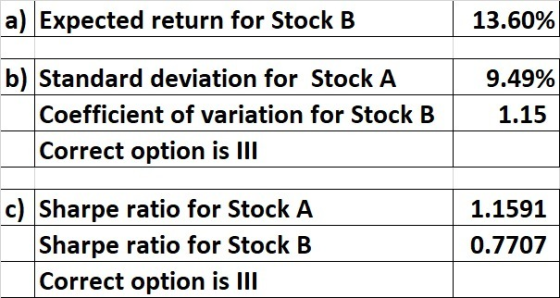
*Please rate thumbs up
Add Answer to:
Stocks A and B have the following probability distributions of
expected future returns:
Probability
A
B...
Stocks A and B have the following probability distributions of expected future returns: Probability A B...
Stocks A and B have the following probability distributions of expected future returns: Probability A B 0.1 (10 %) (35 %) 0.1 3 0 0.5 12 23 0.2 20 25 0.1 30 36 Calculate the expected rate of return, , for Stock B ( = 12.30%.) Do not round intermediate calculations. Round your answer to two decimal places. % Calculate the standard deviation of expected returns, σA, for Stock A (σB = 19.13%.) Do not round intermediate calculations. Round your answer...
Stocks A and B have the following probability distributions of expected future returns: Probability A B...
Stocks A and B have the following probability distributions of expected future returns: Probability A B 0.1 (14 %) (30 %) 0.1 2 0 0.5 13 20 0.2 24 29 0.1 36 45 Calculate the expected rate of return, , for Stock B ( = 13.70%.) Do not round intermediate calculations. Round your answer to two decimal places. % Calculate the standard deviation of expected returns, σA, for Stock A (σB = 19.01%.) Do not round intermediate calculations. Round your...
Stocks A and B have the following probability distributions of expected future returns: Probability A B...
Stocks A and B have the following probability distributions of expected future returns: Probability A B 0.1 (13 %) (22 %) 0.2 6 0 0.5 16 21 0.1 23 27 0.1 39 45 Calculate the expected rate of return, , for Stock B ( = 14.10%.) Do not round intermediate calculations. Round your answer to two decimal places. % Calculate the standard deviation of expected returns, σA, for Stock A (σB = 17.44%.) Do not round intermediate calculations. Round your...
Stocks A and B have the following probability distributions of expected future returns: Probability  ...
Stocks A and B have the following probability distributions of expected future returns: Probability A B 0.1 (8 %) (40 %) 0.2 4 0 0.4 14 19 0.2 18 29 0.1 38 45 Calculate the expected rate of return, , for Stock B ( = 13.00%.) Do not round intermediate calculations. Round your answer to two decimal places. % Calculate the standard deviation of expected returns, σA, for Stock A (σB = 21.95%.) Do not round intermediate calculations. Round your...
8.6 Stocks A and B have the following probability distributions of expected future returns: Probability 0.1...
 8.6
Stocks A and B have the following probability distributions of expected future returns: Probability 0.1 0.1 0.5 А (6%) 5 (25%) 16 0.2 0.1 a. Calculate the expected rate of return, TB, for Stock B (A - 15.30%.) Do not round intermediate calculations. Round your answer to two decimal places. % b. Calculate the standard deviation of expected returns, CA, for Stock A (OB = 18.68%.) Do not round intermediate calculations. Round your answer to two decimal places. Now...
8.6
Stocks A and B have the following probability distributions of expected future returns: Probability 0.1 0.1 0.5 А (6%) 5 (25%) 16 0.2 0.1 a. Calculate the expected rate of return, TB, for Stock B (A - 15.30%.) Do not round intermediate calculations. Round your answer to two decimal places. % b. Calculate the standard deviation of expected returns, CA, for Stock A (OB = 18.68%.) Do not round intermediate calculations. Round your answer to two decimal places. Now...
Stocks A and B have the following probability distributions of expected future returns: Probability A B...
 Stocks A and B have the following probability distributions of expected future returns: Probability A B 0.1 (11 % ) (23 %) 0.2 6 0 0.4 15. 23 0.2 23 27 0.1 39 48 a. Calculate the expected rate of return, rB, for Stock B (rA two decimal places. 14.60 % . ) Do not round intermediate calculations. Round your answer to 11 % b. Calculate the standard deviation of expected returns, aA, for Stock A (oe = 18.66 %...
Stocks A and B have the following probability distributions of expected future returns: Probability 0.1 (8...
 Stocks A and B have the following probability distributions of expected future returns: Probability 0.1 (8 %) (35%) 0.2 0.4 22 0.2 0.1 a. Calculate the expected rate of return, fb, for Stock B (f = 12.00%.) Do not round intermediate calculations. Round your answer to two decimal places. 28 b. Calculate the standard deviation of expected returns, CA, for Stock A (OB = 20.40%.) Do not round intermediate calculations. Round your answer to two decimal places. % Now calculate...
Stocks A and B have the following probability distributions of expected future returns: Probability (119) (34...
 Stocks A and B have the following probability distributions of expected future returns: Probability (119) (34 ) 0.1 0.5 02 0.1 a. Calculate the expected rate of return, for Stock B (TA1440%.) Do not round intermediate calculations. Round your answer to two decimal places. 16 % b. Calculate the standard deviation of expected returns, or for Stock AO = 19.89%.) Do not round intermediate calculations. Round your answer to two decimal Now calculate the coefficient of variation for Stock B....
8.6 Stocks A and B have the following probability distributions of expected future returns: Probability 0.1 (25%) 0.1 0...
 8.6
Stocks A and B have the following probability distributions of expected future returns: Probability 0.1 (25%) 0.1 0.5 (6%) 5 16 0.2 18 30 0.1 38 50 a. Calculate the expected rate of return, TB, for Stock B ("A - 15.30%.) Do not round intermediate calculations. Round your answer to two decimal places. % b. Calculate the standard deviation of expected returns, CA, for Stock A (OB = 18.68%.) Do not round intermediate calculations. Round your answer to two...
8.6
Stocks A and B have the following probability distributions of expected future returns: Probability 0.1 (25%) 0.1 0.5 (6%) 5 16 0.2 18 30 0.1 38 50 a. Calculate the expected rate of return, TB, for Stock B ("A - 15.30%.) Do not round intermediate calculations. Round your answer to two decimal places. % b. Calculate the standard deviation of expected returns, CA, for Stock A (OB = 18.68%.) Do not round intermediate calculations. Round your answer to two...
EXPECTED RETURNS Stocks A and B have the following probability distributions of expected future returns: Probability...
 EXPECTED RETURNS Stocks A and B have the following probability distributions of expected future returns: Probability 0.1 (38%) 0.2 0.2 0.1 a. Calculate the expected rate of return, re, for Stock B (rA = 12.00%.) Do not round intermediate calculations. Round your answer to two decimal places. b. Calculate the standard deviation of expected returns, OA, for Stock A (OB = 20.49%.) Do not round intermediate calculations. Round your answer to two decimal places. % c. Now calculate the coefficient...
 8.6
Stocks A and B have the following probability distributions of expected future returns: Probability 0.1 0.1 0.5 А (6%) 5 (25%) 16 0.2 0.1 a. Calculate the expected rate of return, TB, for Stock B (A - 15.30%.) Do not round intermediate calculations. Round your answer to two decimal places. % b. Calculate the standard deviation of expected returns, CA, for Stock A (OB = 18.68%.) Do not round intermediate calculations. Round your answer to two decimal places. Now...
8.6
Stocks A and B have the following probability distributions of expected future returns: Probability 0.1 0.1 0.5 А (6%) 5 (25%) 16 0.2 0.1 a. Calculate the expected rate of return, TB, for Stock B (A - 15.30%.) Do not round intermediate calculations. Round your answer to two decimal places. % b. Calculate the standard deviation of expected returns, CA, for Stock A (OB = 18.68%.) Do not round intermediate calculations. Round your answer to two decimal places. Now...
 Stocks A and B have the following probability distributions of expected future returns: Probability A B 0.1 (11 % ) (23 %) 0.2 6 0 0.4 15. 23 0.2 23 27 0.1 39 48 a. Calculate the expected rate of return, rB, for Stock B (rA two decimal places. 14.60 % . ) Do not round intermediate calculations. Round your answer to 11 % b. Calculate the standard deviation of expected returns, aA, for Stock A (oe = 18.66 %...
 Stocks A and B have the following probability distributions of expected future returns: Probability 0.1 (8 %) (35%) 0.2 0.4 22 0.2 0.1 a. Calculate the expected rate of return, fb, for Stock B (f = 12.00%.) Do not round intermediate calculations. Round your answer to two decimal places. 28 b. Calculate the standard deviation of expected returns, CA, for Stock A (OB = 20.40%.) Do not round intermediate calculations. Round your answer to two decimal places. % Now calculate...
 Stocks A and B have the following probability distributions of expected future returns: Probability (119) (34 ) 0.1 0.5 02 0.1 a. Calculate the expected rate of return, for Stock B (TA1440%.) Do not round intermediate calculations. Round your answer to two decimal places. 16 % b. Calculate the standard deviation of expected returns, or for Stock AO = 19.89%.) Do not round intermediate calculations. Round your answer to two decimal Now calculate the coefficient of variation for Stock B....
 8.6
Stocks A and B have the following probability distributions of expected future returns: Probability 0.1 (25%) 0.1 0.5 (6%) 5 16 0.2 18 30 0.1 38 50 a. Calculate the expected rate of return, TB, for Stock B ("A - 15.30%.) Do not round intermediate calculations. Round your answer to two decimal places. % b. Calculate the standard deviation of expected returns, CA, for Stock A (OB = 18.68%.) Do not round intermediate calculations. Round your answer to two...
8.6
Stocks A and B have the following probability distributions of expected future returns: Probability 0.1 (25%) 0.1 0.5 (6%) 5 16 0.2 18 30 0.1 38 50 a. Calculate the expected rate of return, TB, for Stock B ("A - 15.30%.) Do not round intermediate calculations. Round your answer to two decimal places. % b. Calculate the standard deviation of expected returns, CA, for Stock A (OB = 18.68%.) Do not round intermediate calculations. Round your answer to two...
 EXPECTED RETURNS Stocks A and B have the following probability distributions of expected future returns: Probability 0.1 (38%) 0.2 0.2 0.1 a. Calculate the expected rate of return, re, for Stock B (rA = 12.00%.) Do not round intermediate calculations. Round your answer to two decimal places. b. Calculate the standard deviation of expected returns, OA, for Stock A (OB = 20.49%.) Do not round intermediate calculations. Round your answer to two decimal places. % c. Now calculate the coefficient...
Most questions answered within 3 hours.
-
Where is the error in this code sequence?
String s1 = "Hello";
String s2 = "ello";...
asked 10 months ago -
Financial data for Joel de Paris, Inc., for last year
follow:
Joel de Paris, Inc.
Balance...
asked 10 months ago -
Consider this reaction:
Al2(SO4)3 (aq)+ BaCl3
(aq) Al2Cl6 (aq)- +
3BaSO4(s) . What is the...
asked 10 months ago -
Suppose that Savneet is considering increasing her
recent random sample from 20 car rentals to 40...
asked 10 months ago -
Trucks arrive at an unloading terminal at an average rate of 120
per hour.
Trucks arrive...
asked 10 months ago -
Why are methanol and ethanol completely soluble in water while
octanol is not very little soluble....
asked 10 months ago -
A facilities manager at a university reads in a research report
that the mean amount of...
asked 10 months ago -
When the CuSO4 is rehydrated by adding water to the anhydrous
compound, is this an endothermic...
asked 10 months ago -
A ray of sunlight is passing from diamond into crown glass; the
angle of incidence is...
asked 10 months ago -
A block of mass 0.249 kg is placed on top of a light, vertical
spring of...
asked 10 months ago -
how do the kidneys compensate in the presences of acidosis
a) trigger hyperventilate
b) reserve acid...
asked 10 months ago -
Question 501 pts
The rental rate of capital to the firm increases. Which of the
following...
asked 10 months ago