
Homework Answers
(a)
In order to calculate cash flows, the net incomes for both projects need to be adjusted for two things: depreciation (non cash expense) and working capital changes. An increase in working capital is reduced from net income whereas a decrease is added.
(Why is working capital adjusted?) Working capital is defined as current assets minus current liabilities. A change in current assets or liabilities implies that money has been accounted for in the income statement but cash flow hasn't yet happened. For example, sales are of two types, cash sales and credit sales. In order to calculate cash flow, credit sales need to be subtracted from income statement because this cash has not yet been received. And to find out the amount of credit sales in a period, you have to look at the increase in accounts receivables which is a current assets account. So, an increase in current assets is reduced while calculating cash flow. Similarly other adjustments are made for current liabilities as well.
Cash flow calculation:

Cash flow in the above excel is calculated simply by adding depreciation and change in NWC to Net income.
(b)
Net present value: It is the sum of all cash flows in a project when discounted using the appropriate discount rate. (cash outflows are subtracted and cash inflows are added)

Present values are calculated as:
So for example, for period 1, Project 1; cash flow is calculated as:
And, finally NPV is calculated by just summing all the above calculated present value cash flows (initial investment is subtracted, hence the negative sign).
(c)
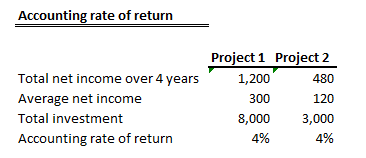
Accounting rate of return is simply the average profit earned over the life of the project as a percentage of the initial investment.
(d)
Internal rate of return is that rate at which the Net present value of a series of cash flows becomes zero. It can be calculated in excel using goal seek function.
 In the above excel, present
value of cash flows is calculated as explained in part (b). After
that NPV are calculated by summing these present values. Now, we
use goal seek to set Net Present value cell to 0 by changing the
IRR. This will give you the rate of return at which NPV is
zero.
In the above excel, present
value of cash flows is calculated as explained in part (b). After
that NPV are calculated by summing these present values. Now, we
use goal seek to set Net Present value cell to 0 by changing the
IRR. This will give you the rate of return at which NPV is
zero.
(e)
Project 1 gives a higher internal rate of return and also it also has a positive Net present value. So, this project should be preferred.
Add Answer to:
3. Consider Table 2. Victoria Way Inc. is considering investing in Projects 1 and 2. The...
Consider Table 1. Public Life Inc. is considering investing in projects 1 and 2. The initial...
 Consider Table 1. Public Life Inc. is considering investing in projects 1 and 2. The initial cost of project 1 is 10,000 and e3,000 for project 2. Each project lasts four years. Straight-line depreciation method is used The minimum accounting rate of return is 10%. The discount rate is 10% for both projects, and the depreciation rate is 25% for each project. 2. Table Project 1 Years Project 2 Years 2 0 2 0 Barnings Cashflows 4 60 120 180...
3. Consider the information in Table 2. Sports Bulletin Plc. is considering investing in two projects,...
 3. Consider the information in Table 2. Sports Bulletin Plc. is considering investing in two projects, A and B. The initial outlay and annual cash flows are shown in Table 2. Straight-line depreciation method is used. The minimum accounting rate of return is 15%. The discount rate is 10%, and the depreciation rate is 25%. The minimum acceptable pavback period is 3 vears. For each project, the change in net working capital is zero in each vear, Both proiects are...
Consider Table 4. The Burren Inc. is considering investing in projects 1 and 2. The initial...
 Consider Table 4. The Burren Inc. is considering investing in projects 1 and 2. The initial cost of project 1 is €3,000 and €2,000 for project 2. Each project lasts four years. Straight-line depreciation method is used The minimum accounting rate of return is 10%. The discount rate is 10% for both projects, and the depreciation rate is 25% for each project. The minimum acceptable payback is 3 years. NWC is net working capital Table 4 Project 1 Time (in...
E12-35A (similar to) Question Help The following table contains information about four projects in which Hughes...
 E12-35A (similar to) Question Help The following table contains information about four projects in which Hughes Corporation has the opportunity to invest. This information is based on estimates that different managers have prepared about their potential project. (Click the icon to view the projects information.) Requirements 1. Rank the four projects in order of preference by using the a. net present value. b. project profitability index c. internal rate of return. d. payback period. e. accounting rate of return. 2....
The following table contains information about four projects in which Renkas Corporation has the opportunity to...
 The following table contains information about four projects in which Renkas Corporation has the opportunity to invest. This information is based on estimates that different managers have prepared about their potential project Click the icon to view the projects information) Requirements 1. Rank the four projects in order of preference by using the a net present value project profitability Index internal rate of return d. payback period e accounting of return 2. Which methods) do you think is best for...
The following table contains information about four projects in which Morales Corporation has the opportunity to...
The following table contains information about four projects in which Morales Corporation has the opportunity to invest. This information is based on estimates that different managers have prepared about their potential project. Investment Net Present Life of Internal Rate Profitability Payback Period Accounting Rate Project Required Value Project of Return Index in Years of Return A. . . . . . $200,000 $52,350 5 22 % 1.26 2.86 20 % B. . . . . . $400,000 $72,230 6 25...
Consider the two mutually exclusive investment projects given in the table below for which MARR =...
 Consider the two mutually exclusive investment projects given in the table below for which MARR = 16%. On the basis of the IRR criterion, which project would be selected under an infinite planning horizon with project repeatability likely? Click the icon to view the cash flows for the investment projects. The rate of return on the incremental investment is % (Round to one decimal place.) n 0 Net Cash Flow Project A -- $4,000 1,500 2,500 2,500 26.23% Project B...
Nicholson Roofing Materials, Inc., is considering two mutually exclusive projects, each with an initial investment of...
Nicholson Roofing Materials, Inc., is considering two mutually exclusive projects, each with an initial investment of $100000. The company's board of directors has set a 4-year payback requirement and has set its cost of capital at 12%. The cash inflows associated with the two projects are shown in the following table: YR Project A Project B 1 30000 85000 2 30000 50000 3 30000 10000 4 30000 10000 5 30000 10000 6 30000 10000 .a. Calculate the payback period for...
Nicholson Roofing Materials, Inc., is considering two mutually exclusive projects, each with an initial investment of...
Nicholson Roofing Materials, Inc., is considering two mutually exclusive projects, each with an initial investment of $110,000. The company's board of directors has set a 4-year payback requirement and has set its cost of capital at 12%. The cash inflows associated with the two projects are shown in the following table: Cash inflows (CFt) Year Project A Project B 1 $35,000 $65,000 2 $35,000 $50,000 3 $35,000 $20,000 4 $35,000 $20,000 5 $35,000 $20,000 6 $35,000 $20,000 a. Calculate the...
VII. KORONA Manufacturing is considering investing in either of two mutually exclusive projects, A and B....
 VII. KORONA Manufacturing is considering investing in either of two mutually exclusive projects, A and B. The firm has a 14 percent cost of capital, and the risk-free rate is currently 9 percent. The initial investment, expected cash inflows, and certainty equivalent factors associated with each of the projects are shown in the following table. Initial investment (II) Project B S 56,000 Year (1) Project A $ 40,000 Certainty Cash inflows equivalent factors (CF) (a) $20,000 0.90 16,000 0.80 12,000...
 Consider Table 1. Public Life Inc. is considering investing in projects 1 and 2. The initial cost of project 1 is 10,000 and e3,000 for project 2. Each project lasts four years. Straight-line depreciation method is used The minimum accounting rate of return is 10%. The discount rate is 10% for both projects, and the depreciation rate is 25% for each project. 2. Table Project 1 Years Project 2 Years 2 0 2 0 Barnings Cashflows 4 60 120 180...
 3. Consider the information in Table 2. Sports Bulletin Plc. is considering investing in two projects, A and B. The initial outlay and annual cash flows are shown in Table 2. Straight-line depreciation method is used. The minimum accounting rate of return is 15%. The discount rate is 10%, and the depreciation rate is 25%. The minimum acceptable pavback period is 3 vears. For each project, the change in net working capital is zero in each vear, Both proiects are...
 Consider Table 4. The Burren Inc. is considering investing in projects 1 and 2. The initial cost of project 1 is €3,000 and €2,000 for project 2. Each project lasts four years. Straight-line depreciation method is used The minimum accounting rate of return is 10%. The discount rate is 10% for both projects, and the depreciation rate is 25% for each project. The minimum acceptable payback is 3 years. NWC is net working capital Table 4 Project 1 Time (in...
 E12-35A (similar to) Question Help The following table contains information about four projects in which Hughes Corporation has the opportunity to invest. This information is based on estimates that different managers have prepared about their potential project. (Click the icon to view the projects information.) Requirements 1. Rank the four projects in order of preference by using the a. net present value. b. project profitability index c. internal rate of return. d. payback period. e. accounting rate of return. 2....
 The following table contains information about four projects in which Renkas Corporation has the opportunity to invest. This information is based on estimates that different managers have prepared about their potential project Click the icon to view the projects information) Requirements 1. Rank the four projects in order of preference by using the a net present value project profitability Index internal rate of return d. payback period e accounting of return 2. Which methods) do you think is best for...
 Consider the two mutually exclusive investment projects given in the table below for which MARR = 16%. On the basis of the IRR criterion, which project would be selected under an infinite planning horizon with project repeatability likely? Click the icon to view the cash flows for the investment projects. The rate of return on the incremental investment is % (Round to one decimal place.) n 0 Net Cash Flow Project A -- $4,000 1,500 2,500 2,500 26.23% Project B...
 VII. KORONA Manufacturing is considering investing in either of two mutually exclusive projects, A and B. The firm has a 14 percent cost of capital, and the risk-free rate is currently 9 percent. The initial investment, expected cash inflows, and certainty equivalent factors associated with each of the projects are shown in the following table. Initial investment (II) Project B S 56,000 Year (1) Project A $ 40,000 Certainty Cash inflows equivalent factors (CF) (a) $20,000 0.90 16,000 0.80 12,000...
Most questions answered within 3 hours.
-
Where is the error in this code sequence?
String s1 = "Hello";
String s2 = "ello";...
asked 10 months ago -
Financial data for Joel de Paris, Inc., for last year
follow:
Joel de Paris, Inc.
Balance...
asked 10 months ago -
Consider this reaction:
Al2(SO4)3 (aq)+ BaCl3
(aq) Al2Cl6 (aq)- +
3BaSO4(s) . What is the...
asked 10 months ago -
Suppose that Savneet is considering increasing her
recent random sample from 20 car rentals to 40...
asked 10 months ago -
Trucks arrive at an unloading terminal at an average rate of 120
per hour.
Trucks arrive...
asked 10 months ago -
Why are methanol and ethanol completely soluble in water while
octanol is not very little soluble....
asked 10 months ago -
A facilities manager at a university reads in a research report
that the mean amount of...
asked 10 months ago -
When the CuSO4 is rehydrated by adding water to the anhydrous
compound, is this an endothermic...
asked 10 months ago -
A ray of sunlight is passing from diamond into crown glass; the
angle of incidence is...
asked 10 months ago -
A block of mass 0.249 kg is placed on top of a light, vertical
spring of...
asked 10 months ago -
how do the kidneys compensate in the presences of acidosis
a) trigger hyperventilate
b) reserve acid...
asked 10 months ago -
Question 501 pts
The rental rate of capital to the firm increases. Which of the
following...
asked 10 months ago