1: Briefly describe how the thyroid and parathyroid hormones are controlled. 2: Thyroid hormones increase...
1: Briefly describe how the thyroid and parathyroid hormones are controlled.
2: Thyroid hormones increase metabolism. Why is giving thyroid hormones not recommended to treat obesity?
Homework Answers
Ans) 1) When the calcium level is high in the bloodstream, the thyroid gland releases calcitonin. Calcitonin slows down the activity of the osteoclasts found in bone. This decreases blood calcium levels. When calcium levels decrease, this stimulates the parathyroid gland to release parathyroid hormone.
Thyroid-releasing hormone (TRH) from the hypothalamus stimulates TSH from the pituitary, which stimulates thyroid hormone release. As blood concentrations of thyroid hormones increase, they inhibit both TSH and TRH, leading to "shutdown" of thyroid epithelial cells.
2) Thyroid hormones stimulate diverse metabolic activities most tissues, leading to an increase in basal metabolic rate. One consequence of this activity is to increase body heat production, which seems to result, at least in part, from increased oxygen consumption and rates of ATP hydrolysis.
- An unexplained change in weight is one of the most common signs of a thyroid disorder. Weight gain may signal low levels of thyroid hormones, a condition called hypothyroidism. In contrast, if the thyroid produces more hormones than the body needs, you may lose weight unexpectedly.
Add Answer to:
1: Briefly describe how the thyroid and parathyroid hormones are
controlled.
2: Thyroid hormones increase...
1. Describe the hormonal control of Ca2+ homeostasis Key: Parathyroid calcitonin&
1. Describe the hormonal control of Ca2+ homeostasis Key: Parathyroid calcitonin increase calcium PTH The thyroid gland also produces the hormone_________________which causes bones to store calcium ions (Ca+2). ________________________glands are 4 tiny glands located on the thyroid gland that secrete parathyroid hormone (_____) to control calcium metabolism by increasing the levels of _______________ions (Ca+2) in blood. Parathyroids ____________ levels of calcium ions by 1. release Ca++ from bone; 2. Promotion of reabsorption of Ca++ by kidneys; 3. Increase absorption of...
1. name the hormones produced by the hypothalamus pituitary gland - thyroid axis 2. do hormones...
1. name the hormones produced by the hypothalamus pituitary gland - thyroid axis 2. do hormones act on all the cells ? what helps the hormones enter the target cells? 3. glucagon and insulin have opposing effect on their target cells . they are _______ to each other in action
Multiple-choice/True-false/Matching: 1. The thyroid parafollicular cells produce parathyroid hormone (PTH). a) true b) false 2. The...
 Multiple-choice/True-false/Matching: 1. The thyroid parafollicular cells produce parathyroid hormone (PTH). a) true b) false 2. The sebaceous glands are examples of endocrine glands. a) true b) false 3. An exophthalmic goiter is caused by a deficiency of iodine. a) true b) false 4. Which pancreatic hormone acts to increase blood glucose levels? a) GHRH b) GnRH c) insulin d) FSH e) glucagon 5. The target organs for FSH are both the ovaries and the testes. a) true b) false 6....
Assignment chapter 37,Thyroid and parathyroid Agents Learning Objective(s) Group Assignments 1. As a group, prepare a...
 Assignment chapter 37,Thyroid and parathyroid Agents
Learning Objective(s) Group Assignments 1. As a group, prepare a table describing the therapeutic actions, indications, pharmacokinetics, most common adverse reactions, contraindications, and important drug-drug interactions for thyroid and parathyroid agents. 2. Divide the class into three groups. Assign each group an age group: children, adults, or older adults. Each group is to discuss the use of thyroid and parathyroid agents in the assigned age group. What are the most likely reasons that each...
Assignment chapter 37,Thyroid and parathyroid Agents
Learning Objective(s) Group Assignments 1. As a group, prepare a table describing the therapeutic actions, indications, pharmacokinetics, most common adverse reactions, contraindications, and important drug-drug interactions for thyroid and parathyroid agents. 2. Divide the class into three groups. Assign each group an age group: children, adults, or older adults. Each group is to discuss the use of thyroid and parathyroid agents in the assigned age group. What are the most likely reasons that each...
11. Regarding the reflex pathway for parathyroid hormone (PTH) release, place the following statements in the...
 11. Regarding the reflex pathway for parathyroid hormone (PTH) release, place the following statements in the proper sequence. a. calcium levels increase b. parathyroid hormone is sent to effector organs C. parathyroid cells detects deviation d. parathyroid cell initiates a response e. kidneys reabsorb calcium f. calcium levels decrease 12. List two reasons (besides strong bones) why Ca" is important to regulate 13. A decrease in plasma glucose is detected by the pancreas, the pancreas formulates a response, alpha cells...
2. Describe briefly the ways in which hormones can exert a controlling action in the regulation...
 2. Describe briefly the ways in which hormones can exert a controlling action in the regulation of physiological systems.
Chapter 18 Objectives Identify the functions of the endocrine system. Identify the hormones of the anterior...
Chapter 18 Objectives Identify the functions of the endocrine system. Identify the hormones of the anterior pituitary (including the appropriate releasing factor), stimulating hormones, target hormones, and target tissues, including normal outcomes. List the hormones of the posterior pituitary and their actions. Discuss the effects of thyroid hormone (T3, T4) and the mechanisms of thyroid hormone regulation. Discuss the effects of parathyroid hormone and the mechanisms of parathyroid hormone regulation. Identify the hormones secreted by the alpha, beta, and delta...
Thyroid hormones are composed of: 1. Thyroperoxidase 2. Iodide 3. Thyroglobulin 4. Folliculum Select all that...
Thyroid hormones are composed of: 1. Thyroperoxidase 2. Iodide 3. Thyroglobulin 4. Folliculum Select all that apply.
3. Calcitriol: 1. Is produced by the Parathyroid gland 2. Acts on bone, the distal nephron...
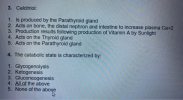 3. Calcitriol: 1. Is produced by the Parathyroid gland 2. Acts on bone, the distal nephron and intestine to increase plasma Ca+2 3. Production results following production of Vitamin A by Sunlight 4. Acts on the Thyroid gland 5. Acts on the Parathyroid gland 4. The catabolic state is characterized by: 1. Glycogenolysis 2. Ketogenesis 3. Gluconeogenesis 4. All of the above 5. None of the above
1. Describe how elevated LDL levels can increase the risk of atherosclerosis 2. Describe in your own...
1. Describe how elevated LDL levels can increase the risk of atherosclerosis 2. Describe in your own words how obesity can increase the risk of diabetes and cardiovascular disease.
 Multiple-choice/True-false/Matching: 1. The thyroid parafollicular cells produce parathyroid hormone (PTH). a) true b) false 2. The sebaceous glands are examples of endocrine glands. a) true b) false 3. An exophthalmic goiter is caused by a deficiency of iodine. a) true b) false 4. Which pancreatic hormone acts to increase blood glucose levels? a) GHRH b) GnRH c) insulin d) FSH e) glucagon 5. The target organs for FSH are both the ovaries and the testes. a) true b) false 6....
 Assignment chapter 37,Thyroid and parathyroid Agents
Learning Objective(s) Group Assignments 1. As a group, prepare a table describing the therapeutic actions, indications, pharmacokinetics, most common adverse reactions, contraindications, and important drug-drug interactions for thyroid and parathyroid agents. 2. Divide the class into three groups. Assign each group an age group: children, adults, or older adults. Each group is to discuss the use of thyroid and parathyroid agents in the assigned age group. What are the most likely reasons that each...
Assignment chapter 37,Thyroid and parathyroid Agents
Learning Objective(s) Group Assignments 1. As a group, prepare a table describing the therapeutic actions, indications, pharmacokinetics, most common adverse reactions, contraindications, and important drug-drug interactions for thyroid and parathyroid agents. 2. Divide the class into three groups. Assign each group an age group: children, adults, or older adults. Each group is to discuss the use of thyroid and parathyroid agents in the assigned age group. What are the most likely reasons that each...
 11. Regarding the reflex pathway for parathyroid hormone (PTH) release, place the following statements in the proper sequence. a. calcium levels increase b. parathyroid hormone is sent to effector organs C. parathyroid cells detects deviation d. parathyroid cell initiates a response e. kidneys reabsorb calcium f. calcium levels decrease 12. List two reasons (besides strong bones) why Ca" is important to regulate 13. A decrease in plasma glucose is detected by the pancreas, the pancreas formulates a response, alpha cells...
 2. Describe briefly the ways in which hormones can exert a controlling action in the regulation of physiological systems.
 3. Calcitriol: 1. Is produced by the Parathyroid gland 2. Acts on bone, the distal nephron and intestine to increase plasma Ca+2 3. Production results following production of Vitamin A by Sunlight 4. Acts on the Thyroid gland 5. Acts on the Parathyroid gland 4. The catabolic state is characterized by: 1. Glycogenolysis 2. Ketogenesis 3. Gluconeogenesis 4. All of the above 5. None of the above
Most questions answered within 3 hours.
-
Where is the error in this code sequence?
String s1 = "Hello";
String s2 = "ello";...
asked 10 months ago -
Financial data for Joel de Paris, Inc., for last year
follow:
Joel de Paris, Inc.
Balance...
asked 10 months ago -
Consider this reaction:
Al2(SO4)3 (aq)+ BaCl3
(aq) Al2Cl6 (aq)- +
3BaSO4(s) . What is the...
asked 10 months ago -
Suppose that Savneet is considering increasing her
recent random sample from 20 car rentals to 40...
asked 10 months ago -
Trucks arrive at an unloading terminal at an average rate of 120
per hour.
Trucks arrive...
asked 10 months ago -
Why are methanol and ethanol completely soluble in water while
octanol is not very little soluble....
asked 10 months ago -
A facilities manager at a university reads in a research report
that the mean amount of...
asked 10 months ago -
When the CuSO4 is rehydrated by adding water to the anhydrous
compound, is this an endothermic...
asked 10 months ago -
A ray of sunlight is passing from diamond into crown glass; the
angle of incidence is...
asked 10 months ago -
A block of mass 0.249 kg is placed on top of a light, vertical
spring of...
asked 10 months ago -
how do the kidneys compensate in the presences of acidosis
a) trigger hyperventilate
b) reserve acid...
asked 10 months ago -
Question 501 pts
The rental rate of capital to the firm increases. Which of the
following...
asked 10 months ago