
Homework Answers
Add Answer to:
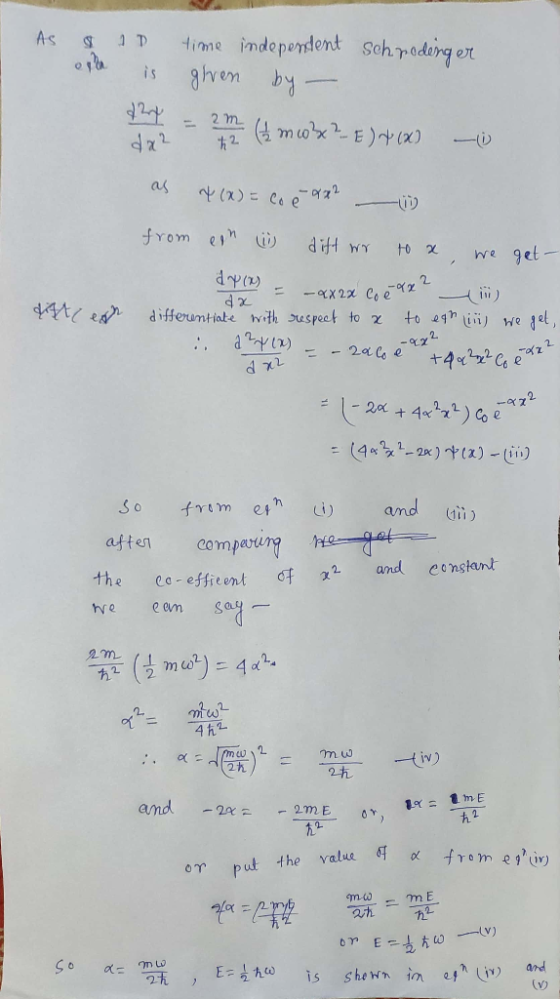
b. The 1-D time-independent Schrodinger equation for the stationary states of a harmonic oscillator is given...
The most general wave function of a particle in the simple harmonic oscillator potential is: V(x,...
 The most general wave function of a particle in the simple harmonic oscillator potential is: V(x, t) = (x)e-1st/ where and E, are the harmonic oscillator's stationary states and their corresponding energies. (a) Show that the expectation value of position is (hint: use the results of Problem 4): (v) = A cos (wt - ) where the real constants A and o are given by: 1 2 Ae-id-1 " Entichtin Interpret this result, comparing it with the motion of a...
A stationary state is a solution to the time independent Schrodinger Equation F T F T...
 A stationary state is a solution to the time independent Schrodinger Equation F T F T Photons are bosons and have spin-1 T Electrons have a permanent magnetic moment F T F All states with n 22 are altered by spin-orbit coupling T F The Pauli Exclusion Principle is a rule for how electrons scatter after a collision T F Conversion nf
Question A2: Coherent states of the harmonic oscillator Consider a one-dimensional harmonic oscillator with the Hamiltonian...
 Question A2: Coherent states of the harmonic oscillator Consider a one-dimensional harmonic oscillator with the Hamiltonian 12 12 m2 H = -2m d. 2+ 2 Here m and w are the mass and frequency, respectively. Consider a time-dependent wave function of the form <(x,t) = C'exp (-a(x – 9(t)+ ik(t)z +io(t)), where a and C are positive constants, and g(t), k(t), and o(t) are real functions of time t. 1. Express C in terms of a. [2 marks] 2. By...
The lowest energy wavefunction of the quantum harmonic oscillator has the form (c) Determine σ an...
 The lowest energy wavefunction of the quantum harmonic oscillator has the form (c) Determine σ and Eo (the energy of this lowest-energy wavefunction) by using the time-independent Schrödinger equation (H/Ho(x)- E/Ho(x) In Lecture 3, we found that the solution for a classical harmonic oscillator displaced from equilibrium by an amount o and released at rest was x(t)cos(wt) (d) Classically, what is the momentum of this harmonic oscillator as a function of time? (e) Show that 〈z) (expectation value of x)...
The three-dimensional harmonic oscillator Cartesian wave functions that you found in Prob. 4.46 a...
 The three-dimensional harmonic oscillator Cartesian wave functions that you found in Prob. 4.46 are simultaneous eigenfunctions of H and parity (i.e., r →-r), but they are not also simultaneous eigenfunctions of L' and Lz. However, we know that it's possible to construct eigenfunctions of H for the 3D harmonic oscillator that are also eigenfunctions of L, Lz, and parity. Combine the Gaussian factors that appear in your Prob. 4.46 eigenfunctions into a function of r that is independent of θ...
6 The Fermionic Oscillator Suppose that we constructed a harmonic oscillator Hamiltonian H in terms of...
 6 The Fermionic Oscillator Suppose that we constructed a harmonic oscillator Hamiltonian H in terms of raising and lowering operators a+,a in the usual way, such that but now whereaa obey the anticommutation relationn (Be careful! The a+,a are operators, rather than numbers.) (a) Suppose I give you a wavefunction that solves the time-independent Schrödinger equation, i.e. such that HUn-EUn-hw (n + ) ψη. Is a+Un also a solution to the time-independent Schrödinger equation If so, what is its energy...
[20 points] A particle in the simple harmonic oscillator potential with angular frequency a is initially...
 [20 points] A particle in the simple harmonic oscillator potential with angular frequency a is initially in the ground state: c,y, (x) =Yo(x Att = 0 , the angular frequency of the oscillator suddenly doubles: a} → a½-2.4 The initial wave function can be written in terms of the modified potential (denoted with a tilde:~: Recall that the general form of the first few stationary states for the harmonic oscillator are given on page 56 of your text. a. What...
4) The wave functions of a one-dimensional harmonic oscillator for the states v = 0 and...
 4) The wave functions of a one-dimensional harmonic oscillator for the states v = 0 and v = 1 are given by: V. (y) = Noe- 4; () = (47) 2ye and y = (Premu)/2 x Write the expression for the Hamiltonian eigenvalue equation for this system and show that yo satisfy the eigenvalue equation:
One solution to the harmonic oscillator, with a potential energy V(x)=1/2 kx2, is ?(?) = ???^...
One solution to the harmonic oscillator, with a potential energy V(x)=1/2 kx2, is ?(?) = ???^ (− ??^ 2) /2 , where N is a normalization constant and ? = √ ??/ ħ^ 2 . Determine the energy of this wave function using the time independent Schrödinger equation
Potential energy function, V(x) = (1/2)mw2x2 Assuming the time-independent Schrödinger equation, show that the following wave...
 Potential energy function,
V(x) = (1/2)mw2x2
Assuming the time-independent Schrödinger equation, show that the following wave functions are solutions describing the one-dimensional harmonic behaviour of a particle of mass m, where ?2-h/v/mK, and where co and ci are constants. Calculate the energies of the particle when it is in wave-functions ?0(x) and V1 (z) What is the general expression for the allowed energies En, corresponding to wave- functions Un(x), of this one-dimensional quantum oscillator? 6 the states corresponding to the...
Potential energy function,
V(x) = (1/2)mw2x2
Assuming the time-independent Schrödinger equation, show that the following wave functions are solutions describing the one-dimensional harmonic behaviour of a particle of mass m, where ?2-h/v/mK, and where co and ci are constants. Calculate the energies of the particle when it is in wave-functions ?0(x) and V1 (z) What is the general expression for the allowed energies En, corresponding to wave- functions Un(x), of this one-dimensional quantum oscillator? 6 the states corresponding to the...
 The most general wave function of a particle in the simple harmonic oscillator potential is: V(x, t) = (x)e-1st/ where and E, are the harmonic oscillator's stationary states and their corresponding energies. (a) Show that the expectation value of position is (hint: use the results of Problem 4): (v) = A cos (wt - ) where the real constants A and o are given by: 1 2 Ae-id-1 " Entichtin Interpret this result, comparing it with the motion of a...
 A stationary state is a solution to the time independent Schrodinger Equation F T F T Photons are bosons and have spin-1 T Electrons have a permanent magnetic moment F T F All states with n 22 are altered by spin-orbit coupling T F The Pauli Exclusion Principle is a rule for how electrons scatter after a collision T F Conversion nf
 Question A2: Coherent states of the harmonic oscillator Consider a one-dimensional harmonic oscillator with the Hamiltonian 12 12 m2 H = -2m d. 2+ 2 Here m and w are the mass and frequency, respectively. Consider a time-dependent wave function of the form <(x,t) = C'exp (-a(x – 9(t)+ ik(t)z +io(t)), where a and C are positive constants, and g(t), k(t), and o(t) are real functions of time t. 1. Express C in terms of a. [2 marks] 2. By...
 The lowest energy wavefunction of the quantum harmonic oscillator has the form (c) Determine σ and Eo (the energy of this lowest-energy wavefunction) by using the time-independent Schrödinger equation (H/Ho(x)- E/Ho(x) In Lecture 3, we found that the solution for a classical harmonic oscillator displaced from equilibrium by an amount o and released at rest was x(t)cos(wt) (d) Classically, what is the momentum of this harmonic oscillator as a function of time? (e) Show that 〈z) (expectation value of x)...
 The three-dimensional harmonic oscillator Cartesian wave functions that you found in Prob. 4.46 are simultaneous eigenfunctions of H and parity (i.e., r →-r), but they are not also simultaneous eigenfunctions of L' and Lz. However, we know that it's possible to construct eigenfunctions of H for the 3D harmonic oscillator that are also eigenfunctions of L, Lz, and parity. Combine the Gaussian factors that appear in your Prob. 4.46 eigenfunctions into a function of r that is independent of θ...
 6 The Fermionic Oscillator Suppose that we constructed a harmonic oscillator Hamiltonian H in terms of raising and lowering operators a+,a in the usual way, such that but now whereaa obey the anticommutation relationn (Be careful! The a+,a are operators, rather than numbers.) (a) Suppose I give you a wavefunction that solves the time-independent Schrödinger equation, i.e. such that HUn-EUn-hw (n + ) ψη. Is a+Un also a solution to the time-independent Schrödinger equation If so, what is its energy...
 [20 points] A particle in the simple harmonic oscillator potential with angular frequency a is initially in the ground state: c,y, (x) =Yo(x Att = 0 , the angular frequency of the oscillator suddenly doubles: a} → a½-2.4 The initial wave function can be written in terms of the modified potential (denoted with a tilde:~: Recall that the general form of the first few stationary states for the harmonic oscillator are given on page 56 of your text. a. What...
 4) The wave functions of a one-dimensional harmonic oscillator for the states v = 0 and v = 1 are given by: V. (y) = Noe- 4; () = (47) 2ye and y = (Premu)/2 x Write the expression for the Hamiltonian eigenvalue equation for this system and show that yo satisfy the eigenvalue equation:
 Potential energy function,
V(x) = (1/2)mw2x2
Assuming the time-independent Schrödinger equation, show that the following wave functions are solutions describing the one-dimensional harmonic behaviour of a particle of mass m, where ?2-h/v/mK, and where co and ci are constants. Calculate the energies of the particle when it is in wave-functions ?0(x) and V1 (z) What is the general expression for the allowed energies En, corresponding to wave- functions Un(x), of this one-dimensional quantum oscillator? 6 the states corresponding to the...
Potential energy function,
V(x) = (1/2)mw2x2
Assuming the time-independent Schrödinger equation, show that the following wave functions are solutions describing the one-dimensional harmonic behaviour of a particle of mass m, where ?2-h/v/mK, and where co and ci are constants. Calculate the energies of the particle when it is in wave-functions ?0(x) and V1 (z) What is the general expression for the allowed energies En, corresponding to wave- functions Un(x), of this one-dimensional quantum oscillator? 6 the states corresponding to the...
Most questions answered within 3 hours.
-
Where is the error in this code sequence?
String s1 = "Hello";
String s2 = "ello";...
asked 11 months ago -
Financial data for Joel de Paris, Inc., for last year
follow:
Joel de Paris, Inc.
Balance...
asked 11 months ago -
Consider this reaction:
Al2(SO4)3 (aq)+ BaCl3
(aq) Al2Cl6 (aq)- +
3BaSO4(s) . What is the...
asked 11 months ago -
Suppose that Savneet is considering increasing her
recent random sample from 20 car rentals to 40...
asked 11 months ago -
Trucks arrive at an unloading terminal at an average rate of 120
per hour.
Trucks arrive...
asked 11 months ago -
Why are methanol and ethanol completely soluble in water while
octanol is not very little soluble....
asked 11 months ago -
A facilities manager at a university reads in a research report
that the mean amount of...
asked 11 months ago -
When the CuSO4 is rehydrated by adding water to the anhydrous
compound, is this an endothermic...
asked 11 months ago -
A ray of sunlight is passing from diamond into crown glass; the
angle of incidence is...
asked 11 months ago -
A block of mass 0.249 kg is placed on top of a light, vertical
spring of...
asked 11 months ago -
how do the kidneys compensate in the presences of acidosis
a) trigger hyperventilate
b) reserve acid...
asked 11 months ago -
Question 501 pts
The rental rate of capital to the firm increases. Which of the
following...
asked 11 months ago