
Homework Answers
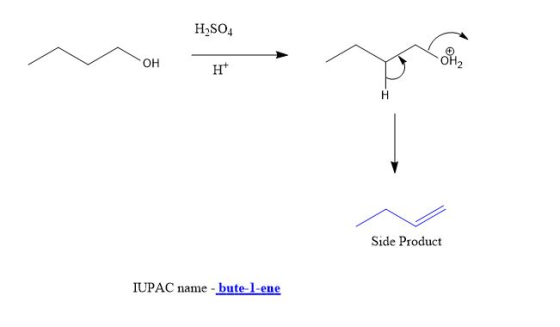
Side product - 1
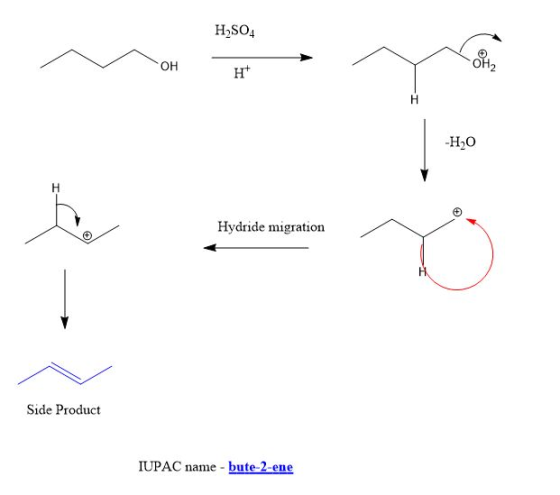
Side Product - 2
Add Answer to:
3. The esterification of butanol by sulfuric acid forms butyl hydrogen sulfate (A). This causes side...
CHE 201 1. Give two reasons why concentrated sulfuric acid was added to the reaction 2....
 CHE 201 1. Give two reasons why concentrated sulfuric acid was added to the reaction 2. In the synthesis of homohutano why was Synthesis of bromobutane why was the reaction mixture cooled in an ice bath before a concentrated sulfuric acid2 Describe what might happen if you forgot to cool the mixture. the esterification of butanol hu ur side products in the synthesis of hom feng butul hydrogen sulfate (A). This causes decreasing the yield of the desired product e...
Write the reaction equation of an Esterification of Butyric acid with Tert-Butyl Alcohol with sulfuric acid...
Write the reaction equation of an Esterification of Butyric acid with Tert-Butyl Alcohol with sulfuric acid as a catalyst and show the products. Balanced equation: (If possible) Write a procedure that would lead to obtaining 5g of the product. Name of Reactant Grams Molar Mass Moles of Reactant Tert-amyl alcohol 88.150 Butyric acid 88.106 NAME OF PRODUCT____________________________________ MOLAR MASS___________ M.P(solid) or B.P.(liquid)__________ THEORETICAL YIELD______________
What is Zaitsev’s rule? Give the mechanism for the acid-catalyzed E1 reaction of 2-butanol. Give the...
What is Zaitsev’s rule? Give the mechanism for the acid-catalyzed E1 reaction of 2-butanol. Give the mechanism for the base-catalyzed E2 reaction of 2-bromobutane. Draw all possible products. You expect three products from the elimination reaction 2-butanol. What are they? The E2 mechanism is a one-step mechanism. True or False? Explain. Which of these two alcohols would you expect to be more reactive under H3PO4/aqueous conditions? Why? Give the structure of the main product in both cases. 1-phenyl-1-propanol 1 -cyclohexyl-1-propanol...
3. If sodium methoxide in methanol was used in place of potassium t butanol, your GC...
 3. If sodium methoxide in methanol was used in place of potassium t butanol, your GC analysis would look much more like the 2-butanol/sulfuric acid reaction products. In addition, a new, non-alkene product would be present in the GC analysis from a competing, non-elimination mechanism. Explain why the alkene distribution would change, what the new product would be, and why this new product would form. 4. If 2-bromobutane was reacted with trimethylamine to produce sec-butyl trimethyl- ammonium bromide (see below),...
Please answer all questions and show all work 1. Write a mechanism for the acid-catalyzed esterification...
Please answer all questions and show all work 1. Write a mechanism for the acid-catalyzed esterification that uses cyclopentanol and acetic acid. 2. Tertiary alcohols do not work well in the procedure outlined for this experiment; they give a different product from what you might expect. Explain this and draw the expected product from t-butyl alcohol (2-methyl-2-propanol).
13 SN1: Synthesis of tert-Butyl Chloride Alkyl halides can be prepared from their corresponding alcohols via...
 13 SN1: Synthesis of tert-Butyl Chloride Alkyl halides can be prepared from their corresponding alcohols via an acid catalyzed substitution reaction. The mechanism of these acid catalyzed substitution reactions are labeled as Syl (substitution, nucleophilic, unimolecular) and S2 (substitution, nucleophilic, bimolecular). Tertiary alcohols follow the Snl route, primary alcohols follow the S2 route, and secondary alcohols can follow either path. Under acidic conditions, the mechanism (Figure 1) of the Sul reaction involves rapid protonation of the alcohol, followed by the...
Dehydration of 3-methyl-2-butanol forms one major and two minor organic products. Draw the...
 Acid-catalyzed dehydration of secondary and tertiary alcohols proceeds through an E1 mechanism. The first step is the protonation of alcohol and oxygen to form anoxonium ion.Dehydration of 3-methyl-2-butanol forms one major and two minor organic products. Draw the structures, including hydrogen atoms, of the three organic products ofthis reaction.The 3.) is correct that is the minor product I came up with but I cant get the answer correct for 1.) major product? and 2.) minor product
Tools Window Help OMX 75% Esterification Experiment Lab Data.pdf (page 1 of 3) Search Product Ester...
 Tools Window Help OMX 75% Esterification Experiment Lab Data.pdf (page 1 of 3) Search Product Ester IR of starting alcohol (1-pentanol) 1-Pentanol M. AM 19ra aromo 14, 2017 m. 1% 1075 20 . 2030 26.1.60.39 10 4000 3500 . 1000 3000 INT 650 2500 cm-1 2000 1500 M 8 Tools Window Help 78 Wed 2:19 PM Go Esterification Experiment Lab Data pdf page 2 of 3) @ Q Search IR of final product (ester) Product Ester Guided Instructions for In-Lab...
13 SN1: Synthesis of tert-Butyl Chloride Alkyl halides can be prepared from their corresponding alcohols via...
 13 SN1: Synthesis of tert-Butyl Chloride Alkyl halides can be prepared from their corresponding alcohols via an acid catalyzed substitution reaction. The mechanism of these acid catalyzed substitution reactions are labeled as Syl (substitution, nucleophilic, unimolecular) and S2 (substitution, nucleophilic, bimolecular). Tertiary alcohols follow the Snl route, primary alcohols follow the S2 route, and secondary alcohols can follow either path. Under acidic conditions, the mechanism (Figure 1) of the Sul reaction involves rapid protonation of the alcohol, followed by the...
Experiment 14 SN2: Synthesis of 1-Bromobutane Alkyl halides can be prepared from their corresponding alcohols via...
 Experiment 14 SN2: Synthesis of 1-Bromobutane Alkyl halides can be prepared from their corresponding alcohols via an acid catalyzed substitution reaction. The mechanism of these acid catalyzed substitution reactions are labeled as SNI (substitution, nucleophilie, unimolecular) and S2 (substitution, nucleophilie, bimolecular). Tertiary alcohols follow the Syl route, primary alcohols follow the S2, route and secondary alcohols can follow either path. Sth CyHe 81 CH? Br-CH e-OH- -C-OH OH Figure / Conversion of 1-butanol into 1-bromobutane by an Sp2 mechanism The...
 CHE 201 1. Give two reasons why concentrated sulfuric acid was added to the reaction 2. In the synthesis of homohutano why was Synthesis of bromobutane why was the reaction mixture cooled in an ice bath before a concentrated sulfuric acid2 Describe what might happen if you forgot to cool the mixture. the esterification of butanol hu ur side products in the synthesis of hom feng butul hydrogen sulfate (A). This causes decreasing the yield of the desired product e...
 3. If sodium methoxide in methanol was used in place of potassium t butanol, your GC analysis would look much more like the 2-butanol/sulfuric acid reaction products. In addition, a new, non-alkene product would be present in the GC analysis from a competing, non-elimination mechanism. Explain why the alkene distribution would change, what the new product would be, and why this new product would form. 4. If 2-bromobutane was reacted with trimethylamine to produce sec-butyl trimethyl- ammonium bromide (see below),...
 13 SN1: Synthesis of tert-Butyl Chloride Alkyl halides can be prepared from their corresponding alcohols via an acid catalyzed substitution reaction. The mechanism of these acid catalyzed substitution reactions are labeled as Syl (substitution, nucleophilic, unimolecular) and S2 (substitution, nucleophilic, bimolecular). Tertiary alcohols follow the Snl route, primary alcohols follow the S2 route, and secondary alcohols can follow either path. Under acidic conditions, the mechanism (Figure 1) of the Sul reaction involves rapid protonation of the alcohol, followed by the...
 Acid-catalyzed dehydration of secondary and tertiary alcohols proceeds through an E1 mechanism. The first step is the protonation of alcohol and oxygen to form anoxonium ion.Dehydration of 3-methyl-2-butanol forms one major and two minor organic products. Draw the structures, including hydrogen atoms, of the three organic products ofthis reaction.The 3.) is correct that is the minor product I came up with but I cant get the answer correct for 1.) major product? and 2.) minor product
 Tools Window Help OMX 75% Esterification Experiment Lab Data.pdf (page 1 of 3) Search Product Ester IR of starting alcohol (1-pentanol) 1-Pentanol M. AM 19ra aromo 14, 2017 m. 1% 1075 20 . 2030 26.1.60.39 10 4000 3500 . 1000 3000 INT 650 2500 cm-1 2000 1500 M 8 Tools Window Help 78 Wed 2:19 PM Go Esterification Experiment Lab Data pdf page 2 of 3) @ Q Search IR of final product (ester) Product Ester Guided Instructions for In-Lab...
 13 SN1: Synthesis of tert-Butyl Chloride Alkyl halides can be prepared from their corresponding alcohols via an acid catalyzed substitution reaction. The mechanism of these acid catalyzed substitution reactions are labeled as Syl (substitution, nucleophilic, unimolecular) and S2 (substitution, nucleophilic, bimolecular). Tertiary alcohols follow the Snl route, primary alcohols follow the S2 route, and secondary alcohols can follow either path. Under acidic conditions, the mechanism (Figure 1) of the Sul reaction involves rapid protonation of the alcohol, followed by the...
 Experiment 14 SN2: Synthesis of 1-Bromobutane Alkyl halides can be prepared from their corresponding alcohols via an acid catalyzed substitution reaction. The mechanism of these acid catalyzed substitution reactions are labeled as SNI (substitution, nucleophilie, unimolecular) and S2 (substitution, nucleophilie, bimolecular). Tertiary alcohols follow the Syl route, primary alcohols follow the S2, route and secondary alcohols can follow either path. Sth CyHe 81 CH? Br-CH e-OH- -C-OH OH Figure / Conversion of 1-butanol into 1-bromobutane by an Sp2 mechanism The...
Most questions answered within 3 hours.
-
Where is the error in this code sequence?
String s1 = "Hello";
String s2 = "ello";...
asked 11 months ago -
Financial data for Joel de Paris, Inc., for last year
follow:
Joel de Paris, Inc.
Balance...
asked 11 months ago -
Consider this reaction:
Al2(SO4)3 (aq)+ BaCl3
(aq) Al2Cl6 (aq)- +
3BaSO4(s) . What is the...
asked 11 months ago -
Suppose that Savneet is considering increasing her
recent random sample from 20 car rentals to 40...
asked 11 months ago -
Trucks arrive at an unloading terminal at an average rate of 120
per hour.
Trucks arrive...
asked 11 months ago -
Why are methanol and ethanol completely soluble in water while
octanol is not very little soluble....
asked 11 months ago -
A facilities manager at a university reads in a research report
that the mean amount of...
asked 11 months ago -
When the CuSO4 is rehydrated by adding water to the anhydrous
compound, is this an endothermic...
asked 11 months ago -
A ray of sunlight is passing from diamond into crown glass; the
angle of incidence is...
asked 11 months ago -
A block of mass 0.249 kg is placed on top of a light, vertical
spring of...
asked 11 months ago -
how do the kidneys compensate in the presences of acidosis
a) trigger hyperventilate
b) reserve acid...
asked 11 months ago -
Question 501 pts
The rental rate of capital to the firm increases. Which of the
following...
asked 11 months ago