
Homework Answers
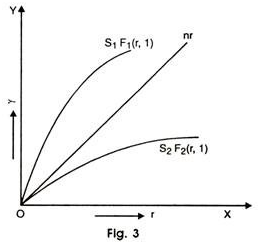
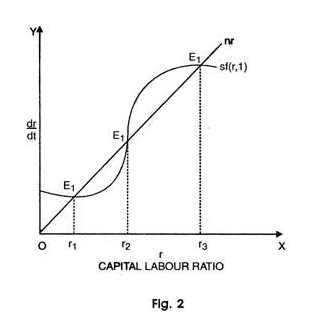
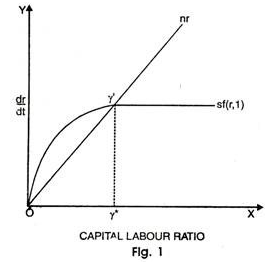
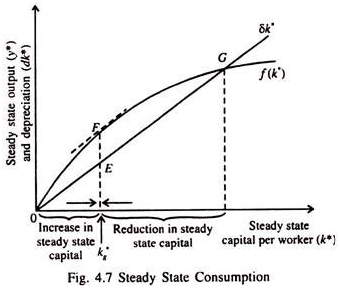
The respective figure number is the answer to the question number respectively.
Add Answer to:
3) Consider the Solow model with population growth and labor-augmenting technological progress. Suppose that the aggregate...
Consider the Solow model with population growth and technological progress. The population grows at rate of...
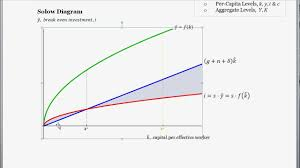
Consider the Solow model with population growth and technological progress. The population grows at rate of d and the technology grows at rate of g. The depreciation rate of capital is λ. The aggregate production function is given as Y=100 ?![(1-u) ?]" where Y, K, L, ?, ? and u refers to aggregate output, aggregate capital stock, aggregate labor, output elasticity with respect to capital, output elasticity with respect to labor, and natural rate of unemployment, respectively. Draw a well-labeled...
In the Solow model with a positive rate of population growth n and technological progress z,...
In the Solow model with a positive rate of population growth n and technological progress z, the steady state level of total real output Y grows at the rate: a. n. b. zero. c. z. d. n + z. In the Solow model with a positive rate of population growth n and technological progress z, the steady state level of per worker real output y grows at the rate: a. n. b. zero. c. z. d. n + z. In...
Macroeconomics Solow model with technological progress
 The Solow model with technological progress.In the lecture, we talked about the Solow model with technological progress and populationgrowth. Now consider a simpler model with only technological progress. Denote thetechnology level at time \(\mathrm{t}\) by \(\mathrm{A}_{\mathrm{t}}\), and the growth rate of technology by \(\mathrm{g}_{\mathrm{A}}\). The number ofworker is constant, \(\mathrm{N}\). The production function is given by$$ Y_{t}=K_{t}^{\alpha}\left(A_{t} N\right)^{1-\alpha} $$where \(\alpha\) is a constant.(a) Define \(x_{t}=X_{t} / A_{t} N\), where \(X_{t}\) stands for all relevant aggregate variables in the model.Write down...
Use a Solow growth model to show the impact of a decrease in labor augmenting technological...
 Use a Solow growth model to show the impact of a decrease in labor augmenting technological progress E on the levels of k, y, c, and i. (show this using a graph, no explanation is required label you graph). a) What is the impact on the steady state levels of total income Y, total consumption C, and total investment I? b) What is the impact of on the steady-state growth rate of y, c, k, Y, K and C?
Use a Solow growth model to show the impact of a decrease in labor augmenting technological...
 Use a Solow growth model to show the impact of a decrease in labor augmenting technological progress E on the levels of k, y, c, and i. (show this using a graph, no explanation is required label you graph). a) What is the impact on the steady state levels of total income Y, total consumption C, and total investment I? b) What is the impact of on the steady-state growth rate of y, c, k, Y, K and C?
Question #3: Solow Model with Technological Progress Suppose than the economy's per effective worker production function...
 Question #3: Solow Model with Technological Progress Suppose than the economy's per effective worker production function is given by y=Ros. Assume that the savings rate (8) is equal to 16 percent, the depreciation rate (8) is equal to 10 percent, the population growth rate (n) is equal to 2 percent and the rate of technological growth (g) is equal to 4 percent. (a) Find the steady-state value of capital per effective worker (K). (b) Find the steady-state value of output...
Answer the following questions using the basic Solow growth model, without population growth or technological progress....
Answer the following questions using the basic Solow growth model, without population growth or technological progress. (a) Draw a diagram with per worker output, y, consumption, c, saving, s and investment, i, on the vertical axis and capital per worker, k, on the horizontal condition. On this diagram, clearly indicate steady-state values for c, i, and y. Briefly outline the condition that holds in the steady state (i.e. what is the relationship between investment and the depreciation of capital?).
Use the basic Solow growth model, without population growth or technological progress. (1) Draw a diagram...
Use the basic Solow growth model, without population growth or technological progress. (1) Draw a diagram with per worker output, y, consumption, c, saving, s and investment, i, on the vertical axis and capital per worker, k, on the horizontal condition. On this diagram, clearly indicate steady-state values for c, i, and y. Briefly outline the condition that holds in the steadystate (i.e. what is the relationship between investment and the depreciation of capital?). (2) Suppose that society becomes thriftier,...
In the Solow growth model with technological progress (and diminishing marginal returns to capital), explain the...
In the Solow growth model with technological progress (and diminishing marginal returns to capital), explain the steady-state growth rates for: a. Capital per effective worker b. Output per effective worker c. Output per worker d. Total output
3) [20 points] Consider the Solow growth model without population growth or technological change. The parameters...
 3) [20 points] Consider the Solow growth model without population growth or technological change. The parameters of the model are given by s = 0.2 (savings rate) and d=0.05 (depreciation rate). Let k denote capital per worker; y output per worker; c consumption per worker; i investment per worker. a. Rewrite production function below in per worker terms: 1 2 Y = K3L3 b. Find the steady-state level of the capital stock, c. What is the golden rule level of...
 Use a Solow growth model to show the impact of a decrease in labor augmenting technological progress E on the levels of k, y, c, and i. (show this using a graph, no explanation is required label you graph). a) What is the impact on the steady state levels of total income Y, total consumption C, and total investment I? b) What is the impact of on the steady-state growth rate of y, c, k, Y, K and C?
 Use a Solow growth model to show the impact of a decrease in labor augmenting technological progress E on the levels of k, y, c, and i. (show this using a graph, no explanation is required label you graph). a) What is the impact on the steady state levels of total income Y, total consumption C, and total investment I? b) What is the impact of on the steady-state growth rate of y, c, k, Y, K and C?
 Question #3: Solow Model with Technological Progress Suppose than the economy's per effective worker production function is given by y=Ros. Assume that the savings rate (8) is equal to 16 percent, the depreciation rate (8) is equal to 10 percent, the population growth rate (n) is equal to 2 percent and the rate of technological growth (g) is equal to 4 percent. (a) Find the steady-state value of capital per effective worker (K). (b) Find the steady-state value of output...
 3) [20 points] Consider the Solow growth model without population growth or technological change. The parameters of the model are given by s = 0.2 (savings rate) and d=0.05 (depreciation rate). Let k denote capital per worker; y output per worker; c consumption per worker; i investment per worker. a. Rewrite production function below in per worker terms: 1 2 Y = K3L3 b. Find the steady-state level of the capital stock, c. What is the golden rule level of...
Most questions answered within 3 hours.
-
Where is the error in this code sequence?
String s1 = "Hello";
String s2 = "ello";...
asked 10 months ago -
Financial data for Joel de Paris, Inc., for last year
follow:
Joel de Paris, Inc.
Balance...
asked 10 months ago -
Consider this reaction:
Al2(SO4)3 (aq)+ BaCl3
(aq) Al2Cl6 (aq)- +
3BaSO4(s) . What is the...
asked 10 months ago -
Suppose that Savneet is considering increasing her
recent random sample from 20 car rentals to 40...
asked 10 months ago -
Trucks arrive at an unloading terminal at an average rate of 120
per hour.
Trucks arrive...
asked 10 months ago -
Why are methanol and ethanol completely soluble in water while
octanol is not very little soluble....
asked 10 months ago -
A facilities manager at a university reads in a research report
that the mean amount of...
asked 10 months ago -
When the CuSO4 is rehydrated by adding water to the anhydrous
compound, is this an endothermic...
asked 10 months ago -
A ray of sunlight is passing from diamond into crown glass; the
angle of incidence is...
asked 10 months ago -
A block of mass 0.249 kg is placed on top of a light, vertical
spring of...
asked 10 months ago -
how do the kidneys compensate in the presences of acidosis
a) trigger hyperventilate
b) reserve acid...
asked 10 months ago -
Question 501 pts
The rental rate of capital to the firm increases. Which of the
following...
asked 10 months ago