Lou Barlow, a divisional manager for Sage Company, has an opportunity to manufacture and sell one...
Lou Barlow, a divisional manager for Sage Company, has an opportunity to manufacture and sell one of two new products for a five-year period. His annual pay raises are determined by his division’s return on investment (ROI), which has exceeded 19% each of the last three years. He has computed the cost and revenue estimates for each product as follows:
| Product A | Product B | ||||
| Initial investment: | |||||
| Cost of equipment (zero salvage value) | $ | 190,000 | $ | 400,000 | |
| Annual revenues and costs: | |||||
| Sales revenues | $ | 270,000 | $ | 370,000 | |
| Variable expenses | $ | 128,000 | $ | 178,000 | |
| Depreciation expense | $ | 38,000 | $ | 80,000 | |
| Fixed out-of-pocket operating costs | $ | 72,000 | $ | 52,000 | |
The company’s discount rate is 17%.
Required:
1. Calculate the payback period for each product.
2. Calculate the net present value for each product.
3. Calculate the internal rate of return for each product.
4. Calculate the project profitability index for each product.
5. Calculate the simple rate of return for each product.
6a. For each measure, identify whether Product A or Product B is preferred.
6b. Based on the simple rate of return, Lou Barlow would likely:
Homework Answers
Computation of Annual cash Inflow:
| Product A | Product B | |
| Sales revenue | 270,000 | 370,000 |
| Less: | ||
| Variable expenses | (128,000) | (178,000) |
| Fixed out of pocket operating cost | (72,000) | (52,000) |
| Annual cash inflows | 70,000 | 140,000 |
Note: As tax are not given here, so depreciation will not be used for calculation of annual cash flows.
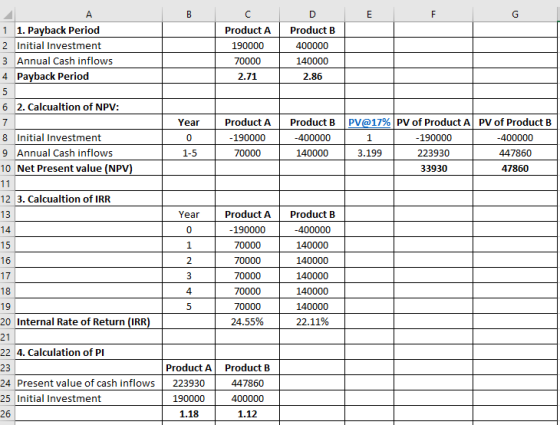
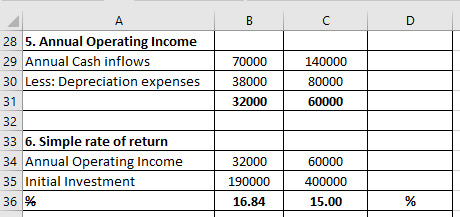
Calculated as:
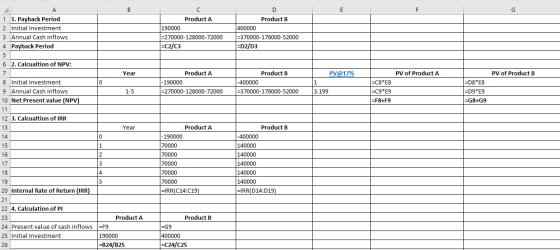
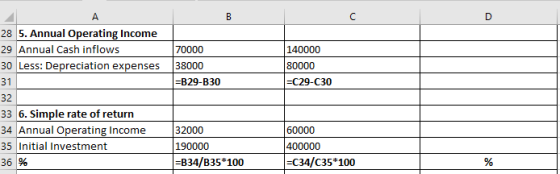
6a.
Solution 6a:
| Product Preference | |
| Payback Period | Product A |
| Net Present Value | Product B |
| IRR | Product A |
| Profitability index | Product A |
| Simple rate of return | Product A |
Solution 6b:
Based on simple rate of return, Lou Barlow would likely to reject both the products as its less than 19%.
Add Answer to:
Lou Barlow, a divisional manager for Sage Company, has an
opportunity to manufacture and sell one...
Lou Barlow, a divisional manager for Sage Company, has an opportunity to manufacture and sell one...
 Lou Barlow, a divisional manager for Sage Company, has an opportunity to manufacture and sell one of two new products for a five- year period. His annual pay raises are determined by his division's return on investment (ROI), which has exceeded 19% each of the last three years. He has computed the cost and revenue estimates for each product as follows: Product A Product B $ 190,000 $ 400,000 Initial investment: Cost of equipment (zero salvage value) Annual revenues and...
Lou Barlow, a divisional manager for Sage Company, has an opportunity to manufacture and sell one...
Lou Barlow, a divisional manager for Sage Company, has an opportunity to manufacture and sell one of two new products for a five-year period. His annual pay raises are determined by his division’s return on investment (ROI), which has exceeded 23% each of the last three years. He has computed the cost and revenue estimates for each product as follows: Product A Product B Initial investment: Cost of equipment (zero salvage value) $ 290,000 $ 490,000 Annual revenues and costs:...
Lou Barlow, a divisional manager for Sage Company, has an opportunity to manufacture and sell one...
 Lou Barlow, a divisional manager for Sage Company, has an opportunity to manufacture and sell one of two new products for a five- year period. His annual pay raises are determined by his division's return on investment (ROI), which has exceeded 21% each of the last three years. He has computed the cost and revenue estimates for each product as follows: Product A Product B $270,000 $480,000 Initial investment: Cost of equipment (zero salvage value) Annual revenues and costs: Sales...
Lou Barlow, a divisional manager for Sage Company, has an opportunity to manufacture and sell one...
 Lou Barlow, a divisional manager for Sage Company, has an
opportunity to manufacture and sell one of two new products for a
five-year period. His annual pay raises are determined by his
division’s return on investment (ROI), which has exceeded 21% each
of the last three years. He has computed the cost and revenue
estimates for each product as follows:
The company’s discount rate is 19%.
1. Calculate the payback period for each product.
2. Calculate the net present value...
Lou Barlow, a divisional manager for Sage Company, has an
opportunity to manufacture and sell one of two new products for a
five-year period. His annual pay raises are determined by his
division’s return on investment (ROI), which has exceeded 21% each
of the last three years. He has computed the cost and revenue
estimates for each product as follows:
The company’s discount rate is 19%.
1. Calculate the payback period for each product.
2. Calculate the net present value...
Lou Barlow, a divisional manager for Sage Company, has an opportunity to manufacture and sell one...
 Lou Barlow, a divisional manager for Sage Company, has an opportunity to manufacture and sell one of two new products for a five- year period. His annual pay raises are determined by his division's return on investment (ROI), which has exceeded 19% each of the last three years. He has computed the cost and revenue estimates for each product as follows: Product A Product B $190,000 $400,000 Initial investment: Cost of equipment (zero salvage value) Annual revenues and costs: Sales...
Lou Barlow, a divisional manager for Sage Company, has an opportunity to manufacture and sell one...
Lou Barlow, a divisional manager for Sage Company, has an opportunity to manufacture and sell one of two new products for a five-year period. His annual pay raises are determined by his division’s return on investment (ROI), which has exceeded 22% each of the last three years. He has computed the cost and revenue estimates for each product as follows: Product A Product B Initial investment: Cost of equipment (zero salvage value) $ 340,000 $ 540,000 Annual revenues and costs:...
Lou Barlow, a divisional manager for Sage Company, has an opportunity to manufacture and sell one...
Lou Barlow, a divisional manager for Sage Company, has an opportunity to manufacture and sell one of two new products for a five-year period. His annual pay raises are determined by his division’s return on investment (ROI), which has exceeded 23% each of the last three years. He has computed the cost and revenue estimates for each product as follows: Product A Product B Initial investment: Cost of equipment (zero salvage value) $ 280,000 $ 480,000 Annual revenues and costs:...
Lou Barlow, a divisional manager for Sage Company, has an opportunity to manufacture and sell one...
Lou Barlow, a divisional manager for Sage Company, has an opportunity to manufacture and sell one of two new products for a five-year period. His annual pay raises are determined by his division’s return on investment (ROI), which has exceeded 20% each of the last three years. He has computed the cost and revenue estimates for each product as follows: Product A Product B Initial investment: Cost of equipment (zero salvage value) $ 250,000 $ 460,000 Annual revenues and costs:...
Lou Barlow, a divisional manager for Sage Company, has an opportunity to manufacture and sell one...
Lou Barlow, a divisional manager for Sage Company, has an opportunity to manufacture and sell one of two new products for a five-year period. His annual pay raises are determined by his division’s return on investment (ROI), which has exceeded 22% each of the last three years. He has computed the cost and revenue estimates for each product as follows: Product A Product B Initial investment: Cost of equipment (zero salvage value) $ 340,000 $ 540,000 Annual revenues and costs:...
Lou Barlow, a divisional manager for Sage Company, has an opportunity to manufacture and sell one...
Lou Barlow, a divisional manager for Sage Company, has an opportunity to manufacture and sell one of two new products for a five-year period. His annual pay raises are determined by his division’s return on investment (ROI), which has exceeded 25% each of the last three years. He has computed the cost and revenue estimates for each product as follows: Product A Product B Initial investment: Cost of equipment (zero salvage value) $ 340,000 $ 525,000 Annual revenues and costs:...
 Lou Barlow, a divisional manager for Sage Company, has an opportunity to manufacture and sell one of two new products for a five- year period. His annual pay raises are determined by his division's return on investment (ROI), which has exceeded 19% each of the last three years. He has computed the cost and revenue estimates for each product as follows: Product A Product B $ 190,000 $ 400,000 Initial investment: Cost of equipment (zero salvage value) Annual revenues and...
 Lou Barlow, a divisional manager for Sage Company, has an opportunity to manufacture and sell one of two new products for a five- year period. His annual pay raises are determined by his division's return on investment (ROI), which has exceeded 21% each of the last three years. He has computed the cost and revenue estimates for each product as follows: Product A Product B $270,000 $480,000 Initial investment: Cost of equipment (zero salvage value) Annual revenues and costs: Sales...
 Lou Barlow, a divisional manager for Sage Company, has an
opportunity to manufacture and sell one of two new products for a
five-year period. His annual pay raises are determined by his
division’s return on investment (ROI), which has exceeded 21% each
of the last three years. He has computed the cost and revenue
estimates for each product as follows:
The company’s discount rate is 19%.
1. Calculate the payback period for each product.
2. Calculate the net present value...
Lou Barlow, a divisional manager for Sage Company, has an
opportunity to manufacture and sell one of two new products for a
five-year period. His annual pay raises are determined by his
division’s return on investment (ROI), which has exceeded 21% each
of the last three years. He has computed the cost and revenue
estimates for each product as follows:
The company’s discount rate is 19%.
1. Calculate the payback period for each product.
2. Calculate the net present value...
 Lou Barlow, a divisional manager for Sage Company, has an opportunity to manufacture and sell one of two new products for a five- year period. His annual pay raises are determined by his division's return on investment (ROI), which has exceeded 19% each of the last three years. He has computed the cost and revenue estimates for each product as follows: Product A Product B $190,000 $400,000 Initial investment: Cost of equipment (zero salvage value) Annual revenues and costs: Sales...
Most questions answered within 3 hours.
-
Where is the error in this code sequence?
String s1 = "Hello";
String s2 = "ello";...
asked 11 months ago -
Financial data for Joel de Paris, Inc., for last year
follow:
Joel de Paris, Inc.
Balance...
asked 11 months ago -
Consider this reaction:
Al2(SO4)3 (aq)+ BaCl3
(aq) Al2Cl6 (aq)- +
3BaSO4(s) . What is the...
asked 11 months ago -
Suppose that Savneet is considering increasing her
recent random sample from 20 car rentals to 40...
asked 11 months ago -
Trucks arrive at an unloading terminal at an average rate of 120
per hour.
Trucks arrive...
asked 11 months ago -
Why are methanol and ethanol completely soluble in water while
octanol is not very little soluble....
asked 11 months ago -
A facilities manager at a university reads in a research report
that the mean amount of...
asked 11 months ago -
When the CuSO4 is rehydrated by adding water to the anhydrous
compound, is this an endothermic...
asked 11 months ago -
A ray of sunlight is passing from diamond into crown glass; the
angle of incidence is...
asked 11 months ago -
A block of mass 0.249 kg is placed on top of a light, vertical
spring of...
asked 11 months ago -
how do the kidneys compensate in the presences of acidosis
a) trigger hyperventilate
b) reserve acid...
asked 11 months ago -
Question 501 pts
The rental rate of capital to the firm increases. Which of the
following...
asked 11 months ago