Homework Answers

Add Answer to:
5. Based on this analysis, the compound might be or contain
the following substructure:
6. How...
7. What kind of carbons correspond to these chemical shifts? 8. Based on this analysis, the unknown might contain the f...
 7. What kind of carbons correspond to these chemical
shifts?
8. Based on this analysis, the unknown might contain the
following substructure:
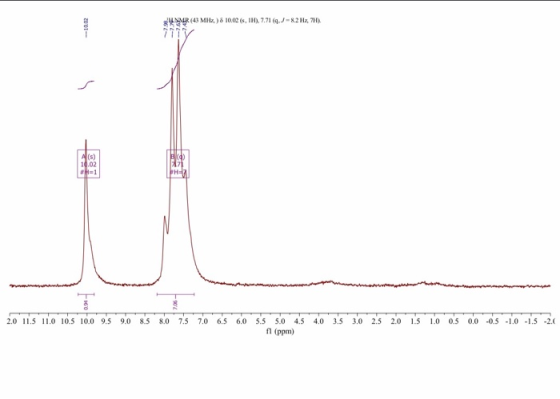
UN (43 MIL.) 10.02s, 1H), 7.716.J-2 Hz. ) 2.0 11.5 11.0 10.5 10.0 9.5 9.0 8.5 8.0 7.5 7.0 6.5 6.0 4.0 3.5 3.0 2.5 20 15 100.5 0.0 -0.5 -1.0 -1.5 -2. 5.5 5.0 4.5 fl (ppm)
7. What kind of carbons correspond to these chemical
shifts?
8. Based on this analysis, the unknown might contain the
following substructure:
UN (43 MIL.) 10.02s, 1H), 7.716.J-2 Hz. ) 2.0 11.5 11.0 10.5 10.0 9.5 9.0 8.5 8.0 7.5 7.0 6.5 6.0 4.0 3.5 3.0 2.5 20 15 100.5 0.0 -0.5 -1.0 -1.5 -2. 5.5 5.0 4.5 fl (ppm)
analyze this NMR & IR S23 CDC13 QE-300 240 UN (43 MIL.) 10.02s, 1H), 7.716.J-2 Hz....
 analyze this NMR & IR
S23 CDC13 QE-300 240 UN (43 MIL.) 10.02s, 1H), 7.716.J-2 Hz. ) 2.0 11.5 11.0 10.5 10.0 9.5 9.0 8.5 8.0 7.5 7.0 6.5 6.0 4.0 3.5 3.0 2.5 20 15 100.5 0.0 -0.5 -1.0 -1.5 -2. 5.5 5.0 4.5 fl (ppm)
analyze this NMR & IR
S23 CDC13 QE-300 240 UN (43 MIL.) 10.02s, 1H), 7.716.J-2 Hz. ) 2.0 11.5 11.0 10.5 10.0 9.5 9.0 8.5 8.0 7.5 7.0 6.5 6.0 4.0 3.5 3.0 2.5 20 15 100.5 0.0 -0.5 -1.0 -1.5 -2. 5.5 5.0 4.5 fl (ppm)
1. How many different types of protons appear to be present? What are the chemical shifts...
 1.
How many different types
of protons appear to be present? What are the chemical shifts for
these protons? What does this indicate (if anything) about the
electronic environment of the protons?
2.
What are the multiplicities for each peak?
UN (43 MIL.) 10.02s, 1H), 7.716.J-2 Hz. ) 2.0 11.5 11.0 10.5 10.0 9.5 9.0 8.5 8.0 7.5 7.0 6.5 6.0 4.0 3.5 3.0 2.5 20 15 100.5 0.0 -0.5 -1.0 -1.5 -2. 5.5 5.0 4.5 fl (ppm)
1.
How many different types
of protons appear to be present? What are the chemical shifts for
these protons? What does this indicate (if anything) about the
electronic environment of the protons?
2.
What are the multiplicities for each peak?
UN (43 MIL.) 10.02s, 1H), 7.716.J-2 Hz. ) 2.0 11.5 11.0 10.5 10.0 9.5 9.0 8.5 8.0 7.5 7.0 6.5 6.0 4.0 3.5 3.0 2.5 20 15 100.5 0.0 -0.5 -1.0 -1.5 -2. 5.5 5.0 4.5 fl (ppm)
3. Based on the integration of the peaks, what is the relative number of protons which...
 3. Based on the integration of the peaks, what is the relative
number of protons which make up each signal?
4. Identify any common splitting patterns. (ie. Isopropyl,
ethyl, etc)
UN (43 MIL.) 10.02s, 1H), 7.716.J-2 Hz. ) 2.0 11.5 11.0 10.5 10.0 9.5 9.0 8.5 8.0 7.5 7.0 6.5 6.0 4.0 3.5 3.0 2.5 20 15 100.5 0.0 -0.5 -1.0 -1.5 -2. 5.5 5.0 4.5 fl (ppm)
3. Based on the integration of the peaks, what is the relative
number of protons which make up each signal?
4. Identify any common splitting patterns. (ie. Isopropyl,
ethyl, etc)
UN (43 MIL.) 10.02s, 1H), 7.716.J-2 Hz. ) 2.0 11.5 11.0 10.5 10.0 9.5 9.0 8.5 8.0 7.5 7.0 6.5 6.0 4.0 3.5 3.0 2.5 20 15 100.5 0.0 -0.5 -1.0 -1.5 -2. 5.5 5.0 4.5 fl (ppm)
Fill out the tables below of the starting material and pure product by using the given...
 Fill out the tables below of the starting material and pure
product by using the given NMR spectrums. Identify if the pure
isomer of methyl nitrobenzoate as ortho, meta, or para.
Complete the table below using your proton NMR spectrum of your starting material. Be sure to include all peaks. Note: The table is expandable. Use the structure below for the letter assignments in your table. Splitting Integration Assignment Peak (ppm) Other Notes -7.95 -7.92 0627 -787 785 7.30 751...
Fill out the tables below of the starting material and pure
product by using the given NMR spectrums. Identify if the pure
isomer of methyl nitrobenzoate as ortho, meta, or para.
Complete the table below using your proton NMR spectrum of your starting material. Be sure to include all peaks. Note: The table is expandable. Use the structure below for the letter assignments in your table. Splitting Integration Assignment Peak (ppm) Other Notes -7.95 -7.92 0627 -787 785 7.30 751...
Analyze the peaks in this NMR spectrum of p-nitrophenol assigning the peaks, discuss multiplicity, splitting, shielding/deshielding...
 Analyze the peaks in this NMR spectrum of p-nitrophenol
assigning the peaks, discuss multiplicity, splitting,
shielding/deshielding effects, and integration.
I have assigned the peaks but i am not sure if i have done it
correctly. Is there expected to a peak for the -OH? or is there not
a peak because the proton is exchangeable? is there complex or
normal splitting observed?
901 C 18 1.00 19 -429 -7.5 7030 P-nitrophenol OH H NMR, nitrophenol in CDCl un A 7...
Analyze the peaks in this NMR spectrum of p-nitrophenol
assigning the peaks, discuss multiplicity, splitting,
shielding/deshielding effects, and integration.
I have assigned the peaks but i am not sure if i have done it
correctly. Is there expected to a peak for the -OH? or is there not
a peak because the proton is exchangeable? is there complex or
normal splitting observed?
901 C 18 1.00 19 -429 -7.5 7030 P-nitrophenol OH H NMR, nitrophenol in CDCl un A 7...
A variety of spectra for an organic compound with molecular formula C10H16O are presented below. The experimental accurate mass using (+) APCI source is 153.1280 u. The 1H, 13C, COSY, HSQC and HMBC NM...
 A variety of spectra for an organic compound with molecular
formula C10H16O are presented below. The
experimental accurate mass using (+) APCI source is 153.1280 u. The
1H, 13C, COSY, HSQC and HMBC NMR spectra are given in the following
slides. Propose a structure for this unknown and answer or address
the following questions or requirements:
d. If there are still any questionable assignments, propose
additional NMR experiments which would solve those questions and
briefly explain specifically what correlations you...
A variety of spectra for an organic compound with molecular
formula C10H16O are presented below. The
experimental accurate mass using (+) APCI source is 153.1280 u. The
1H, 13C, COSY, HSQC and HMBC NMR spectra are given in the following
slides. Propose a structure for this unknown and answer or address
the following questions or requirements:
d. If there are still any questionable assignments, propose
additional NMR experiments which would solve those questions and
briefly explain specifically what correlations you...
How would you analyze the peaks for a 1H NMR of Bromovanillyl Alcohol and an IR...
 How would you analyze the peaks for a 1H NMR of
Bromovanillyl Alcohol and an IR spectra of Bromovanillyl
Alcohol?
IR Peaks
NMR Peaks
%Transmittance 3446.63 3121.86 8 3004.87 2925.69 2877.64 8 1611.72" 1588.93 1499.44 1420.46 1398.31 1371.05 05 1277.51 1200.01 1179.94 1143.10 8 1047.61 1010.21 948.66 852.87 836.91 823.94 780.44 719.71 H NMR (400 mHz, CDCls) Br 6.86 s) 92 7.09 5.90 4.60 1.64 CDCls H20 12.5 12.0 11.5 11.0 10.5 10.0 9.5 9.0 8.5 8.0 7.5 7.0 6.5...
How would you analyze the peaks for a 1H NMR of
Bromovanillyl Alcohol and an IR spectra of Bromovanillyl
Alcohol?
IR Peaks
NMR Peaks
%Transmittance 3446.63 3121.86 8 3004.87 2925.69 2877.64 8 1611.72" 1588.93 1499.44 1420.46 1398.31 1371.05 05 1277.51 1200.01 1179.94 1143.10 8 1047.61 1010.21 948.66 852.87 836.91 823.94 780.44 719.71 H NMR (400 mHz, CDCls) Br 6.86 s) 92 7.09 5.90 4.60 1.64 CDCls H20 12.5 12.0 11.5 11.0 10.5 10.0 9.5 9.0 8.5 8.0 7.5 7.0 6.5...
A variety of spectra for an organic compound with molecular formula C10H16O are presented below. The experimental accurate mass using (+) APCI source is 153.1280 u. The 1H, 13C, COSY, HSQC and HMBC NM...
 A variety of spectra for an organic compound with molecular
formula C10H16O are presented below. The
experimental accurate mass using (+) APCI source is 153.1280 u. The
1H, 13C, COSY, HSQC and HMBC NMR spectra are given in the following
slides. Propose a structure for this unknown and answer or address
the following questions or requirements:
a. Using the most abundant isotopes of C, H and O, what are the
errors in ppm and milli-Daltons for the experimental accurate
mass?...
A variety of spectra for an organic compound with molecular
formula C10H16O are presented below. The
experimental accurate mass using (+) APCI source is 153.1280 u. The
1H, 13C, COSY, HSQC and HMBC NMR spectra are given in the following
slides. Propose a structure for this unknown and answer or address
the following questions or requirements:
a. Using the most abundant isotopes of C, H and O, what are the
errors in ppm and milli-Daltons for the experimental accurate
mass?...
V. Draw the structures of Compound 23A (6 pts), Compound 23B (6 pts) and clearly indicate...
 V. Draw the structures of Compound 23A (6 pts), Compound 23B (6 pts) and clearly indicate your assignments of all proton resonances using the lower case letter associated with the signal (6 pts). Calculate the Unsaturation Index of each compound (2 pts) (20 points total) 1.24 3.0 1.26 2.5 e = 1.25 ppm doublet, 6H 2.0 a = 10.0 ppm 1.5 Compound 23a: C10H420 singlet, 1H 10.00 7.83 7.85 7.09 7.07 1.0 Unsat. Index = (2C+2-H-X+N)/2 = X=number of halogens...
 7. What kind of carbons correspond to these chemical
shifts?
8. Based on this analysis, the unknown might contain the
following substructure:
UN (43 MIL.) 10.02s, 1H), 7.716.J-2 Hz. ) 2.0 11.5 11.0 10.5 10.0 9.5 9.0 8.5 8.0 7.5 7.0 6.5 6.0 4.0 3.5 3.0 2.5 20 15 100.5 0.0 -0.5 -1.0 -1.5 -2. 5.5 5.0 4.5 fl (ppm)
7. What kind of carbons correspond to these chemical
shifts?
8. Based on this analysis, the unknown might contain the
following substructure:
UN (43 MIL.) 10.02s, 1H), 7.716.J-2 Hz. ) 2.0 11.5 11.0 10.5 10.0 9.5 9.0 8.5 8.0 7.5 7.0 6.5 6.0 4.0 3.5 3.0 2.5 20 15 100.5 0.0 -0.5 -1.0 -1.5 -2. 5.5 5.0 4.5 fl (ppm)
 analyze this NMR & IR
S23 CDC13 QE-300 240 UN (43 MIL.) 10.02s, 1H), 7.716.J-2 Hz. ) 2.0 11.5 11.0 10.5 10.0 9.5 9.0 8.5 8.0 7.5 7.0 6.5 6.0 4.0 3.5 3.0 2.5 20 15 100.5 0.0 -0.5 -1.0 -1.5 -2. 5.5 5.0 4.5 fl (ppm)
analyze this NMR & IR
S23 CDC13 QE-300 240 UN (43 MIL.) 10.02s, 1H), 7.716.J-2 Hz. ) 2.0 11.5 11.0 10.5 10.0 9.5 9.0 8.5 8.0 7.5 7.0 6.5 6.0 4.0 3.5 3.0 2.5 20 15 100.5 0.0 -0.5 -1.0 -1.5 -2. 5.5 5.0 4.5 fl (ppm)
 1.
How many different types
of protons appear to be present? What are the chemical shifts for
these protons? What does this indicate (if anything) about the
electronic environment of the protons?
2.
What are the multiplicities for each peak?
UN (43 MIL.) 10.02s, 1H), 7.716.J-2 Hz. ) 2.0 11.5 11.0 10.5 10.0 9.5 9.0 8.5 8.0 7.5 7.0 6.5 6.0 4.0 3.5 3.0 2.5 20 15 100.5 0.0 -0.5 -1.0 -1.5 -2. 5.5 5.0 4.5 fl (ppm)
1.
How many different types
of protons appear to be present? What are the chemical shifts for
these protons? What does this indicate (if anything) about the
electronic environment of the protons?
2.
What are the multiplicities for each peak?
UN (43 MIL.) 10.02s, 1H), 7.716.J-2 Hz. ) 2.0 11.5 11.0 10.5 10.0 9.5 9.0 8.5 8.0 7.5 7.0 6.5 6.0 4.0 3.5 3.0 2.5 20 15 100.5 0.0 -0.5 -1.0 -1.5 -2. 5.5 5.0 4.5 fl (ppm)
 3. Based on the integration of the peaks, what is the relative
number of protons which make up each signal?
4. Identify any common splitting patterns. (ie. Isopropyl,
ethyl, etc)
UN (43 MIL.) 10.02s, 1H), 7.716.J-2 Hz. ) 2.0 11.5 11.0 10.5 10.0 9.5 9.0 8.5 8.0 7.5 7.0 6.5 6.0 4.0 3.5 3.0 2.5 20 15 100.5 0.0 -0.5 -1.0 -1.5 -2. 5.5 5.0 4.5 fl (ppm)
3. Based on the integration of the peaks, what is the relative
number of protons which make up each signal?
4. Identify any common splitting patterns. (ie. Isopropyl,
ethyl, etc)
UN (43 MIL.) 10.02s, 1H), 7.716.J-2 Hz. ) 2.0 11.5 11.0 10.5 10.0 9.5 9.0 8.5 8.0 7.5 7.0 6.5 6.0 4.0 3.5 3.0 2.5 20 15 100.5 0.0 -0.5 -1.0 -1.5 -2. 5.5 5.0 4.5 fl (ppm)
 Fill out the tables below of the starting material and pure
product by using the given NMR spectrums. Identify if the pure
isomer of methyl nitrobenzoate as ortho, meta, or para.
Complete the table below using your proton NMR spectrum of your starting material. Be sure to include all peaks. Note: The table is expandable. Use the structure below for the letter assignments in your table. Splitting Integration Assignment Peak (ppm) Other Notes -7.95 -7.92 0627 -787 785 7.30 751...
Fill out the tables below of the starting material and pure
product by using the given NMR spectrums. Identify if the pure
isomer of methyl nitrobenzoate as ortho, meta, or para.
Complete the table below using your proton NMR spectrum of your starting material. Be sure to include all peaks. Note: The table is expandable. Use the structure below for the letter assignments in your table. Splitting Integration Assignment Peak (ppm) Other Notes -7.95 -7.92 0627 -787 785 7.30 751...
 Analyze the peaks in this NMR spectrum of p-nitrophenol
assigning the peaks, discuss multiplicity, splitting,
shielding/deshielding effects, and integration.
I have assigned the peaks but i am not sure if i have done it
correctly. Is there expected to a peak for the -OH? or is there not
a peak because the proton is exchangeable? is there complex or
normal splitting observed?
901 C 18 1.00 19 -429 -7.5 7030 P-nitrophenol OH H NMR, nitrophenol in CDCl un A 7...
Analyze the peaks in this NMR spectrum of p-nitrophenol
assigning the peaks, discuss multiplicity, splitting,
shielding/deshielding effects, and integration.
I have assigned the peaks but i am not sure if i have done it
correctly. Is there expected to a peak for the -OH? or is there not
a peak because the proton is exchangeable? is there complex or
normal splitting observed?
901 C 18 1.00 19 -429 -7.5 7030 P-nitrophenol OH H NMR, nitrophenol in CDCl un A 7...
 A variety of spectra for an organic compound with molecular
formula C10H16O are presented below. The
experimental accurate mass using (+) APCI source is 153.1280 u. The
1H, 13C, COSY, HSQC and HMBC NMR spectra are given in the following
slides. Propose a structure for this unknown and answer or address
the following questions or requirements:
d. If there are still any questionable assignments, propose
additional NMR experiments which would solve those questions and
briefly explain specifically what correlations you...
A variety of spectra for an organic compound with molecular
formula C10H16O are presented below. The
experimental accurate mass using (+) APCI source is 153.1280 u. The
1H, 13C, COSY, HSQC and HMBC NMR spectra are given in the following
slides. Propose a structure for this unknown and answer or address
the following questions or requirements:
d. If there are still any questionable assignments, propose
additional NMR experiments which would solve those questions and
briefly explain specifically what correlations you...
 How would you analyze the peaks for a 1H NMR of
Bromovanillyl Alcohol and an IR spectra of Bromovanillyl
Alcohol?
IR Peaks
NMR Peaks
%Transmittance 3446.63 3121.86 8 3004.87 2925.69 2877.64 8 1611.72" 1588.93 1499.44 1420.46 1398.31 1371.05 05 1277.51 1200.01 1179.94 1143.10 8 1047.61 1010.21 948.66 852.87 836.91 823.94 780.44 719.71 H NMR (400 mHz, CDCls) Br 6.86 s) 92 7.09 5.90 4.60 1.64 CDCls H20 12.5 12.0 11.5 11.0 10.5 10.0 9.5 9.0 8.5 8.0 7.5 7.0 6.5...
How would you analyze the peaks for a 1H NMR of
Bromovanillyl Alcohol and an IR spectra of Bromovanillyl
Alcohol?
IR Peaks
NMR Peaks
%Transmittance 3446.63 3121.86 8 3004.87 2925.69 2877.64 8 1611.72" 1588.93 1499.44 1420.46 1398.31 1371.05 05 1277.51 1200.01 1179.94 1143.10 8 1047.61 1010.21 948.66 852.87 836.91 823.94 780.44 719.71 H NMR (400 mHz, CDCls) Br 6.86 s) 92 7.09 5.90 4.60 1.64 CDCls H20 12.5 12.0 11.5 11.0 10.5 10.0 9.5 9.0 8.5 8.0 7.5 7.0 6.5...
 A variety of spectra for an organic compound with molecular
formula C10H16O are presented below. The
experimental accurate mass using (+) APCI source is 153.1280 u. The
1H, 13C, COSY, HSQC and HMBC NMR spectra are given in the following
slides. Propose a structure for this unknown and answer or address
the following questions or requirements:
a. Using the most abundant isotopes of C, H and O, what are the
errors in ppm and milli-Daltons for the experimental accurate
mass?...
A variety of spectra for an organic compound with molecular
formula C10H16O are presented below. The
experimental accurate mass using (+) APCI source is 153.1280 u. The
1H, 13C, COSY, HSQC and HMBC NMR spectra are given in the following
slides. Propose a structure for this unknown and answer or address
the following questions or requirements:
a. Using the most abundant isotopes of C, H and O, what are the
errors in ppm and milli-Daltons for the experimental accurate
mass?...
 V. Draw the structures of Compound 23A (6 pts), Compound 23B (6 pts) and clearly indicate your assignments of all proton resonances using the lower case letter associated with the signal (6 pts). Calculate the Unsaturation Index of each compound (2 pts) (20 points total) 1.24 3.0 1.26 2.5 e = 1.25 ppm doublet, 6H 2.0 a = 10.0 ppm 1.5 Compound 23a: C10H420 singlet, 1H 10.00 7.83 7.85 7.09 7.07 1.0 Unsat. Index = (2C+2-H-X+N)/2 = X=number of halogens...
Most questions answered within 3 hours.
-
Where is the error in this code sequence?
String s1 = "Hello";
String s2 = "ello";...
asked 10 months ago -
Financial data for Joel de Paris, Inc., for last year
follow:
Joel de Paris, Inc.
Balance...
asked 10 months ago -
Consider this reaction:
Al2(SO4)3 (aq)+ BaCl3
(aq) Al2Cl6 (aq)- +
3BaSO4(s) . What is the...
asked 10 months ago -
Suppose that Savneet is considering increasing her
recent random sample from 20 car rentals to 40...
asked 10 months ago -
Trucks arrive at an unloading terminal at an average rate of 120
per hour.
Trucks arrive...
asked 10 months ago -
Why are methanol and ethanol completely soluble in water while
octanol is not very little soluble....
asked 10 months ago -
A facilities manager at a university reads in a research report
that the mean amount of...
asked 10 months ago -
When the CuSO4 is rehydrated by adding water to the anhydrous
compound, is this an endothermic...
asked 10 months ago -
A ray of sunlight is passing from diamond into crown glass; the
angle of incidence is...
asked 10 months ago -
A block of mass 0.249 kg is placed on top of a light, vertical
spring of...
asked 10 months ago -
how do the kidneys compensate in the presences of acidosis
a) trigger hyperventilate
b) reserve acid...
asked 10 months ago -
Question 501 pts
The rental rate of capital to the firm increases. Which of the
following...
asked 10 months ago