
Homework Answers
![Answer!- C Given that enuation is MO NO The Occupied given M੯ ! *222 Mata 2p 2P ATE TRY IT 2/2 02P 13] 18 m onths MOD NO W S](http://img.homeworklib.com/questions/18a94b90-74b4-11ea-ada5-81d2796ea824.png?x-oss-process=image/resize,w_560)
Add Answer to:
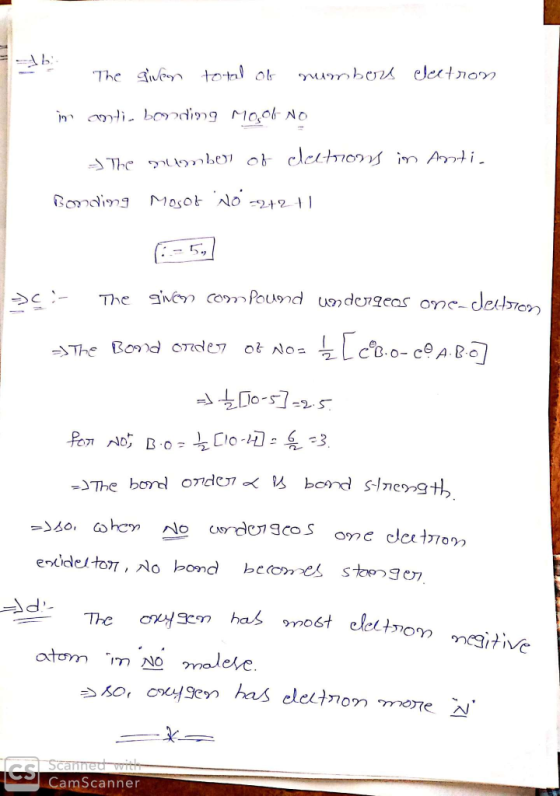
10. The MO diagrams of NO and NO+ are similar (see Lecture 15 for the MO...
3. Consider Heat and respond to the following. (a) Sketch the singly occupied MO of Hez*....
 3. Consider Heat and respond to the following. (a) Sketch the singly occupied MO of Hez*. He He (b) Decide whether Heation should have a t-MO. Explain. (c) What should happen to Hez upon one-electron reduction? Explain.
15. BFO is isoelectronic and isostructural with CO2 discussed in CH225 Lecture 17. On the basis...
 15. BFO is isoelectronic and isostructural with CO2 discussed in CH225 Lecture 17. On the basis of this consideration, respond to the following: (a) Sketch the two group orbitals involved in o-bonding in BFO. F во FB 0 (b) For one of the above group orbitals, sketch its bonding combination with a p orbital of boron. F в о (c) Sketch a T* MO of BFO. Е в о (d) Tell the numbers of valence electrons in the following molecules...
4. On the basis of molecular orbitals and molecular orbital diagrams, predict which molecule in each...
 4. On the basis of molecular orbitals and molecular orbital diagrams, predict which molecule in each series will have the longest bond. Be sure to provide a brief explanation a. B2, B2 b. 02*, 0,- c. HHe", Hz 5. Consider the hydroxide ion, OH and do the following: a. Prepare a molecular orbital diagram and fill with electrons given the following atomic orbital potential energies: O(2s) = -32.3 eV, O(2p) = -15.8 eV, H(s) -13.6 eV. Be sure to label...
 3. Consider Heat and respond to the following. (a) Sketch the singly occupied MO of Hez*. He He (b) Decide whether Heation should have a t-MO. Explain. (c) What should happen to Hez upon one-electron reduction? Explain.
 15. BFO is isoelectronic and isostructural with CO2 discussed in CH225 Lecture 17. On the basis of this consideration, respond to the following: (a) Sketch the two group orbitals involved in o-bonding in BFO. F во FB 0 (b) For one of the above group orbitals, sketch its bonding combination with a p orbital of boron. F в о (c) Sketch a T* MO of BFO. Е в о (d) Tell the numbers of valence electrons in the following molecules...
 4. On the basis of molecular orbitals and molecular orbital diagrams, predict which molecule in each series will have the longest bond. Be sure to provide a brief explanation a. B2, B2 b. 02*, 0,- c. HHe", Hz 5. Consider the hydroxide ion, OH and do the following: a. Prepare a molecular orbital diagram and fill with electrons given the following atomic orbital potential energies: O(2s) = -32.3 eV, O(2p) = -15.8 eV, H(s) -13.6 eV. Be sure to label...
Most questions answered within 3 hours.
-
Where is the error in this code sequence?
String s1 = "Hello";
String s2 = "ello";...
asked 11 months ago -
Financial data for Joel de Paris, Inc., for last year
follow:
Joel de Paris, Inc.
Balance...
asked 11 months ago -
Consider this reaction:
Al2(SO4)3 (aq)+ BaCl3
(aq) Al2Cl6 (aq)- +
3BaSO4(s) . What is the...
asked 11 months ago -
Suppose that Savneet is considering increasing her
recent random sample from 20 car rentals to 40...
asked 11 months ago -
Trucks arrive at an unloading terminal at an average rate of 120
per hour.
Trucks arrive...
asked 11 months ago -
Why are methanol and ethanol completely soluble in water while
octanol is not very little soluble....
asked 11 months ago -
A facilities manager at a university reads in a research report
that the mean amount of...
asked 11 months ago -
When the CuSO4 is rehydrated by adding water to the anhydrous
compound, is this an endothermic...
asked 11 months ago -
A ray of sunlight is passing from diamond into crown glass; the
angle of incidence is...
asked 11 months ago -
A block of mass 0.249 kg is placed on top of a light, vertical
spring of...
asked 11 months ago -
how do the kidneys compensate in the presences of acidosis
a) trigger hyperventilate
b) reserve acid...
asked 11 months ago -
Question 501 pts
The rental rate of capital to the firm increases. Which of the
following...
asked 11 months ago