
Homework Answers
Add Answer to:
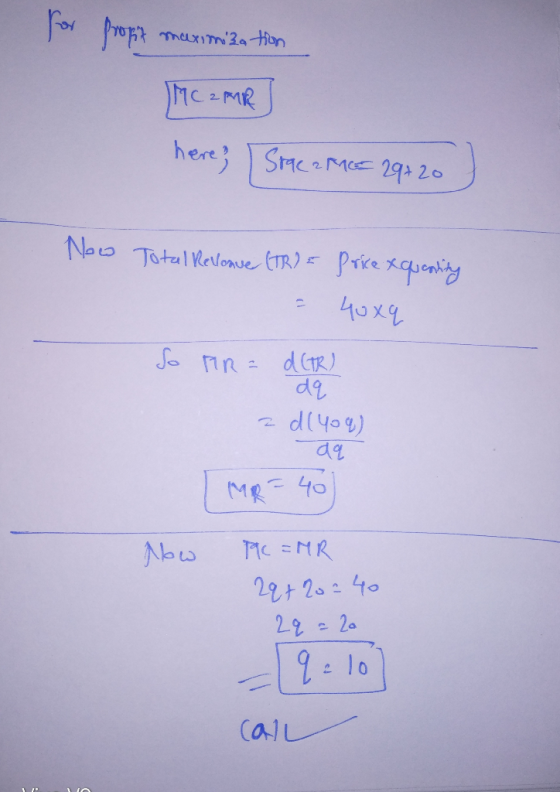
38. For a particular perfectly competitive firm STC = 100+ 20q+q? and SMC = 20+2q, where...
Draw a diagram below that shows the short run profit maximizing output for a competitive firm...
 Draw a diagram below that shows the short run profit maximizing output for a competitive firm at a market price of S10 producing an output of 20 that leads to a profit of $40. 4. 5. If SMC-20+2Q, AVC-1.5Q, P $100. a. Find Q b. This perfectly competitive firm will break-even if fixed cost equal how much?
20. Which of the following statements is not a characteristic of a perfectly competitive firm? a....
20. Which of the following statements is not a characteristic of a perfectly competitive firm? a. Perfectly competitive firms view each other as fierce rivals. b. Firms are price-takers. c. All firms produce a homogeneous product. d. Perfectly competitive markets allow freedom of entry and exit. 21. Since the firm’s demand curve is perfectly elastic for a price-taking firm, a. P = MR. b. P = MRP. c. P = TR. d. both a and b. e. both a and...
STC = 40 + 10Q + 0.1Q^2 . SMC = 10 + 0.2Q. The market price...
STC = 40 + 10Q + 0.1Q^2 . SMC = 10 + 0.2Q. The market price is $20. a. Find the profit maximizing Q. b. Calculate the maximum profit. c. Find the average variable cost. d. In the short run, at what price will this firm close? e. Find the firm’s short run supply curve and express it as a function of price: Qs (P) = ?
Ron's Window Washing Service is a small business that operates in the perfectly competitive residential window...
 Ron's Window Washing Service is a small business that operates in the perfectly competitive residential window washing industry in Evanston, Illinois. The short-run total cost of production is STC(Q) = 40+ 100 + 0.1Q?, where Q is the number of windows washed per day. The corresponding short-run marginal cost function is SMC(q) = 10 + 0.29. The prevailing market price is $20 per window. a) How many windows should Ron wash to maximize profit? b) What is Ron's maximum daily...
1. Suppose that a firm operating in perfectly competitive industry has short-run cost function given by...
 1. Suppose that a firm operating in perfectly competitive industry has short-run cost function given by C(q) = 5+2q+9. The market price is $10. (a) What is the profit-maximizing output level for this firm? (b) What is the firm's total revenue and profits at the profit-maximizing output? (c) What is the minimum price at which the firm will produce a positive level of output in the short run?
Short-run Equilibrium: Bumper sticker firms produce bumper stickers in a perfectly competitive market. Each identical firm...
 Short-run Equilibrium: Bumper sticker firms produce bumper stickers in a perfectly competitive market. Each identical firm has a short-run total cost function equal to: STC (Q) = 3 + 2q + 2Q2. Suppose that there are 100 firms, and the market demand is D(P) = 100 - 5P where D(P) is the quantity consumed in the market when the market price is P. 1. What is the short-run equilibrium price? 2. How much does each firm produce? 3. Are they...
1. For a perfectly competitive firm, long-run average cost is: LAC = 300 - 20Q +...
1. For a perfectly competitive firm, long-run average cost is: LAC = 300 - 20Q + 1.8Q2, where Q denotes the firm’s output. The firm’s long-run profit-maximizing price is _____. 2. Demand for a good is given by: QD = 50 – 2P and supply by QS = 1P – 10, where P is the market price of the good. In equilibrium, price would be ___. 3. Demand for a good is given by: QD = 50 – 2P and...
Suppose that a particular firm is in a perfectly competitive constant-cost industry. When it is using...
Suppose that a particular firm is in a perfectly competitive constant-cost industry. When it is using the optimal amount of capital for the long-run, total cost is C(q)=1000+(q2/10), ATC(q)=(1000/q)+q/10, and marginal cost is MC(q)=2q/10. This implies that ATC=MC at a quantity of 100 and a per unit cost of $20. 1. At what quantity is average total cost minimized? 2. What is the long-run competitive equilibrium price? 3. If market demand is QD=12,000-200P and short-run market supply is QS=300P, what...
13. If Firm A operates in a perfectly competitive industry, with market price = $1,200/unit. If...
13. If Firm A operates in a perfectly competitive industry, with market price = $1,200/unit. If Firm A’s total cost function is given by TC(q)= 20q^2+ 80q + 200, find Firm A’s profit maximizing level of output. 14. Using the information from the above question: is the market in which Firm A is selling its output currently in long run equilibrium?
Question 27 A perfectly competitive industry is composed of 100 firms. Each firm has an identical...
 Question 27 A perfectly competitive industry is composed of 100 firms. Each firm has an identical short-run marginal cost function SMC = 5+10q (where q is the firm's level of output). If Q denotes industry output, what is the short-run market supply curve for output? a) Q = -50 + 10p if p > 5 and 0 if p 5 5 α Q = -5 + TOP p if p > 5 and 0 if p < 5 + α...
 Draw a diagram below that shows the short run profit maximizing output for a competitive firm at a market price of S10 producing an output of 20 that leads to a profit of $40. 4. 5. If SMC-20+2Q, AVC-1.5Q, P $100. a. Find Q b. This perfectly competitive firm will break-even if fixed cost equal how much?
 Ron's Window Washing Service is a small business that operates in the perfectly competitive residential window washing industry in Evanston, Illinois. The short-run total cost of production is STC(Q) = 40+ 100 + 0.1Q?, where Q is the number of windows washed per day. The corresponding short-run marginal cost function is SMC(q) = 10 + 0.29. The prevailing market price is $20 per window. a) How many windows should Ron wash to maximize profit? b) What is Ron's maximum daily...
 1. Suppose that a firm operating in perfectly competitive industry has short-run cost function given by C(q) = 5+2q+9. The market price is $10. (a) What is the profit-maximizing output level for this firm? (b) What is the firm's total revenue and profits at the profit-maximizing output? (c) What is the minimum price at which the firm will produce a positive level of output in the short run?
 Short-run Equilibrium: Bumper sticker firms produce bumper stickers in a perfectly competitive market. Each identical firm has a short-run total cost function equal to: STC (Q) = 3 + 2q + 2Q2. Suppose that there are 100 firms, and the market demand is D(P) = 100 - 5P where D(P) is the quantity consumed in the market when the market price is P. 1. What is the short-run equilibrium price? 2. How much does each firm produce? 3. Are they...
 Question 27 A perfectly competitive industry is composed of 100 firms. Each firm has an identical short-run marginal cost function SMC = 5+10q (where q is the firm's level of output). If Q denotes industry output, what is the short-run market supply curve for output? a) Q = -50 + 10p if p > 5 and 0 if p 5 5 α Q = -5 + TOP p if p > 5 and 0 if p < 5 + α...
Most questions answered within 3 hours.
-
Where is the error in this code sequence?
String s1 = "Hello";
String s2 = "ello";...
asked 10 months ago -
Financial data for Joel de Paris, Inc., for last year
follow:
Joel de Paris, Inc.
Balance...
asked 10 months ago -
Consider this reaction:
Al2(SO4)3 (aq)+ BaCl3
(aq) Al2Cl6 (aq)- +
3BaSO4(s) . What is the...
asked 10 months ago -
Suppose that Savneet is considering increasing her
recent random sample from 20 car rentals to 40...
asked 10 months ago -
Trucks arrive at an unloading terminal at an average rate of 120
per hour.
Trucks arrive...
asked 10 months ago -
Why are methanol and ethanol completely soluble in water while
octanol is not very little soluble....
asked 10 months ago -
A facilities manager at a university reads in a research report
that the mean amount of...
asked 10 months ago -
When the CuSO4 is rehydrated by adding water to the anhydrous
compound, is this an endothermic...
asked 10 months ago -
A ray of sunlight is passing from diamond into crown glass; the
angle of incidence is...
asked 10 months ago -
A block of mass 0.249 kg is placed on top of a light, vertical
spring of...
asked 10 months ago -
how do the kidneys compensate in the presences of acidosis
a) trigger hyperventilate
b) reserve acid...
asked 10 months ago -
Question 501 pts
The rental rate of capital to the firm increases. Which of the
following...
asked 10 months ago