Homework Answers
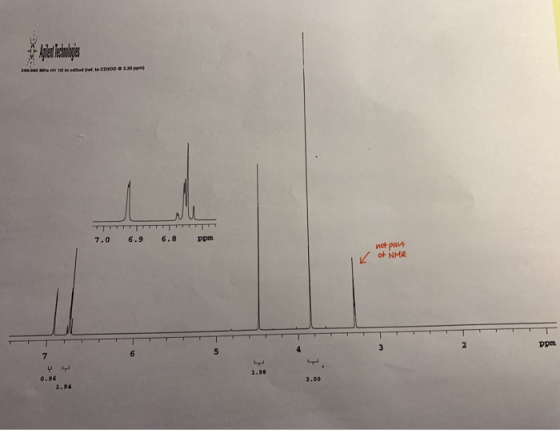
According to multiplicity (n+1) rule:
If the there is no hydrogen on the adjacent carbon then the multiplicity is 1, i.e. singlet, here n=0 therefore, n=0+1=1.
Peak (ppm)
multiplicity number of adjacent carbon
3.8 singlet 0
4.5 singlet 0
6.7 triplet 2
6.9 doublet 1
From 6.7 and 6.9, it could be 1,2 disubstituted benzene.
Add Answer to:
assign multiplicity and adjacent hydrogens associated with
peak on nmr spectrum
7.0 6.9 6.8 ppm k...
analyze the NMR spectrum assign the peaks to the corresponding structure of vanillyl alcohol 399.980 Mr HI 10 i...
 analyze the NMR spectrum
assign the peaks to the corresponding structure of vanillyl alcohol
399.980 Mr HI 10 in ed3ed (ret, to CD3OD e 330 ppm) 7.0 6.9 6.8 Ppm not pavt ot NMR 7 6 3 Ppm 1.98 0.96 3.00 1.94 Но НО Vanillyl Alcohol
analyze the NMR spectrum
assign the peaks to the corresponding structure of vanillyl alcohol
399.980 Mr HI 10 in ed3ed (ret, to CD3OD e 330 ppm) 7.0 6.9 6.8 Ppm not pavt ot NMR 7 6 3 Ppm 1.98 0.96 3.00 1.94 Но НО Vanillyl Alcohol
Assign proton signals in spectrum to hydrogens in the molecular structure and predict the multiplicity of...
 Assign proton signals in spectrum to hydrogens in the molecular
structure and predict the multiplicity of the signals.
Assign proton signals in spectrum to hydrogens in the molecular structure Predict multiplicity of the signal:s 9 8 7 6 5 4 3 2 0 1-02-117 ppm
Assign proton signals in spectrum to hydrogens in the molecular
structure and predict the multiplicity of the signals.
Assign proton signals in spectrum to hydrogens in the molecular structure Predict multiplicity of the signal:s 9 8 7 6 5 4 3 2 0 1-02-117 ppm
6. Assign hydrogens on the structure to each of the NMR peaks by writing the ppm...
 6. Assign hydrogens on the structure to each of the NMR peaks by writing the ppm value at which each hydrogen appears Не Hi: H7: Н,о. Hа Н: Hi:. На: Ha на Hs: Hs н 7. Draw the other possible structure that could have formed, and explain what drives this reaction forward. How would the NMR spectrum change for this isomeric compound (Be specific)?
Draw a H NMR spectrum for each compound. Pay attention to the chemical shift (ppm) multiplicity,...
 Draw a H NMR spectrum for each compound. Pay attention to the chemical shift (ppm) multiplicity, and integration of each peak. The boxes indicate where the peaks should go (which ppm range) as well as the relative height of each peak OH PPM O 3 PPM -2. H 10 8 PPM
assign each peak H-NMR spectrum of styrene oxide Spectral Data H NMR spectrum (400MHZ, CDCi) ciicici...
 assign each peak H-NMR spectrum of styrene oxide
Spectral Data H NMR spectrum (400MHZ, CDCi) ciicici 7.4 7.3 7.2 3.8 3.6 3.4 3,0 2.8 4.0 10 0.9 5.0 10 Ppm 7
assign each peak H-NMR spectrum of styrene oxide
Spectral Data H NMR spectrum (400MHZ, CDCi) ciicici 7.4 7.3 7.2 3.8 3.6 3.4 3,0 2.8 4.0 10 0.9 5.0 10 Ppm 7
Given the Cosey, HSQC and HMBC experiments assign the 1H NMR spectrum and 13C NMR spectrum...
 Given the Cosey, HSQC and HMBC experiments assign the
1H NMR spectrum and 13C NMR spectrum signals
of the compound. 1H peaks are labelled using lowercase
letters and 13C peaks using uppercase. Be aware that the
letters of the same peak does not necessarily refer to the position
in the molecule. For example, peak a in the 1H and peak
A in the 13C NMR are not necessarily assigned to the
same number atom. The assignment of protons 4 and...
Given the Cosey, HSQC and HMBC experiments assign the
1H NMR spectrum and 13C NMR spectrum signals
of the compound. 1H peaks are labelled using lowercase
letters and 13C peaks using uppercase. Be aware that the
letters of the same peak does not necessarily refer to the position
in the molecule. For example, peak a in the 1H and peak
A in the 13C NMR are not necessarily assigned to the
same number atom. The assignment of protons 4 and...
predict the IR spectrum and HNMR of 2-bromocyclohexanone peaks in the NMR spectrum and record the...
 predict the IR spectrum and HNMR of 2-bromocyclohexanone
peaks in the NMR spectrum and record the chemical shift, the splitting, an peak in the NMR table below. 1H NMR Data Peak Chemical Shift (6) Multiplicity н Peak Structure: 1 1 5 Br 6 N 3 7 4 8 + Specify the number of hydrogens associated with each peak. 11. Draw the major organic product for each of the following reactions. a. o
predict the IR spectrum and HNMR of 2-bromocyclohexanone
peaks in the NMR spectrum and record the chemical shift, the splitting, an peak in the NMR table below. 1H NMR Data Peak Chemical Shift (6) Multiplicity н Peak Structure: 1 1 5 Br 6 N 3 7 4 8 + Specify the number of hydrogens associated with each peak. 11. Draw the major organic product for each of the following reactions. a. o
Analyze the peaks in this NMR spectrum of p-nitrophenol assigning the peaks, discuss multiplicity, splitting, shielding/deshielding...
 Analyze the peaks in this NMR spectrum of p-nitrophenol
assigning the peaks, discuss multiplicity, splitting,
shielding/deshielding effects, and integration.
I have assigned the peaks but i am not sure if i have done it
correctly. Is there expected to a peak for the -OH? or is there not
a peak because the proton is exchangeable? is there complex or
normal splitting observed?
901 C 18 1.00 19 -429 -7.5 7030 P-nitrophenol OH H NMR, nitrophenol in CDCl un A 7...
Analyze the peaks in this NMR spectrum of p-nitrophenol
assigning the peaks, discuss multiplicity, splitting,
shielding/deshielding effects, and integration.
I have assigned the peaks but i am not sure if i have done it
correctly. Is there expected to a peak for the -OH? or is there not
a peak because the proton is exchangeable? is there complex or
normal splitting observed?
901 C 18 1.00 19 -429 -7.5 7030 P-nitrophenol OH H NMR, nitrophenol in CDCl un A 7...
the compound is dibenzalacetone -NMR (expansion 7.0-7.8 ppm (400 MHz) in CDC13 7.76 7.72 DO 7.07 Solvent peak (ig...
 the
compound is dibenzalacetone
-NMR (expansion 7.0-7.8 ppm (400 MHz) in CDC13 7.76 7.72 DO 7.07 Solvent peak (ignorel) 7.80 7.75 7.70 7.65 7.60 7.55 7.50 7.45 7.40 7.35 7.30 7.25 7.20 7.15 7.10 ppm 18 Peak List for 1H NMR (8 in ppm) TH NMR (draw labelled structure here) (10 marks) Multiplicity Chemical shift 8 (ppm, 4 decimal places) Coupling constant Integral J (Hz) Assignment indicate whether it is a singlet (s) doublet (a), triplet 3. quartet (allor dd...
the
compound is dibenzalacetone
-NMR (expansion 7.0-7.8 ppm (400 MHz) in CDC13 7.76 7.72 DO 7.07 Solvent peak (ignorel) 7.80 7.75 7.70 7.65 7.60 7.55 7.50 7.45 7.40 7.35 7.30 7.25 7.20 7.15 7.10 ppm 18 Peak List for 1H NMR (8 in ppm) TH NMR (draw labelled structure here) (10 marks) Multiplicity Chemical shift 8 (ppm, 4 decimal places) Coupling constant Integral J (Hz) Assignment indicate whether it is a singlet (s) doublet (a), triplet 3. quartet (allor dd...
Creat Ch 13 Spectroscopy map the hydrogens to the NMR spectrum of 1-propanol map the hydrogens...
 Creat Ch 13 Spectroscopy map the hydrogens to the NMR spectrum of 1-propanol map the hydrogens to the NMR spectrum of 1-propanol Part A 1-Propanol has the "H NMR spectrum showm below Map each hydrogen atom in the molecule of 1 propanol with iks comesponding peak number Hint Draw all hydrogen atoms 3 4 1 2 10 d (ppm) Draw the molecule on the canvas by choosing butons from the Tools (for bonds and charges). Atoms, and Templates toolbars, lIdentify...
 analyze the NMR spectrum
assign the peaks to the corresponding structure of vanillyl alcohol
399.980 Mr HI 10 in ed3ed (ret, to CD3OD e 330 ppm) 7.0 6.9 6.8 Ppm not pavt ot NMR 7 6 3 Ppm 1.98 0.96 3.00 1.94 Но НО Vanillyl Alcohol
analyze the NMR spectrum
assign the peaks to the corresponding structure of vanillyl alcohol
399.980 Mr HI 10 in ed3ed (ret, to CD3OD e 330 ppm) 7.0 6.9 6.8 Ppm not pavt ot NMR 7 6 3 Ppm 1.98 0.96 3.00 1.94 Но НО Vanillyl Alcohol
 Assign proton signals in spectrum to hydrogens in the molecular
structure and predict the multiplicity of the signals.
Assign proton signals in spectrum to hydrogens in the molecular structure Predict multiplicity of the signal:s 9 8 7 6 5 4 3 2 0 1-02-117 ppm
Assign proton signals in spectrum to hydrogens in the molecular
structure and predict the multiplicity of the signals.
Assign proton signals in spectrum to hydrogens in the molecular structure Predict multiplicity of the signal:s 9 8 7 6 5 4 3 2 0 1-02-117 ppm
 6. Assign hydrogens on the structure to each of the NMR peaks by writing the ppm value at which each hydrogen appears Не Hi: H7: Н,о. Hа Н: Hi:. На: Ha на Hs: Hs н 7. Draw the other possible structure that could have formed, and explain what drives this reaction forward. How would the NMR spectrum change for this isomeric compound (Be specific)?
 Draw a H NMR spectrum for each compound. Pay attention to the chemical shift (ppm) multiplicity, and integration of each peak. The boxes indicate where the peaks should go (which ppm range) as well as the relative height of each peak OH PPM O 3 PPM -2. H 10 8 PPM
 assign each peak H-NMR spectrum of styrene oxide
Spectral Data H NMR spectrum (400MHZ, CDCi) ciicici 7.4 7.3 7.2 3.8 3.6 3.4 3,0 2.8 4.0 10 0.9 5.0 10 Ppm 7
assign each peak H-NMR spectrum of styrene oxide
Spectral Data H NMR spectrum (400MHZ, CDCi) ciicici 7.4 7.3 7.2 3.8 3.6 3.4 3,0 2.8 4.0 10 0.9 5.0 10 Ppm 7
 Given the Cosey, HSQC and HMBC experiments assign the
1H NMR spectrum and 13C NMR spectrum signals
of the compound. 1H peaks are labelled using lowercase
letters and 13C peaks using uppercase. Be aware that the
letters of the same peak does not necessarily refer to the position
in the molecule. For example, peak a in the 1H and peak
A in the 13C NMR are not necessarily assigned to the
same number atom. The assignment of protons 4 and...
Given the Cosey, HSQC and HMBC experiments assign the
1H NMR spectrum and 13C NMR spectrum signals
of the compound. 1H peaks are labelled using lowercase
letters and 13C peaks using uppercase. Be aware that the
letters of the same peak does not necessarily refer to the position
in the molecule. For example, peak a in the 1H and peak
A in the 13C NMR are not necessarily assigned to the
same number atom. The assignment of protons 4 and...
 predict the IR spectrum and HNMR of 2-bromocyclohexanone
peaks in the NMR spectrum and record the chemical shift, the splitting, an peak in the NMR table below. 1H NMR Data Peak Chemical Shift (6) Multiplicity н Peak Structure: 1 1 5 Br 6 N 3 7 4 8 + Specify the number of hydrogens associated with each peak. 11. Draw the major organic product for each of the following reactions. a. o
predict the IR spectrum and HNMR of 2-bromocyclohexanone
peaks in the NMR spectrum and record the chemical shift, the splitting, an peak in the NMR table below. 1H NMR Data Peak Chemical Shift (6) Multiplicity н Peak Structure: 1 1 5 Br 6 N 3 7 4 8 + Specify the number of hydrogens associated with each peak. 11. Draw the major organic product for each of the following reactions. a. o
 Analyze the peaks in this NMR spectrum of p-nitrophenol
assigning the peaks, discuss multiplicity, splitting,
shielding/deshielding effects, and integration.
I have assigned the peaks but i am not sure if i have done it
correctly. Is there expected to a peak for the -OH? or is there not
a peak because the proton is exchangeable? is there complex or
normal splitting observed?
901 C 18 1.00 19 -429 -7.5 7030 P-nitrophenol OH H NMR, nitrophenol in CDCl un A 7...
Analyze the peaks in this NMR spectrum of p-nitrophenol
assigning the peaks, discuss multiplicity, splitting,
shielding/deshielding effects, and integration.
I have assigned the peaks but i am not sure if i have done it
correctly. Is there expected to a peak for the -OH? or is there not
a peak because the proton is exchangeable? is there complex or
normal splitting observed?
901 C 18 1.00 19 -429 -7.5 7030 P-nitrophenol OH H NMR, nitrophenol in CDCl un A 7...
 the
compound is dibenzalacetone
-NMR (expansion 7.0-7.8 ppm (400 MHz) in CDC13 7.76 7.72 DO 7.07 Solvent peak (ignorel) 7.80 7.75 7.70 7.65 7.60 7.55 7.50 7.45 7.40 7.35 7.30 7.25 7.20 7.15 7.10 ppm 18 Peak List for 1H NMR (8 in ppm) TH NMR (draw labelled structure here) (10 marks) Multiplicity Chemical shift 8 (ppm, 4 decimal places) Coupling constant Integral J (Hz) Assignment indicate whether it is a singlet (s) doublet (a), triplet 3. quartet (allor dd...
the
compound is dibenzalacetone
-NMR (expansion 7.0-7.8 ppm (400 MHz) in CDC13 7.76 7.72 DO 7.07 Solvent peak (ignorel) 7.80 7.75 7.70 7.65 7.60 7.55 7.50 7.45 7.40 7.35 7.30 7.25 7.20 7.15 7.10 ppm 18 Peak List for 1H NMR (8 in ppm) TH NMR (draw labelled structure here) (10 marks) Multiplicity Chemical shift 8 (ppm, 4 decimal places) Coupling constant Integral J (Hz) Assignment indicate whether it is a singlet (s) doublet (a), triplet 3. quartet (allor dd...
 Creat Ch 13 Spectroscopy map the hydrogens to the NMR spectrum of 1-propanol map the hydrogens to the NMR spectrum of 1-propanol Part A 1-Propanol has the "H NMR spectrum showm below Map each hydrogen atom in the molecule of 1 propanol with iks comesponding peak number Hint Draw all hydrogen atoms 3 4 1 2 10 d (ppm) Draw the molecule on the canvas by choosing butons from the Tools (for bonds and charges). Atoms, and Templates toolbars, lIdentify...
Most questions answered within 3 hours.
-
Where is the error in this code sequence?
String s1 = "Hello";
String s2 = "ello";...
asked 10 months ago -
Financial data for Joel de Paris, Inc., for last year
follow:
Joel de Paris, Inc.
Balance...
asked 10 months ago -
Consider this reaction:
Al2(SO4)3 (aq)+ BaCl3
(aq) Al2Cl6 (aq)- +
3BaSO4(s) . What is the...
asked 10 months ago -
Suppose that Savneet is considering increasing her
recent random sample from 20 car rentals to 40...
asked 10 months ago -
Trucks arrive at an unloading terminal at an average rate of 120
per hour.
Trucks arrive...
asked 10 months ago -
Why are methanol and ethanol completely soluble in water while
octanol is not very little soluble....
asked 10 months ago -
A facilities manager at a university reads in a research report
that the mean amount of...
asked 10 months ago -
When the CuSO4 is rehydrated by adding water to the anhydrous
compound, is this an endothermic...
asked 10 months ago -
A ray of sunlight is passing from diamond into crown glass; the
angle of incidence is...
asked 10 months ago -
A block of mass 0.249 kg is placed on top of a light, vertical
spring of...
asked 10 months ago -
how do the kidneys compensate in the presences of acidosis
a) trigger hyperventilate
b) reserve acid...
asked 10 months ago -
Question 501 pts
The rental rate of capital to the firm increases. Which of the
following...
asked 10 months ago