
Homework Answers
A). Expected return of portfolio (MOR) = 14.5%
Expected return of ABC =7.5%
Let Expected return of XTP = x
14.5% = 7.5% *30%+ x * 70
By solving x, we get value x= 3%(Approx)
B)
Correlation Rxy = Sxy / SxSy
By putting figures , we get correlation = 5.374
Add Answer to:
Suppose there are 2 funds ABC and XTP. ABC has an expected return of 7.5%. Portfolio...
(a) Suppose there are 2 assets A1 and Plan B. A1 has an expected return of...
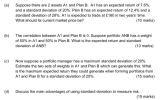 (a) Suppose there are 2 assets A1 and Plan B. A1 has an expected return of 7.6% and a standard deviation of 20%. Plan B has an expected return of 12.4% and a standard deviation of 28%. Al is expected to trade at £180 in two years' time. What should its current market price be? (10 marks) The correlation between A1 and Plan B is 0. Suppose portfolio ANB has a weight of 50% in A1 and 50% in Plan...
Show work in excel please An investor can design a risky portfolio based on two stocks,...
Show work in excel please An investor can design a risky portfolio based on two stocks, A and B. Stock A has an expected return of 19% and a standard deviation of return of 15.0%. Stock B has an expected return of 15% and a standard deviation of return of 6%. The correlation coefficient between the returns of A and B is 0.80. The risk-free rate of return is 11%. The proportion of the optimal risky portfolio that should be...
3. You have a risky portfolio that yields an expected rate of return of 15% with...
3. You have a risky portfolio that yields an expected rate of return of 15% with a standard deviation of 25%. Draw the CAL for an expected return/standard deviation diagram if the risk free rate is 5%. a. What is the slope of the CAL? b. If your coefficient of risk aversion is 5, how much should you invest in the risky portfolio? 4. A pension fund manager is considering three mutual funds. The first is a stock fund, the...
Suppose the optimal risky portfolio has an expected return of 13.25% and a standard deviation of...
Suppose the optimal risky portfolio has an expected return of 13.25% and a standard deviation of 24.57%. Mr. Jones wants an efficient portfolio with an expected return of 12%. If the optimal risky portfolio consists of 70.75% in stocks and 29.25% in bonds, what is the proportion of Mr. Jones' portfolio invested in the stock fund. the risk-free rate is 5.5%.
Suppose that Jason manages a risky portfolio with an expected return of 15% and a standard...
Suppose that Jason manages a risky portfolio with an expected return of 15% and a standard deviation of 25%. The (risk-free) T-bill rate is 4%. Connor, a friend of Jason’s, decides to invest 70% of his wealth into Jason’s fund and 30% into a T-bill money market fund. What is the expected return (E[Rc]) and standard deviation (σc) of Connor’s portfolio? A. E[Rc] of Connor’s portfolio is 14.5% and σc is 17.5%. B. E[Rc] of Connor’s portfolio is 11.7% and...
An investor can design a risky portfolio based on two stocks, A and B. Stock A...
An investor can design a risky portfolio based on two stocks, A and B. Stock A has an expected return of 14% and a standard deviation of return of 24.0%. Stock B has an expected return of 10% and a standard deviation of return of 4%. The correlation coefficient between the returns of A and B is 0.50. The risk-free rate of return is 8%. The proportion of the optimal risky portfolio that should be invested in stock A is...
A portfolio has an expected rate of return of 10% and a standard deviation of 29%....
A portfolio has an expected rate of return of 10% and a standard deviation of 29%. The risk-free rate is 2.50%. An investor has the following utility function: U = E(r) - (1/2)A*Variance. Which value of A makes this investor indifferent between the risky portfolio and the risk-free asset?
Suppose there are three assets: A, B, and C. Asset A’s expected return and standard deviation are 1 percent and 1 percent. Asset B has the same expected return and standard deviation as Asset A. However, the correlation coefficient of Assets A and B is −0
 Suppose there are three assets: A, B, and C. Asset A’s expected return and
standard deviation are 1 percent and 1 percent. Asset B has the same expected
return and standard deviation as Asset A. However, the correlation coefficient of
Assets A and B is −0.25. Asset C’s return is independent of the other two assets.
The expected return and standard deviation of Asset C are 0.5 percent and 1
percent.
(a) Find a portfolio of the three assets that...
Suppose there are three assets: A, B, and C. Asset A’s expected return and
standard deviation are 1 percent and 1 percent. Asset B has the same expected
return and standard deviation as Asset A. However, the correlation coefficient of
Assets A and B is −0.25. Asset C’s return is independent of the other two assets.
The expected return and standard deviation of Asset C are 0.5 percent and 1
percent.
(a) Find a portfolio of the three assets that...
Compute the expected return, standard deviation, beta, and nonsystematic standard deviation of the portfolio. 4. Assume...
 Compute the expected return, standard deviation, beta, and nonsystematic standard deviation of the portfolio. 4. Assume that the total market value of an initial portfolio is $300,000. Suppose that the owner of this portfolio wishes to decrease risk by reducing the allocation to the risky portfolio from y = 0.7 to y = 0.56. How do you reallocate your risky portfolio? 5. Which of the following factors reflect pure market risk for a given corporation? a. Increased short-term interest rates....
#15 I ceases to 12trom an increase portfolio risk) An investo por can expected return of...
 #15
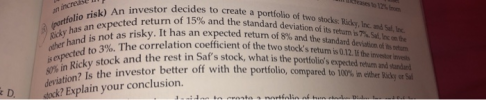
I ceases to 12trom an increase portfolio risk) An investo por can expected return of 15% and the standard devis decides to create a portfolio of two stocks: Ricky, Inc. and of 15% and the standard deviation of its retum is 7. Sal. In the TE has an expected return of 7o and the standard deviation rrelation coefficient of the two stock's return is 0.12. If the investor invests the rest in Saf's stock, what is the portfolio's expected...
#15
I ceases to 12trom an increase portfolio risk) An investo por can expected return of 15% and the standard devis decides to create a portfolio of two stocks: Ricky, Inc. and of 15% and the standard deviation of its retum is 7. Sal. In the TE has an expected return of 7o and the standard deviation rrelation coefficient of the two stock's return is 0.12. If the investor invests the rest in Saf's stock, what is the portfolio's expected...
 (a) Suppose there are 2 assets A1 and Plan B. A1 has an expected return of 7.6% and a standard deviation of 20%. Plan B has an expected return of 12.4% and a standard deviation of 28%. Al is expected to trade at £180 in two years' time. What should its current market price be? (10 marks) The correlation between A1 and Plan B is 0. Suppose portfolio ANB has a weight of 50% in A1 and 50% in Plan...
 Compute the expected return, standard deviation, beta, and nonsystematic standard deviation of the portfolio. 4. Assume that the total market value of an initial portfolio is $300,000. Suppose that the owner of this portfolio wishes to decrease risk by reducing the allocation to the risky portfolio from y = 0.7 to y = 0.56. How do you reallocate your risky portfolio? 5. Which of the following factors reflect pure market risk for a given corporation? a. Increased short-term interest rates....
 #15
I ceases to 12trom an increase portfolio risk) An investo por can expected return of 15% and the standard devis decides to create a portfolio of two stocks: Ricky, Inc. and of 15% and the standard deviation of its retum is 7. Sal. In the TE has an expected return of 7o and the standard deviation rrelation coefficient of the two stock's return is 0.12. If the investor invests the rest in Saf's stock, what is the portfolio's expected...
#15
I ceases to 12trom an increase portfolio risk) An investo por can expected return of 15% and the standard devis decides to create a portfolio of two stocks: Ricky, Inc. and of 15% and the standard deviation of its retum is 7. Sal. In the TE has an expected return of 7o and the standard deviation rrelation coefficient of the two stock's return is 0.12. If the investor invests the rest in Saf's stock, what is the portfolio's expected...
Most questions answered within 3 hours.
-
Where is the error in this code sequence?
String s1 = "Hello";
String s2 = "ello";...
asked 10 months ago -
Financial data for Joel de Paris, Inc., for last year
follow:
Joel de Paris, Inc.
Balance...
asked 10 months ago -
Consider this reaction:
Al2(SO4)3 (aq)+ BaCl3
(aq) Al2Cl6 (aq)- +
3BaSO4(s) . What is the...
asked 10 months ago -
Suppose that Savneet is considering increasing her
recent random sample from 20 car rentals to 40...
asked 10 months ago -
Trucks arrive at an unloading terminal at an average rate of 120
per hour.
Trucks arrive...
asked 10 months ago -
Why are methanol and ethanol completely soluble in water while
octanol is not very little soluble....
asked 10 months ago -
A facilities manager at a university reads in a research report
that the mean amount of...
asked 10 months ago -
When the CuSO4 is rehydrated by adding water to the anhydrous
compound, is this an endothermic...
asked 10 months ago -
A ray of sunlight is passing from diamond into crown glass; the
angle of incidence is...
asked 10 months ago -
A block of mass 0.249 kg is placed on top of a light, vertical
spring of...
asked 10 months ago -
how do the kidneys compensate in the presences of acidosis
a) trigger hyperventilate
b) reserve acid...
asked 10 months ago -
Question 501 pts
The rental rate of capital to the firm increases. Which of the
following...
asked 10 months ago