
Homework Answers
Add Answer to:
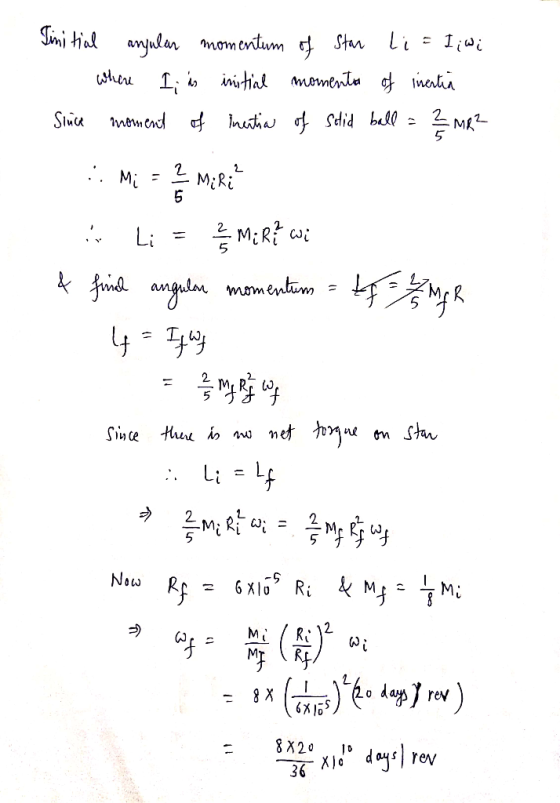
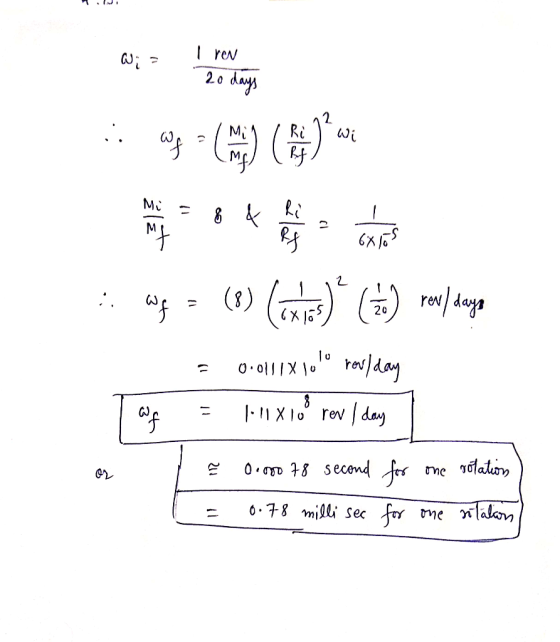
2. A neutron star is the remnant of a large star that exploded in a supernova...
Formation of a Neutron Star A star rotates with a period of 29 days about an axis through its cen...
 Please solve for Tf and how
fast the neuron star rotate in rotations per seconds.
Formation of a Neutron Star A star rotates with a period of 29 days about an axis through its center. The period is the time interval required for a point on the star's equator to make one complete revolution around the axis of rotation. After the star undergoes a supernova explosion, the stellar core, which had a radlus of 1.5 x 10⁴ km, collapses into...
Please solve for Tf and how
fast the neuron star rotate in rotations per seconds.
Formation of a Neutron Star A star rotates with a period of 29 days about an axis through its center. The period is the time interval required for a point on the star's equator to make one complete revolution around the axis of rotation. After the star undergoes a supernova explosion, the stellar core, which had a radlus of 1.5 x 10⁴ km, collapses into...
A neutron star is a star that remains after a supernova, having a large enough density...
A neutron star is a star that remains after a supernova, having a large enough density that the it is comprised of mostly neutrons and few protons. A pulsar is a neutron star that spins, radiating electromagnetic energy. We detect this energy as radio waves, noticing that they pulse at a rate of 1 kHz (1000 Hz). Let's assume that this rate corresponds to the rotations per second of the star (1000 rotations per second). Any solid sphere has a...
Under some circumstances, a star can collapse into an extremely dense object made mostly of neutrons...
Under some circumstances, a star can collapse into an extremely dense object made mostly of neutrons and called a neutron star. The density of a neutron star is roughly 1014 times as great as that of ordinary solid matter. Suppose we represent the star as a uniform, solid, rigid sphere, both before and after the collapse. The star's initial radius was 6.0×10⁵ km (comparable to our sun); its final radius is 17 km. If the original star rotated once in...
Under some circumstances, a star can collapse into an extremely dense object made mostly of neutrons...
Under some circumstances, a star can collapse into an extremely dense object made mostly of neutrons and called a neutron star. The density of a neutron star is roughly 1014 times as great as that of ordinary solid matter. Suppose we represent the star as a uniform, solid, rigid sphere, both before and after the collapse. The star's initial radius was 9.0×10⁵ km (comparable to our sun); its final radius is 18 km . Part A If the original star...
Under some circumstances, a star can collapse into an extremely dense object made mostly of neutrons and called a neutr...
Under some circumstances, a star can collapse into an extremely dense object made mostly of neutrons and called a neutron star. The density of a neutron star is roughly 10^14 times as great as that of ordinary solid matter. Suppose we represent the star as a uniform, solid, rigid sphere, both before and after the collapse. The star's initial radius was 7.0×10^5 km (comparable to our sun); its final radius is 18km . If the original star rotated once in...
Under some circumstances, a star can collapse into an extremely dense object made mostly of neutrons...
Under some circumstances, a star can collapse into an extremely dense object made mostly of neutrons and called a neutron star. The density of a neutron star is roughly 1014 times as great as that of ordinary solid matter. Suppose we represent the star as a uniform, solid, rigid sphere, both before and after the collapse. The star's initial radius was 8.0×10⁵ km (comparable to our sun); its final radius is 17 km . Part A If the original star...
A neutron star is an extremely dense, rapidly spinning object that results from the collapse of...
A neutron star is an extremely dense, rapidly spinning object that results from the collapse of a massive star at the end of its life. A neutron star with 2.3 times the Sun's mass has an essentially uniform density of 4.8× 10^17 kg/m^3. Part A What's its rotational inertia? Assume the star is a solid sphere. Express your answer with the appropriate units. Part B The neutron star's spin rate slowly decreases as a result of torque associated with magnetic...
Constants Under some circumstances, a star can collapse into an extremely dense object made mostly of...
 Constants Under some circumstances, a star can collapse into an extremely dense object made mostly of neutrons and called a neutron star. The density of a neutron star is roughly 10"4 times as great as that of ordinary solid matter. Suppose we represent the star as a uniform, solid, rigid sphere, both before and after the collapse. The star's initial radius was 9.0x10⁵ km (comparable to our sun); its final radius is 18 km. Part A If the original star...
t rotates once every 36 days 15. A star of radius 6.95-1o* m and mass 3.25-10...
 t rotates once every 36 days 15. A star of radius 6.95-1o* m and mass 3.25-10 g is spinning. R 4 pts What is the angular velocity of the star b. 14 pts) How fast does a point on the star's equator, at the surface, move? C. 14 pts) Treating the star as a uniformly solid sphere, find its kinetic energy d. I4 pts] If the star collapsed in on itself, andits radius became one fourth as big what would...
Under some circumstances, a star can collapse into an extremely dense object made mostly of neutrons...
Under some circumstances, a star can collapse into an extremely dense object made mostly of neutrons and called a neutron star. The density of a neutron star is roughly 1014 times as great as that of ordinary solid matter. Suppose we represent the star as a uniform, solid, rigid sphere, both before and after the collapse. The star’s initial radius was 7.0 × 10⁵km (comparable to our sun); its final radius is 16 km. If the original star rotated once...
 Please solve for Tf and how
fast the neuron star rotate in rotations per seconds.
Formation of a Neutron Star A star rotates with a period of 29 days about an axis through its center. The period is the time interval required for a point on the star's equator to make one complete revolution around the axis of rotation. After the star undergoes a supernova explosion, the stellar core, which had a radlus of 1.5 x 10⁴ km, collapses into...
Please solve for Tf and how
fast the neuron star rotate in rotations per seconds.
Formation of a Neutron Star A star rotates with a period of 29 days about an axis through its center. The period is the time interval required for a point on the star's equator to make one complete revolution around the axis of rotation. After the star undergoes a supernova explosion, the stellar core, which had a radlus of 1.5 x 10⁴ km, collapses into...
 Constants Under some circumstances, a star can collapse into an extremely dense object made mostly of neutrons and called a neutron star. The density of a neutron star is roughly 10"4 times as great as that of ordinary solid matter. Suppose we represent the star as a uniform, solid, rigid sphere, both before and after the collapse. The star's initial radius was 9.0x10⁵ km (comparable to our sun); its final radius is 18 km. Part A If the original star...
 t rotates once every 36 days 15. A star of radius 6.95-1o* m and mass 3.25-10 g is spinning. R 4 pts What is the angular velocity of the star b. 14 pts) How fast does a point on the star's equator, at the surface, move? C. 14 pts) Treating the star as a uniformly solid sphere, find its kinetic energy d. I4 pts] If the star collapsed in on itself, andits radius became one fourth as big what would...
Most questions answered within 3 hours.
-
Where is the error in this code sequence?
String s1 = "Hello";
String s2 = "ello";...
asked 11 months ago -
Financial data for Joel de Paris, Inc., for last year
follow:
Joel de Paris, Inc.
Balance...
asked 11 months ago -
Consider this reaction:
Al2(SO4)3 (aq)+ BaCl3
(aq) Al2Cl6 (aq)- +
3BaSO4(s) . What is the...
asked 11 months ago -
Suppose that Savneet is considering increasing her
recent random sample from 20 car rentals to 40...
asked 11 months ago -
Trucks arrive at an unloading terminal at an average rate of 120
per hour.
Trucks arrive...
asked 11 months ago -
Why are methanol and ethanol completely soluble in water while
octanol is not very little soluble....
asked 11 months ago -
A facilities manager at a university reads in a research report
that the mean amount of...
asked 11 months ago -
When the CuSO4 is rehydrated by adding water to the anhydrous
compound, is this an endothermic...
asked 11 months ago -
A ray of sunlight is passing from diamond into crown glass; the
angle of incidence is...
asked 11 months ago -
A block of mass 0.249 kg is placed on top of a light, vertical
spring of...
asked 11 months ago -
how do the kidneys compensate in the presences of acidosis
a) trigger hyperventilate
b) reserve acid...
asked 11 months ago -
Question 501 pts
The rental rate of capital to the firm increases. Which of the
following...
asked 11 months ago