
Homework Answers


![.: G)r)(F)-6674x1t Nm.ka] će. (0/ f:@ (dj -9 ac tion](http://img.homeworklib.com/questions/8c6dc3b0-74c8-11ea-95da-716382699a54.png?x-oss-process=image/resize,w_560)
Add Answer to:
Explain in details. What is the difference if you used
66.73(10^-12) or 6.637(10^-11) for g
Thanks...
a. Two 700-kg masses (1543 lb) are separated by a distance of 33 m. Using Newton’s...
a. Two 700-kg masses (1543 lb) are separated by a distance of 33 m. Using Newton’s law of gravitation, find the magnitude of the gravitational force exerted by one mass on the other. (Use G = 6.67 × 10⁻¹¹ N·m2/kg2.) (Round the final answer to four decimal places.) The magnitude of the gravitational force exerted by one mass on the other is ___________ × 10–9 N. b. Two masses are attracted by a gravitational force of 0.36 N. What will...
Laboratory Unversal Gravitational Law please answer all 3 cases. thank you Laboratory universal gravitational law Answer...
 Laboratory Unversal Gravitational Law
please answer all 3 cases. thank you
Laboratory universal gravitational law Answer all cases please. (Equation 11 Where: - mass of one object in ks - mass of the other object in kg G-Newton's Universal Gravitational Constant r - distance between the two masses in meters Case 1: Glven two masses. - 100 kg = 400 kg, and the attractive force between the two masses is Newtons Case 2: Glven two masses... 230 kg. - 280...
Laboratory Unversal Gravitational Law
please answer all 3 cases. thank you
Laboratory universal gravitational law Answer all cases please. (Equation 11 Where: - mass of one object in ks - mass of the other object in kg G-Newton's Universal Gravitational Constant r - distance between the two masses in meters Case 1: Glven two masses. - 100 kg = 400 kg, and the attractive force between the two masses is Newtons Case 2: Glven two masses... 230 kg. - 280...
Two people with masses 55 kg and 72 kg stand 3.2 m apart. What is the...
Two people with masses 55 kg and 72 kg stand 3.2 m apart. What is the magnitude of the gravitational attraction between them? G = 6.674 x 10^-11
001 10.0 points An apparatus like the one Cavendish used to find G has large lead balls that are 5.1 kg in mass and small ones that are 0.038 kg. The center of a large ball is separated by 0.06 m fro...
 001 10.0 points An apparatus like the one Cavendish used to find G has large lead balls that are 5.1 kg in mass and small ones that are 0.038 kg. The center of a large ball is separated by 0.06 m from the center of a small ball KLight Mirror source SN The Cavendish apparatus for measuring G. As the small spheres of mass m are attracted to the large spheres of mass M, the rod between the two small...
12. Two rocks, each of mass 72 kg, are positioned 95 m away from each other...
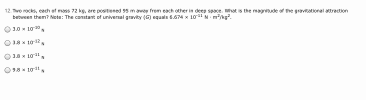 12. Two rocks, each of mass 72 kg, are positioned 95 m away from each other in deep space. What is the magnitude of the gravitational attraction between them? Note: The constant of universal gravity (G) equals 6.674 10-11 N·m2/kg2. O 3.0 10-10 N O3.8 x 10-12 N O3.8 x 10-11 N O9.8 x 10-11 N
A. The force of gravity acting between two objects is given by the equation F=G(m1m2/d2), where...
A. The force of gravity acting between two objects is given by the equation F=G(m1m2/d2), where G is the gravitational constant, G=6.674×10⁻¹¹N⋅m2/kg2. m1 and m2 are the masses of the two objects, and d is the distance separating them. What is the gravitational force of attraction (in Newtons) between the electron and proton? Use the same distance: 2×10²pm. Mass of an electron, me=9.109×10⁻³¹kg Mass of a proton, mp=1.673×10⁻²⁷kg Express your answer to two significant figures and include the appropriate units....
My teacher is not very helpful, so please write cleanly and explain your steps so I...
My teacher is not very helpful, so please write cleanly and explain your steps so I can learn. At the end, please summarize formulas used. =================================== Three identical very dense masses of 7400 kg each are placed on the x axis. One mass is at x1 = -110 cm , one is at the origin, and one is at x2 = 340 cm . =================================== Part A What is the magnitude of the net gravitational force Fgrav on the mass...
Two concentric uniform thin spherical shells of masses 71 kg and 20 kg and radii 26...
Two concentric uniform thin spherical shells of masses 71 kg and 20 kg and radii 26 m and 87 m, respectively. What is the gravitational force on a particle of mass 130 kg located (a) a distance 13 m from the center of the shells: F1= ____pN (b) a distance 62 m from the center of the shells: F2= _____pN (c) a distance 189 m: F3= _____pN (Use G=6.67 x 10⁻¹¹ N kg2/m2) CAREFUL! ANSWER IN PICONEWTONS (pN) (1 pN=10...
Calculate your answer based on the following constants: g = 9.80 m/s2 G = 6.67 x...
Calculate your answer based on the following constants: g = 9.80 m/s2 G = 6.67 x 10⁻¹¹N⋅m2/kg2 ME = 5.97 x 1024 kg rE = 6.38 x 10³ km 1. A man of mass mM is dancing with his wife, who has a mass of mW. Assume that each person's mass is concentrated at their respective centers of mass, which are separated by distance d. What is the gravitational attraction between them? Express your answer in terms of μN (micro...
A football player's weight could be in the range of 1,500 N. Explain why the gravitational...
 A football player's weight could be in the range of 1,500 N. Explain why the gravitational forces in your lab experiment are way smaller, despite the fact that the two masses are measured in billion kg. In other words, the gravitational force between two 1 billion kg bodies 2 km apart is 16.7 N: Force on mass 2 by mass 1 - 10.7N Force on mass 1 by mass 2 16.7N mas Mass 1 Mass 2 Force Values Distance Constant...
 Laboratory Unversal Gravitational Law
please answer all 3 cases. thank you
Laboratory universal gravitational law Answer all cases please. (Equation 11 Where: - mass of one object in ks - mass of the other object in kg G-Newton's Universal Gravitational Constant r - distance between the two masses in meters Case 1: Glven two masses. - 100 kg = 400 kg, and the attractive force between the two masses is Newtons Case 2: Glven two masses... 230 kg. - 280...
Laboratory Unversal Gravitational Law
please answer all 3 cases. thank you
Laboratory universal gravitational law Answer all cases please. (Equation 11 Where: - mass of one object in ks - mass of the other object in kg G-Newton's Universal Gravitational Constant r - distance between the two masses in meters Case 1: Glven two masses. - 100 kg = 400 kg, and the attractive force between the two masses is Newtons Case 2: Glven two masses... 230 kg. - 280...
 001 10.0 points An apparatus like the one Cavendish used to find G has large lead balls that are 5.1 kg in mass and small ones that are 0.038 kg. The center of a large ball is separated by 0.06 m from the center of a small ball KLight Mirror source SN The Cavendish apparatus for measuring G. As the small spheres of mass m are attracted to the large spheres of mass M, the rod between the two small...
 12. Two rocks, each of mass 72 kg, are positioned 95 m away from each other in deep space. What is the magnitude of the gravitational attraction between them? Note: The constant of universal gravity (G) equals 6.674 10-11 N·m2/kg2. O 3.0 10-10 N O3.8 x 10-12 N O3.8 x 10-11 N O9.8 x 10-11 N
 A football player's weight could be in the range of 1,500 N. Explain why the gravitational forces in your lab experiment are way smaller, despite the fact that the two masses are measured in billion kg. In other words, the gravitational force between two 1 billion kg bodies 2 km apart is 16.7 N: Force on mass 2 by mass 1 - 10.7N Force on mass 1 by mass 2 16.7N mas Mass 1 Mass 2 Force Values Distance Constant...
Most questions answered within 3 hours.
-
Where is the error in this code sequence?
String s1 = "Hello";
String s2 = "ello";...
asked 10 months ago -
Financial data for Joel de Paris, Inc., for last year
follow:
Joel de Paris, Inc.
Balance...
asked 10 months ago -
Consider this reaction:
Al2(SO4)3 (aq)+ BaCl3
(aq) Al2Cl6 (aq)- +
3BaSO4(s) . What is the...
asked 10 months ago -
Suppose that Savneet is considering increasing her
recent random sample from 20 car rentals to 40...
asked 10 months ago -
Trucks arrive at an unloading terminal at an average rate of 120
per hour.
Trucks arrive...
asked 10 months ago -
Why are methanol and ethanol completely soluble in water while
octanol is not very little soluble....
asked 10 months ago -
A facilities manager at a university reads in a research report
that the mean amount of...
asked 10 months ago -
When the CuSO4 is rehydrated by adding water to the anhydrous
compound, is this an endothermic...
asked 10 months ago -
A ray of sunlight is passing from diamond into crown glass; the
angle of incidence is...
asked 10 months ago -
A block of mass 0.249 kg is placed on top of a light, vertical
spring of...
asked 10 months ago -
how do the kidneys compensate in the presences of acidosis
a) trigger hyperventilate
b) reserve acid...
asked 10 months ago -
Question 501 pts
The rental rate of capital to the firm increases. Which of the
following...
asked 10 months ago