
Homework Answers
Prove that for all integers n > 0, 2 (na + n).
 Prove that for all integers n > 0, 2 (na + n).
In the following reaction: N,04(8) Na(g) +20,(g) + energy, if the temperature is increased the equilibrium...
 In the following reaction: N,04(8) Na(g) +20,(g) + energy, if the temperature is increased the equilibrium will shift to favor. a. the forward reaction (more products) c. both the forward and the reverse reaction b. the reverse reaction (more reactants) d. neither the forward nor the reverse reaction c o Od
If the measured [Na+]in=21mM, and the cell is 8 times more permeable to K+ than Na+,...
If the measured [Na+]in=21mM, and the cell is 8 times more permeable to K+ than Na+, what is the value of [K+]in?
Draw a curved arrow mechanism for the following reaction. Na H H N Na H- H...
 Draw a curved arrow mechanism for the following reaction. Na H H N Na H- H H T
(a + b)(cd)*(a + b) denotes the following set a. {a(cd)nb|n = 1} b. {a(cd)na|n =...
(a + b)(cd)*(a + b) denotes the following set a. {a(cd)nb|n = 1} b. {a(cd)na|n = 1} ? {b(cd)nb/n = 1} c. {a(cd)na|n = 0} ? {a(cd)nb/n = 0} ? {b(cd)na/n = 0} ? {b(cd)nb/n = 0} d. {acndnb|n = 1}
Argue that n! dominates any polynomial function of n, i.e., na = O(n!) for any real...
 Argue that n! dominates any polynomial function of n, i.e., na = O(n!) for any real a.
If n(AUB) = 43. n(ANB)=22, and n(B) = 37, find n(A). NA) Enter your answer in...
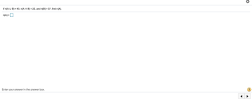 If n(AUB) = 43. n(ANB)=22, and n(B) = 37, find n(A). NA) Enter your answer in the answer box. ?
CN Nå c=N H-c=n ka 7 Na NECH
 CN Nå c=N H-c=n ka 7 Na NECH
NON N(CH3)2 Na 0,5 Na Os N - N(CH3)2 1. methyl orange, an acid-base indicator HC...
 NON N(CH3)2 Na 0,5 Na Os N - N(CH3)2 1. methyl orange, an acid-base indicator HC HC H excess NH NH4Cl 2. H H NH2 a = Electrophilic addition d = Sy2 Nucleophilic substitution g=Nucleophilic subs at carbonylacyl Xfer) b =E2 Elimination e-Electrophilic aromatic substitution h = Conjugate (nucleophilic) addn c=Syl Nucleophilic substitution 1=Carbonyl nucleophilic addn Identify the mechanism by which each of the reactions above proceeds from among the mechanisms listed. Use the letters ai for your answers
number 8, i just need clarification 10.4) QUESTIONS The following reaction is: Na → Na+ +...
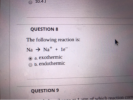 number 8, i just need clarification
10.4) QUESTIONS The following reaction is: Na → Na+ + le • a exothermic b. endothermic QUESTION 9 tam of which reaction com
number 8, i just need clarification
10.4) QUESTIONS The following reaction is: Na → Na+ + le • a exothermic b. endothermic QUESTION 9 tam of which reaction com
 Prove that for all integers n > 0, 2 (na + n).
 In the following reaction: N,04(8) Na(g) +20,(g) + energy, if the temperature is increased the equilibrium will shift to favor. a. the forward reaction (more products) c. both the forward and the reverse reaction b. the reverse reaction (more reactants) d. neither the forward nor the reverse reaction c o Od
 Draw a curved arrow mechanism for the following reaction. Na H H N Na H- H H T
 Argue that n! dominates any polynomial function of n, i.e., na = O(n!) for any real a.
 If n(AUB) = 43. n(ANB)=22, and n(B) = 37, find n(A). NA) Enter your answer in the answer box. ?
 CN Nå c=N H-c=n ka 7 Na NECH
 NON N(CH3)2 Na 0,5 Na Os N - N(CH3)2 1. methyl orange, an acid-base indicator HC HC H excess NH NH4Cl 2. H H NH2 a = Electrophilic addition d = Sy2 Nucleophilic substitution g=Nucleophilic subs at carbonylacyl Xfer) b =E2 Elimination e-Electrophilic aromatic substitution h = Conjugate (nucleophilic) addn c=Syl Nucleophilic substitution 1=Carbonyl nucleophilic addn Identify the mechanism by which each of the reactions above proceeds from among the mechanisms listed. Use the letters ai for your answers
 number 8, i just need clarification
10.4) QUESTIONS The following reaction is: Na → Na+ + le • a exothermic b. endothermic QUESTION 9 tam of which reaction com
number 8, i just need clarification
10.4) QUESTIONS The following reaction is: Na → Na+ + le • a exothermic b. endothermic QUESTION 9 tam of which reaction com
Most questions answered within 3 hours.
-
Where is the error in this code sequence?
String s1 = "Hello";
String s2 = "ello";...
asked 11 months ago -
Financial data for Joel de Paris, Inc., for last year
follow:
Joel de Paris, Inc.
Balance...
asked 11 months ago -
Consider this reaction:
Al2(SO4)3 (aq)+ BaCl3
(aq) Al2Cl6 (aq)- +
3BaSO4(s) . What is the...
asked 11 months ago -
Suppose that Savneet is considering increasing her
recent random sample from 20 car rentals to 40...
asked 11 months ago -
Trucks arrive at an unloading terminal at an average rate of 120
per hour.
Trucks arrive...
asked 11 months ago -
Why are methanol and ethanol completely soluble in water while
octanol is not very little soluble....
asked 11 months ago -
A facilities manager at a university reads in a research report
that the mean amount of...
asked 11 months ago -
When the CuSO4 is rehydrated by adding water to the anhydrous
compound, is this an endothermic...
asked 11 months ago -
A ray of sunlight is passing from diamond into crown glass; the
angle of incidence is...
asked 11 months ago -
A block of mass 0.249 kg is placed on top of a light, vertical
spring of...
asked 11 months ago -
how do the kidneys compensate in the presences of acidosis
a) trigger hyperventilate
b) reserve acid...
asked 11 months ago -
Question 501 pts
The rental rate of capital to the firm increases. Which of the
following...
asked 11 months ago