Consider a 1.0-L solution that is 0.480 M HCOOH and 0.83 M NaHCOO at 25 °C....
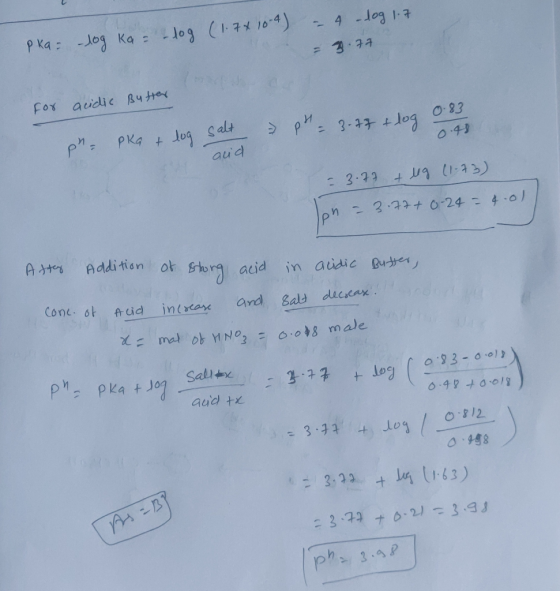
Consider a 1.0-L solution that is 0.480 M HCOOH and 0.83 M NaHCOO at 25 °C. What is the pH of this solution before and after 0.018 moles of HNO3 have been added? Ka of HCOOH is 1.7E-4
initial pH: 4.01, final pH: 3.56.
initial pH: 4.01, final pH: 3.98.
initial pH: 3.53, final pH: 4.03.
initial pH: 3.53, final pH: 3.51.
initial pH: 3.77, final pH: 4.03.
Homework Answers
Add Answer to:
Consider a 1.0-L solution that is 0.480 M HCOOH and 0.83 M
NaHCOO at 25 °C....
Consider a 1.0-L solution that is 0.480 M C5H5N and 0.17 M C5H5NHCl at 25 °C. What is the pH of this solution before and...
Consider a 1.0-L solution that is 0.480 M C5H5N and 0.17 M C5H5NHCl at 25 °C. What is the pH of this solution before and after 0.012 moles of HI have been added? Kb of C5H5N is 1.7E-9 a-initial pH: 4.78, final pH: 5.72 .b- initial pH: 5.68, final pH: 5.64 .c- initial pH: 5.68, final pH: 5.74. d-initial pH: 5.23, final pH: 4.82. e-initial pH: 5.68, final pH: 4.82
Consider a 1.0-L solution that is 0.260 M C6H5COOH and 0.73 M NaC6H5COO at 25 °C....
Consider a 1.0-L solution that is 0.260 M C6H5COOH and 0.73 M NaC6H5COO at 25 °C. What is the pH of this solution before and after 0.006 moles of KOH have been added? Ka of C6H5COOH is 6.5×10⁻⁵. Options: initial pH: 3.74, final pH: 3.75. initial pH: 3.74, final pH: 4.62. initial pH: 4.64, final pH: 4.65. initial pH: 4.19, final pH: 4.62. initial pH: 4.64, final pH: 3.73.
Consider a 1.0-L solution that is 0.830 M HNO2 and 0.37 M NaNO2 at 25 °C. What is the pH of this solution before and aft...
Consider a 1.0-L solution that is 0.830 M HNO2 and 0.37 M NaNO2 at 25 °C. What is the pH of this solution before and after 0.011 moles of LiOH have been added? Ka of HNO2 is 4.5×10⁻⁴. initial pH: 3.7, final pH: 2.98. initial pH: 3.35, final pH: 2.98. initial pH: 3.0, final pH: 3.68. initial pH: 3.7, final pH: 3.72. initial pH: 3.0, final pH: 3.01.
23. A 1.0 L buffer solution is prepared with 0.25 M formic acid (HCOOH) and 0.50...
 23. A 1.0 L buffer solution is prepared with 0.25 M formic acid (HCOOH) and 0.50 M sodium formate (HCOONa). HCOOH(aq) + H2O(aq) – HCOO (aq) + H30+(aq) pKa = 3.74 What is the pH of this buffer solution? (A) 3.74 (B) 4.04 (C) 4.50 (D) 4.20
2. A formic acid buffer containing 0.50 M HCOOH and 0.50 M HCOONa has a pH...
 2. A formic acid buffer containing 0.50 M HCOOH and 0.50 M HCOONa has a pH of 3.77. What will the pH be after 0.010 mol of NaOH has been added to 100.0 mL of the buffer? A) 3.67 B) 3.78 C) 3.81 D) 3.85 E) 3.95 A buffer is prepared by adding 1.00 L of 1.0 M HCl to 750 mL of 1.5 M Nalcoo. What is the pH of this buffer? Ka = 1.7 * 104 A) 2.87...
You have 2.50 L of a 0.450 M HCOOH and 0.550 M HCOONa buffer solution. (Ka...
You have 2.50 L of a 0.450 M HCOOH and 0.550 M HCOONa buffer solution. (Ka for HCOOH is 1.8x10^-4) a) Calculate the pH of the buffer solution. b) Determine the pH of the buffer solution after the addition of 0.150 mol of NaOH (assume no change in volume).
What quantity (moles) of NaOH must be added to 1.0 L of 1.8 M HC2H3O2 to produce a solution buffered at pH = 4.00? Ka =...
What quantity (moles) of NaOH must be added to 1.0 L of 1.8 M HC2H3O2 to produce a solution buffered at pH = 4.00? Ka = 1.8×10⁻⁵
A 1.0 L solution initially contains 0.3 M CH3COOH. Approximate the number of moles of CH3COOH...
A 1.0 L solution initially contains 0.3 M CH3COOH. Approximate the number of moles of CH3COOH and CH3COO− in the solution after 0.1 mol of solid NaOH is added, and calculate the pH of the resulting solution. Ka of CH3COOH is 1.8 ×10⁻⁵. 1) The number of moles of CH3COOH present is [ Select ] ["0.2", "0.3", "0.1"] mol. 2) The number of...
23) What is the pH of a solution prepared by mixing:
23) What is the pH of a solution prepared by mixing: 0.20 moles of acetic acid 0.40 moles of sodium acetate 0.10 moles of sodium hydroxide in 1.0 L of solution a) 4.74 b) 4.14 5.34 d) 13.00 e) None of the above 24) Barbituric acid (Ka = 9.8 X 10⁻⁵) is titrated with 0.200 M NaOH. What is the initial pH of 20.0 mL of 0.100 barbituric acida) 2.50 b) 4.01 c) 8.35 d) 7.00 e) None of the above 25) What is the pH in...
A buffer solution contains 1.0 M HF and 1.0 M NaF. The ka for HF is...
 A buffer solution contains 1.0 M HF and 1.0 M NaF. The ka for HF is 7.2x10⁻⁵. 0.10 moles of HCl are added to 1 liter of the buffer. The pH of the resulting solution is a) 4.05 b) 4.14 c) 4.23 d) 4.74
 23. A 1.0 L buffer solution is prepared with 0.25 M formic acid (HCOOH) and 0.50 M sodium formate (HCOONa). HCOOH(aq) + H2O(aq) – HCOO (aq) + H30+(aq) pKa = 3.74 What is the pH of this buffer solution? (A) 3.74 (B) 4.04 (C) 4.50 (D) 4.20
 2. A formic acid buffer containing 0.50 M HCOOH and 0.50 M HCOONa has a pH of 3.77. What will the pH be after 0.010 mol of NaOH has been added to 100.0 mL of the buffer? A) 3.67 B) 3.78 C) 3.81 D) 3.85 E) 3.95 A buffer is prepared by adding 1.00 L of 1.0 M HCl to 750 mL of 1.5 M Nalcoo. What is the pH of this buffer? Ka = 1.7 * 104 A) 2.87...
 A buffer solution contains 1.0 M HF and 1.0 M NaF. The ka for HF is 7.2x10⁻⁵. 0.10 moles of HCl are added to 1 liter of the buffer. The pH of the resulting solution is a) 4.05 b) 4.14 c) 4.23 d) 4.74
Most questions answered within 3 hours.
-
Where is the error in this code sequence?
String s1 = "Hello";
String s2 = "ello";...
asked 10 months ago -
Financial data for Joel de Paris, Inc., for last year
follow:
Joel de Paris, Inc.
Balance...
asked 10 months ago -
Consider this reaction:
Al2(SO4)3 (aq)+ BaCl3
(aq) Al2Cl6 (aq)- +
3BaSO4(s) . What is the...
asked 10 months ago -
Suppose that Savneet is considering increasing her
recent random sample from 20 car rentals to 40...
asked 10 months ago -
Trucks arrive at an unloading terminal at an average rate of 120
per hour.
Trucks arrive...
asked 10 months ago -
Why are methanol and ethanol completely soluble in water while
octanol is not very little soluble....
asked 10 months ago -
A facilities manager at a university reads in a research report
that the mean amount of...
asked 10 months ago -
When the CuSO4 is rehydrated by adding water to the anhydrous
compound, is this an endothermic...
asked 10 months ago -
A ray of sunlight is passing from diamond into crown glass; the
angle of incidence is...
asked 10 months ago -
A block of mass 0.249 kg is placed on top of a light, vertical
spring of...
asked 10 months ago -
how do the kidneys compensate in the presences of acidosis
a) trigger hyperventilate
b) reserve acid...
asked 10 months ago -
Question 501 pts
The rental rate of capital to the firm increases. Which of the
following...
asked 10 months ago