
Homework Answers
Add Answer to:
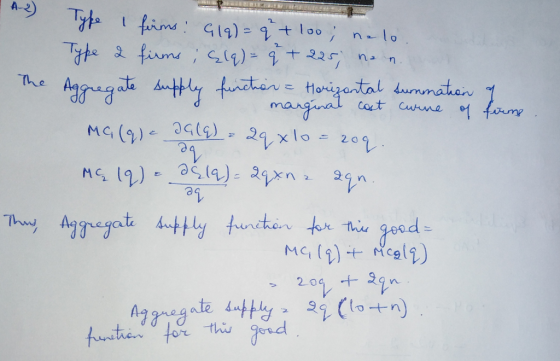
2. Suppose ten firms of type 1 each have cost function C()q2 100, while (infinitely) many...
Suppose there are 100 firms each with a short run total cost of STC = q2...
Suppose there are 100 firms each with a short run total cost of STC = q2 + q + 10. If market demand is given by QD = 1050 − 50P, how much will be produced in the market? a. 300 b. 400 c. 500 d. 600 Suppose there are 100 firms each with a short run total cost of STC = q2 + q + 10. If market demand is given by QD = 1050 − 50P, how much...
Consider a perfectly competitive market comprised of identical firms each facing the following cost function: C(q)...
 Consider a perfectly competitive market comprised of identical firms each facing the following cost function: C(q) = 4 +q? where q is the firm-specific level of production of the representative firm. The market demand function is Q(p) = 400 - 4p where Q(p) is the aggregate demand in the market (expressed as function of price) and p is the price a) Derive the firm-specific supply function of the representative firm as a function of price b) Assume there are N...
In the Stackelberg model we saw in class there were two firms 1 and 2. Suppose...
In the Stackelberg model we saw in class there were two firms 1 and 2. Suppose that the market demand is p(Q) = 60−Q, where as in class Q is the aggregate quantity. The const function for firm 1 is c1(q1) = 10q1 and the cost function for firm 2 is c2(q2) = q2. Firm 1 is the leader and Firm 2 is the follower. (a) Solve for the follow’s reaction function, and the leader’s maximization problem. (b) Describe the...
Suppose there are n identical firms in the market for plums. Each firm's cost function is...
Suppose there are n identical firms in the market for plums. Each firm's cost function is given by C(q)=25+q^2 where q represents the amount that an individual firm will produce. Also, the market demand for plums is given by P = 100 - 2Q, where Q is the total amount of the good produced by all the firms combined (Q=q*n). How much output will each firm produce in the long run? What will be the long run equilibrium price? How...
Suppose we have two firms with the same cost C(q) = {Q2 in a market which...
 Suppose we have two firms with the same cost C(q) = {Q2 in a market which demand is Q 18 – P, the two firms compete in the Cournot Model. a. Set up firm 1's profit maximization and best response function. b. Solve for firm 1's quantity, firm 2's quantity, the equilibrium market quantity, and price. Please show your work. c. Is this a Nash equilibrium?
5. (20 points) Consider there are four homogeneous firms with cost function C(a) = are considering...
 5. (20 points) Consider there are four homogeneous firms with cost function C(a) = are considering whether to enter a market with demand P = 9-Q They 5q + 4 (a) Find two industry supply curves when there are one firm entered the market and two firms entered the market. (b) Draw the curves you found in (a) on a demand-supply diagram and mark these aggregate supply quantity (c) Should the third firm enter the market? Why or why not?...
Take a total cost function, equal to C(y) = 50 + 0.5*y^2. Suppose there are 10...
Take a total cost function, equal to C(y) = 50 + 0.5*y^2. Suppose there are 10 firms, all with that same cost function, in a market whose aggregate demand is given by Y=150-p. a) Compute each firm’s supply, aggregate (total) supply and the competitive equilibrium. b) Compute the elasticity of demand to price, at equilibrium.
2. An industry consists of many identical firms, each with the cost function C(q) = 100...
 2. An industry consists of many identical firms, each with the cost function C(q) = 100 + 30q – 8q2 + q3 a. Derive the average cost, average variable cost, and marginal cost curves of a firm. b. Compute the outputs at which the AC and AVC curves reach their minimums. C. If the market price is $40, and each firm is a price-taker, how much output will each firm supply? d. How much profit or loss is each firm...
3. There are two types of firms in an industry. Type 1 firms have the costs...
 3. There are two types of firms in an industry. Type 1 firms have the costs TC(n) = 625+ 0.25qi and type 2 firms have costs TC(2) 50000.52 The fixed costs for both types of firms are NOT sunk. (a) Derive each firm's ATC(g), AVC() and MC() functions and plot the curves on separate diagrams (b) Derive each firm's supply function q(p) and show the corresponding curves in the diagrams (c Suppose that there are 10 firms of each type....
4. In the competit ve market for widgets there are 50 identical consumers and 200 iden tical firms. Each individual...
 4. In the competit ve market for widgets there are 50 identical consumers and 200 iden tical firms. Each individual consumer has the following demand function for widgets P(P) 100 2P where qD is the quantity an individual consumes and P is the widget's price. Each firm has the following cost function: C() 100 2qq (a) (3 points) Find the market demand function for widgets QP(P). Find the industry supply function for widgets Qs(P), make sure to find each firm's...
 Consider a perfectly competitive market comprised of identical firms each facing the following cost function: C(q) = 4 +q? where q is the firm-specific level of production of the representative firm. The market demand function is Q(p) = 400 - 4p where Q(p) is the aggregate demand in the market (expressed as function of price) and p is the price a) Derive the firm-specific supply function of the representative firm as a function of price b) Assume there are N...
 Suppose we have two firms with the same cost C(q) = {Q2 in a market which demand is Q 18 – P, the two firms compete in the Cournot Model. a. Set up firm 1's profit maximization and best response function. b. Solve for firm 1's quantity, firm 2's quantity, the equilibrium market quantity, and price. Please show your work. c. Is this a Nash equilibrium?
 5. (20 points) Consider there are four homogeneous firms with cost function C(a) = are considering whether to enter a market with demand P = 9-Q They 5q + 4 (a) Find two industry supply curves when there are one firm entered the market and two firms entered the market. (b) Draw the curves you found in (a) on a demand-supply diagram and mark these aggregate supply quantity (c) Should the third firm enter the market? Why or why not?...
 2. An industry consists of many identical firms, each with the cost function C(q) = 100 + 30q – 8q2 + q3 a. Derive the average cost, average variable cost, and marginal cost curves of a firm. b. Compute the outputs at which the AC and AVC curves reach their minimums. C. If the market price is $40, and each firm is a price-taker, how much output will each firm supply? d. How much profit or loss is each firm...
 3. There are two types of firms in an industry. Type 1 firms have the costs TC(n) = 625+ 0.25qi and type 2 firms have costs TC(2) 50000.52 The fixed costs for both types of firms are NOT sunk. (a) Derive each firm's ATC(g), AVC() and MC() functions and plot the curves on separate diagrams (b) Derive each firm's supply function q(p) and show the corresponding curves in the diagrams (c Suppose that there are 10 firms of each type....
 4. In the competit ve market for widgets there are 50 identical consumers and 200 iden tical firms. Each individual consumer has the following demand function for widgets P(P) 100 2P where qD is the quantity an individual consumes and P is the widget's price. Each firm has the following cost function: C() 100 2qq (a) (3 points) Find the market demand function for widgets QP(P). Find the industry supply function for widgets Qs(P), make sure to find each firm's...
Most questions answered within 3 hours.
-
Where is the error in this code sequence?
String s1 = "Hello";
String s2 = "ello";...
asked 11 months ago -
Financial data for Joel de Paris, Inc., for last year
follow:
Joel de Paris, Inc.
Balance...
asked 11 months ago -
Consider this reaction:
Al2(SO4)3 (aq)+ BaCl3
(aq) Al2Cl6 (aq)- +
3BaSO4(s) . What is the...
asked 11 months ago -
Suppose that Savneet is considering increasing her
recent random sample from 20 car rentals to 40...
asked 11 months ago -
Trucks arrive at an unloading terminal at an average rate of 120
per hour.
Trucks arrive...
asked 11 months ago -
Why are methanol and ethanol completely soluble in water while
octanol is not very little soluble....
asked 11 months ago -
A facilities manager at a university reads in a research report
that the mean amount of...
asked 11 months ago -
When the CuSO4 is rehydrated by adding water to the anhydrous
compound, is this an endothermic...
asked 11 months ago -
A ray of sunlight is passing from diamond into crown glass; the
angle of incidence is...
asked 11 months ago -
A block of mass 0.249 kg is placed on top of a light, vertical
spring of...
asked 11 months ago -
how do the kidneys compensate in the presences of acidosis
a) trigger hyperventilate
b) reserve acid...
asked 11 months ago -
Question 501 pts
The rental rate of capital to the firm increases. Which of the
following...
asked 11 months ago