
Homework Answers
Ans:
KHP = Potassium hydrogen phthalate (monoprotic acid)
Mass of KHP taken = 0.445 g
Molar mass of KHP = 204.42 g·mol−1
No. of millimoles of KHP taken,n = (0.445/204.42) x 1000 = 2.17689 mmol
Volume of water/solution taken, V1 = 20.0 mL (ignored the volume change due to the addition of KHP)
Molarity of KHP = n/V1 = 2.17689mmol/20.0mL = 0.10884 M (M1)
Initial burette reading = 1.88 mL
End point burette reading = 28.66 mL
Volume of NaOH added = (28.66-1.88) = 26.78 mL (V2)
Molarity of NaOH (monoacidic base, M2 = ?
For an acid base titration involving monoprotic acid and monoacidic base, we have
M1.V1 = M2.V2
0.10884 M x 20.0 mL = M2 x 26.78 mL
M2 = 0.0813 M
Concentration of NaOH solution, M2 = 0.0813 M
Add Answer to:
oP Ktp CKcgHsOu) A Student dissolved in 20.0NL O Diwater Tu Students then titrates the unknocon...
A student weighs out 0.605g of KHP, dissolves it in 50ml of water and titrates it...
A student weighs out 0.605g of KHP, dissolves it in 50ml of water and titrates it with NaOH, using phenolphalein to determine the end point. If the initial buret reading for the NaOH is 3.50ml and the final buret reading is 27.32ml, What is the concentration of the NaOH solution (in M).
A student titrates 50.00 mL of HCl with 0.0112 M Ca(OH)2. She uses 38.5 mL of...
 A student titrates 50.00 mL of HCl with 0.0112 M Ca(OH)2. She uses 38.5 mL of 0.0112M Ca(OH)2 to reach the equivalence point. What is the concentration of HCI? Ca(OH)2 + 2HCI - CaCl2 + 2H20 O 0.172M 0 0.0172M O 1.154M O 4.52M
A student titrates an unknown amount of potassium hydrogen phthalate ( KHC,H,O,, often abbreviated KHP) with...
 A student titrates an unknown amount of potassium hydrogen phthalate ( KHC,H,O,, often abbreviated KHP) with 23.48 mL of a 0.1100-M NaOH solution. KHP (molar mass = 204.22 g/mol) has one acidic hydrogen. What mass of KHP was titrated (reacted completely) by the sodium hydroxide solution? Mass-
Suppose a student needs to standardize a sodium thiosulfate, Na, S,O,, solution for a titration experiment....
 Suppose a student needs to standardize a sodium thiosulfate, Na, S,O,, solution for a titration experiment. To do so, he or she will react it with a solution of iodine. The student adds a 1.00 mL aliquot of 0.0200 M KIO, solution to a flask, followed by 3 mL of distilled water, 0.2 g of solid KI, and I mL H, SO. The student then titrates the solution with sodium thiosulfate solution in order to determine the exact concentration of...
0.5 pts Question 1 A student titrates 0.139 g of an unknown monoprotic weak acid to...
 0.5 pts Question 1 A student titrates 0.139 g of an unknown monoprotic weak acid to the equivalence point with 44.6 mL of 0.100 M NaOH (aq). What is the molar mass of the weak acid? O 0.0615 g/mol 0.0312 g/mol 13.9 g/mol 31.2 g/mol O 61.5 g/mol
A student prepared a 101.4 ml solution of malonic acid (C,H,O) with a concentration of 0.076...
 A student prepared a 101.4 ml solution of malonic acid (C,H,O) with a concentration of 0.076 M. What is the mass of malonic acid dissolved in the solution? Answer:
Please use a diagram to explain! CE U. TU I TIUI. The 13. Joe Student is...
 Please use a diagram to explain!
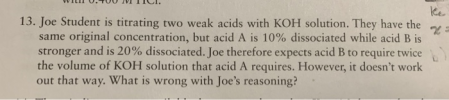
CE U. TU I TIUI. The 13. Joe Student is titrating two weak acids with KOH solution. They have the same original concentration, but acid A is 10% dissociated while acid B is stronger and is 20% dissociated. Joe therefore expects acid B to require twice the volume of KOH solution that acid A requires. However, it doesn't work out that way. What is wrong with Joe's reasoning?
Please use a diagram to explain!
CE U. TU I TIUI. The 13. Joe Student is titrating two weak acids with KOH solution. They have the same original concentration, but acid A is 10% dissociated while acid B is stronger and is 20% dissociated. Joe therefore expects acid B to require twice the volume of KOH solution that acid A requires. However, it doesn't work out that way. What is wrong with Joe's reasoning?
Suppose a student needs to standardize a sodium thiosulfate, Na, S, O3, solution for a titration...
 Suppose a student needs to standardize a sodium thiosulfate, Na, S, O3, solution for a titration experiment. To do so, he or she will react it with a solution of iodine. The student adds a 1.00 mL aliquot of 0.0200 M KIO, solution to a flask, followed by 3 mL of distilled water, 0.2 g of solid KI, and 1 mL H, SO . The student then titrates the solution with sodium thiosulfate solution in order to determine the exact...
tion 2 of 2 OAttempt 1 Suppose a student needs to standardize a sodium thiosulfate, Na,...
 tion 2 of 2 OAttempt 1 Suppose a student needs to standardize a sodium thiosulfate, Na, S, O,, solution for a titration experiment. To do so, he or she will react it with a solution of iodine. The student adds a 1.00 mlL aliquot of 0.0200 M KIO, solution to a flask, followed by 3 mL of distilled water, 0.2 g of solid KI, and 1 mL H,SO,. The student then titrates the solution with sodium thiosulfate solution in order...
Calculus-based physics: A student with mass of 50.o kg is walking north with speed of 1.2...
Calculus-based physics: A student with mass of 50.o kg is walking north with speed of 1.2 m/s while texting on their phone. Another student with mass 45.0 kg is traveling west with a speed of 1.5 m/s while reading a book. The two occupied students collide and stick together. a) Determine the speed and direction of the resulting collision b) What is their (total) initial and final kinetic energy Thank you!!
 A student titrates 50.00 mL of HCl with 0.0112 M Ca(OH)2. She uses 38.5 mL of 0.0112M Ca(OH)2 to reach the equivalence point. What is the concentration of HCI? Ca(OH)2 + 2HCI - CaCl2 + 2H20 O 0.172M 0 0.0172M O 1.154M O 4.52M
 A student titrates an unknown amount of potassium hydrogen phthalate ( KHC,H,O,, often abbreviated KHP) with 23.48 mL of a 0.1100-M NaOH solution. KHP (molar mass = 204.22 g/mol) has one acidic hydrogen. What mass of KHP was titrated (reacted completely) by the sodium hydroxide solution? Mass-
 Suppose a student needs to standardize a sodium thiosulfate, Na, S,O,, solution for a titration experiment. To do so, he or she will react it with a solution of iodine. The student adds a 1.00 mL aliquot of 0.0200 M KIO, solution to a flask, followed by 3 mL of distilled water, 0.2 g of solid KI, and I mL H, SO. The student then titrates the solution with sodium thiosulfate solution in order to determine the exact concentration of...
 0.5 pts Question 1 A student titrates 0.139 g of an unknown monoprotic weak acid to the equivalence point with 44.6 mL of 0.100 M NaOH (aq). What is the molar mass of the weak acid? O 0.0615 g/mol 0.0312 g/mol 13.9 g/mol 31.2 g/mol O 61.5 g/mol
 A student prepared a 101.4 ml solution of malonic acid (C,H,O) with a concentration of 0.076 M. What is the mass of malonic acid dissolved in the solution? Answer:
 Please use a diagram to explain!
CE U. TU I TIUI. The 13. Joe Student is titrating two weak acids with KOH solution. They have the same original concentration, but acid A is 10% dissociated while acid B is stronger and is 20% dissociated. Joe therefore expects acid B to require twice the volume of KOH solution that acid A requires. However, it doesn't work out that way. What is wrong with Joe's reasoning?
Please use a diagram to explain!
CE U. TU I TIUI. The 13. Joe Student is titrating two weak acids with KOH solution. They have the same original concentration, but acid A is 10% dissociated while acid B is stronger and is 20% dissociated. Joe therefore expects acid B to require twice the volume of KOH solution that acid A requires. However, it doesn't work out that way. What is wrong with Joe's reasoning?
 Suppose a student needs to standardize a sodium thiosulfate, Na, S, O3, solution for a titration experiment. To do so, he or she will react it with a solution of iodine. The student adds a 1.00 mL aliquot of 0.0200 M KIO, solution to a flask, followed by 3 mL of distilled water, 0.2 g of solid KI, and 1 mL H, SO . The student then titrates the solution with sodium thiosulfate solution in order to determine the exact...
 tion 2 of 2 OAttempt 1 Suppose a student needs to standardize a sodium thiosulfate, Na, S, O,, solution for a titration experiment. To do so, he or she will react it with a solution of iodine. The student adds a 1.00 mlL aliquot of 0.0200 M KIO, solution to a flask, followed by 3 mL of distilled water, 0.2 g of solid KI, and 1 mL H,SO,. The student then titrates the solution with sodium thiosulfate solution in order...
Most questions answered within 3 hours.
-
Where is the error in this code sequence?
String s1 = "Hello";
String s2 = "ello";...
asked 10 months ago -
Financial data for Joel de Paris, Inc., for last year
follow:
Joel de Paris, Inc.
Balance...
asked 10 months ago -
Consider this reaction:
Al2(SO4)3 (aq)+ BaCl3
(aq) Al2Cl6 (aq)- +
3BaSO4(s) . What is the...
asked 10 months ago -
Suppose that Savneet is considering increasing her
recent random sample from 20 car rentals to 40...
asked 10 months ago -
Trucks arrive at an unloading terminal at an average rate of 120
per hour.
Trucks arrive...
asked 10 months ago -
Why are methanol and ethanol completely soluble in water while
octanol is not very little soluble....
asked 10 months ago -
A facilities manager at a university reads in a research report
that the mean amount of...
asked 10 months ago -
When the CuSO4 is rehydrated by adding water to the anhydrous
compound, is this an endothermic...
asked 10 months ago -
A ray of sunlight is passing from diamond into crown glass; the
angle of incidence is...
asked 10 months ago -
A block of mass 0.249 kg is placed on top of a light, vertical
spring of...
asked 10 months ago -
how do the kidneys compensate in the presences of acidosis
a) trigger hyperventilate
b) reserve acid...
asked 10 months ago -
Question 501 pts
The rental rate of capital to the firm increases. Which of the
following...
asked 10 months ago