If someone takes a breath and the lungs expand from 3.3 L to 5.9 L in...
If someone takes a breath and the lungs expand from 3.3 L to 5.9 L in volume, and the initial pressure was 758 mm Hg, what is the pressure (in mm Hg) inside the lungs before any additional air is pulled in?
Homework Answers

Add Answer to:
If someone takes a breath and the lungs expand from 3.3 L to 5.9
L in...
If someone takes a breath and the lungs expand from 4.0 L to 5.9 L in...
If someone takes a breath and the lungs expand from 4.0 L to 5.9 L in volume, and the initial pressure was 752 mm Hg, what is the pressure (in mm Hg) inside the lungs before any additional air is pulled in?
On a chilly 12∘C day, you quickly take a deep breath--all your lungs can hold, 4.0...
On a chilly 12∘C day, you quickly take a deep breath--all your lungs can hold, 4.0 L. The air warms to your body temperature of 37∘C. If the air starts at a pressure of 1.0 atm, and you hold the volume of your lungs constant (a good approximation) and the number of molecules in your lungs stays constant as well (also a good approximation), what is the increase in pressure inside your lungs?
A diver takes a deep breath at the surface where the pressure is 1.0 atm, filling...
 A diver takes a deep breath at the surface where the pressure is 1.0 atm, filling his lungs with 4.0 L of air. He then descends to a depth where the pressure is 0.5 atm higher than at the surface. What is the volume of air in his lungs at this depth given that the air's temperature remains the same? 4 A) 2.67 L B) 8.00 L C) 0.375 L D) 6.00 L E) 0.125 L (181 Finol 014)
An ideal gas is allowed to expand from 7.20 L to 10.8 L at constant temperature....
 An ideal gas is allowed to expand from 7.20 L to 10.8 L at constant temperature. By what factor does the volume increase? factor: The pressure will decrease by that same factor. increase by that same factor. If the initial pressure was 113 atm, what is the final pressure? Pinal = The volume of a sample of hydrogen gas was decreased from 14.32 L to 7.61 L at constant temperature. If the final pressure exerted by the hydrogen gas sample...
On a cold day, you take a breath, inhaling 0.4 L of air whose initial temperature...
 On a cold day, you take a breath, inhaling 0.4 L of air whose initial temperature is -10 degree C. In your lungs, its temperature is raised to 37 degree C. Assume that the pressure is 106 kPa and that the air may be treated as an ideal gas. What is the total change in translational kinetic energy of the air you inhaled number? Round your answer to the nearest whole.
A volume of 2.8 L of air at 36°C is expelled from the lungs into cold surroundings at 0.3°C. What volume does the expell...
A volume of 2.8 L of air at 36°C is expelled from the lungs into cold surroundings at 0.3°C. What volume does the expelled air occupy at this temperature? The pressure and the number of gas particles do not change. Answer in L
An ideal gas is allowed to expand from 3.80 L to 17.1 L at constant temperature....
 An ideal gas is allowed to expand from 3.80 L to 17.1 L at constant temperature. By what factor does the volume increase? factor: The pressure will increase by that same factor. decrease by that same factor. If the initial pressure was 131 atm, what is the final pressure? Pinal =
An ideal gas is allowed to expand from 6.80 L to 17.0 L at constant temperature....
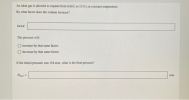 An ideal gas is allowed to expand from 6.80 L to 17.0 L at constant temperature. By what factor does the volume increase? factor: The pressure will increase by that same factor. decrease by that same factor. If the initial pressure was 119 atm, what is the final pressure? Pinal =
An ideal gas is allowed to expand from 4.00 L to 38.0 L at constant temperature....
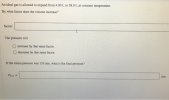 An ideal gas is allowed to expand from 4.00 L to 38.0 L at constant temperature. By what factor does the volume increase? factor: The pressure will increase by that same factor. decrease by that same factor. If the initial pressure was 133 atm, what is the final pressure? Pinal= atm
4 Air that is exhaled from the lungs has a total pressure of 1.00 atm and a temperature of 37°C. The partial pressur...
 4 Air that is exhaled from the lungs has a total pressure of 1.00 atm and a temperature of 37°C. The partial pressures of water vapor, oxygen, and nitrogen in the exhaled air are: 47, 104 & 569 mm Hg. What is the partial pressure of the exhaled carbon dioxide?
 A diver takes a deep breath at the surface where the pressure is 1.0 atm, filling his lungs with 4.0 L of air. He then descends to a depth where the pressure is 0.5 atm higher than at the surface. What is the volume of air in his lungs at this depth given that the air's temperature remains the same? 4 A) 2.67 L B) 8.00 L C) 0.375 L D) 6.00 L E) 0.125 L (181 Finol 014)
 An ideal gas is allowed to expand from 7.20 L to 10.8 L at constant temperature. By what factor does the volume increase? factor: The pressure will decrease by that same factor. increase by that same factor. If the initial pressure was 113 atm, what is the final pressure? Pinal = The volume of a sample of hydrogen gas was decreased from 14.32 L to 7.61 L at constant temperature. If the final pressure exerted by the hydrogen gas sample...
 On a cold day, you take a breath, inhaling 0.4 L of air whose initial temperature is -10 degree C. In your lungs, its temperature is raised to 37 degree C. Assume that the pressure is 106 kPa and that the air may be treated as an ideal gas. What is the total change in translational kinetic energy of the air you inhaled number? Round your answer to the nearest whole.
 An ideal gas is allowed to expand from 3.80 L to 17.1 L at constant temperature. By what factor does the volume increase? factor: The pressure will increase by that same factor. decrease by that same factor. If the initial pressure was 131 atm, what is the final pressure? Pinal =
 An ideal gas is allowed to expand from 6.80 L to 17.0 L at constant temperature. By what factor does the volume increase? factor: The pressure will increase by that same factor. decrease by that same factor. If the initial pressure was 119 atm, what is the final pressure? Pinal =
 An ideal gas is allowed to expand from 4.00 L to 38.0 L at constant temperature. By what factor does the volume increase? factor: The pressure will increase by that same factor. decrease by that same factor. If the initial pressure was 133 atm, what is the final pressure? Pinal= atm
 4 Air that is exhaled from the lungs has a total pressure of 1.00 atm and a temperature of 37°C. The partial pressures of water vapor, oxygen, and nitrogen in the exhaled air are: 47, 104 & 569 mm Hg. What is the partial pressure of the exhaled carbon dioxide?
Most questions answered within 3 hours.
-
Where is the error in this code sequence?
String s1 = "Hello";
String s2 = "ello";...
asked 11 months ago -
Financial data for Joel de Paris, Inc., for last year
follow:
Joel de Paris, Inc.
Balance...
asked 11 months ago -
Consider this reaction:
Al2(SO4)3 (aq)+ BaCl3
(aq) Al2Cl6 (aq)- +
3BaSO4(s) . What is the...
asked 11 months ago -
Suppose that Savneet is considering increasing her
recent random sample from 20 car rentals to 40...
asked 11 months ago -
Trucks arrive at an unloading terminal at an average rate of 120
per hour.
Trucks arrive...
asked 11 months ago -
Why are methanol and ethanol completely soluble in water while
octanol is not very little soluble....
asked 11 months ago -
A facilities manager at a university reads in a research report
that the mean amount of...
asked 11 months ago -
When the CuSO4 is rehydrated by adding water to the anhydrous
compound, is this an endothermic...
asked 11 months ago -
A ray of sunlight is passing from diamond into crown glass; the
angle of incidence is...
asked 11 months ago -
A block of mass 0.249 kg is placed on top of a light, vertical
spring of...
asked 11 months ago -
how do the kidneys compensate in the presences of acidosis
a) trigger hyperventilate
b) reserve acid...
asked 11 months ago -
Question 501 pts
The rental rate of capital to the firm increases. Which of the
following...
asked 11 months ago