Think about the various energy sources such as the sun, fossil fuels, water, wind, and nuclear...
Think about the various energy sources such as the sun, fossil fuels, water, wind, and nuclear power. What is the energy source to power your home? Do you prefer this energy source? If not, which energy source would you prefer was used to power your house?
Homework Answers


Add Answer to:
Think about the various energy sources such as the sun, fossil
fuels, water, wind, and nuclear...
what are the Technologies to get energy from fossil and nuclear fuels, and renewable sources (solar...
what are the Technologies to get energy from fossil and nuclear fuels, and renewable sources (solar only)
Energy consumed in the US can be classified as coming from one of three sources: fossil...
Energy consumed in the US can be classified as coming from one of three sources: fossil fuels, nuclear power, and renewable energy. In 2014, the energy from these three sources was 80.3, 8.3, and 9.6 quadrillion BTU, respectively. In 2004, the corresponding amounts were 85.8, 8.2, and 6.1. Write a description of the changes from 2004 to 2014 expressed in these data. Illustrate your summary with appropriate graphical summaries. Be sure to discuss both the amounts of energy from each...
Help me write a recommendation and conclusion for this report. Topic: Harnessing Wave and Wind Energy...
Help me write a recommendation and conclusion for this report. Topic: Harnessing Wave and Wind Energy in Sweden and Why wave and wind energy is better than fossil fuels while stating the advantages and disadvantages of wave and wind energy Abstract: Sweden is planning to run entirely on renewable energy by 2040. One of these renewable energies is wind and wave energy. Wave and Wind energy are one of the most promising alternatives to fossil fuels which have completely polluted...
What are the sources, uses, and any problems associated with 1) fossil, 2) nuclear, and 3)...
What are the sources, uses, and any problems associated with 1) fossil, 2) nuclear, and 3) renewable fuels? How did your results from the “Build Your Proficiency” Diagnostic reflect an understanding, or lack of understanding, about this content?
Please type!! In your opinion, what is the best form of energy (nuclear, wind, fossil fuel,...
Please type!! In your opinion, what is the best form of energy (nuclear, wind, fossil fuel, etc.) and why?
Problem 3 (5 marks): The advantage of fossil fuels is that a lot of energy can be transported in a small amount of mass...
 Problem 3 (5 marks): The advantage of fossil fuels is that a lot of energy can be transported in a small amount of mass. The disadvantage is that their combustion produces CO2 (a greenhouse gas). a) Calculate how much energy is recoverable by the combustion of 1 g of octane. In a hydrogen-based economy, H2 could be produced collected and compressed so that it could be transported and burned like fossil fuels in car engines. b) How many grams of...
Only need question C answered Problem 3 (5 marks): The advantage of fossil fuels is that a lot of energy can be transpor...
 Only need question C answered
Problem 3 (5 marks): The advantage of fossil fuels is that a lot of energy can be transported in a small amount of mass. The disadvantage is that their combustion produces CO2 (a greenhouse gas). a) Calculate how much energy is recoverable by the combustion of 1 g of octane. In a hydrogen-based economy, H2 could be produced collected and compressed so that it could be transported and burned like fossil fuels in car engines....
Only need question C answered
Problem 3 (5 marks): The advantage of fossil fuels is that a lot of energy can be transported in a small amount of mass. The disadvantage is that their combustion produces CO2 (a greenhouse gas). a) Calculate how much energy is recoverable by the combustion of 1 g of octane. In a hydrogen-based economy, H2 could be produced collected and compressed so that it could be transported and burned like fossil fuels in car engines....
Energy sources that do not increase carbon emissions include O Solar cells O Wind mills Nuclear...
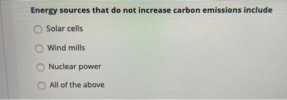 Energy sources that do not increase carbon emissions include O Solar cells O Wind mills Nuclear power All of the above How does climate change (global warming) affect human health? By increasing illnesses, such as heat stress, cardiovascular disease, and kidney disease. By increasing respiratory illnesses, such as asthma and allergies. By increasing insect borne infections, such as dengue fever. All of the above
3. Which statement about nuclear fission is correct? (1 point) A. Nuclear fission provides energy for...
3. Which statement about nuclear fission is correct? (1 point) A. Nuclear fission provides energy for the sun and most U.S. nuclear power plants. B. Nuclear fission produces massive amounts of energy but requires special containment and a temperature of millions of degrees Celsius. C. The fission process can be manipulated in a reactor via the use of control rods, and the energy released is used for generating electricity. D. Fission is the process used to produce energy both in...
) It is necessary to switch from fossil fuels to renewable energy. This requires putting a...
) It is necessary to switch from fossil fuels to renewable energy. This requires putting a price on the emission of carbon. Only governmental policies coordinated among the nations of the world can accomplish this goal. What did the Kyoto Accord propose and how successful was it? What did the Paris Agreement propose and how successful was it? Explain what you think the future holds? https://www.e-education.psu.edu/meteo469/node/185 4) What role do you think religion plays in our need to address climate...
 Problem 3 (5 marks): The advantage of fossil fuels is that a lot of energy can be transported in a small amount of mass. The disadvantage is that their combustion produces CO2 (a greenhouse gas). a) Calculate how much energy is recoverable by the combustion of 1 g of octane. In a hydrogen-based economy, H2 could be produced collected and compressed so that it could be transported and burned like fossil fuels in car engines. b) How many grams of...
 Only need question C answered
Problem 3 (5 marks): The advantage of fossil fuels is that a lot of energy can be transported in a small amount of mass. The disadvantage is that their combustion produces CO2 (a greenhouse gas). a) Calculate how much energy is recoverable by the combustion of 1 g of octane. In a hydrogen-based economy, H2 could be produced collected and compressed so that it could be transported and burned like fossil fuels in car engines....
Only need question C answered
Problem 3 (5 marks): The advantage of fossil fuels is that a lot of energy can be transported in a small amount of mass. The disadvantage is that their combustion produces CO2 (a greenhouse gas). a) Calculate how much energy is recoverable by the combustion of 1 g of octane. In a hydrogen-based economy, H2 could be produced collected and compressed so that it could be transported and burned like fossil fuels in car engines....
 Energy sources that do not increase carbon emissions include O Solar cells O Wind mills Nuclear power All of the above How does climate change (global warming) affect human health? By increasing illnesses, such as heat stress, cardiovascular disease, and kidney disease. By increasing respiratory illnesses, such as asthma and allergies. By increasing insect borne infections, such as dengue fever. All of the above
Most questions answered within 3 hours.
-
Where is the error in this code sequence?
String s1 = "Hello";
String s2 = "ello";...
asked 10 months ago -
Financial data for Joel de Paris, Inc., for last year
follow:
Joel de Paris, Inc.
Balance...
asked 10 months ago -
Consider this reaction:
Al2(SO4)3 (aq)+ BaCl3
(aq) Al2Cl6 (aq)- +
3BaSO4(s) . What is the...
asked 10 months ago -
Suppose that Savneet is considering increasing her
recent random sample from 20 car rentals to 40...
asked 10 months ago -
Trucks arrive at an unloading terminal at an average rate of 120
per hour.
Trucks arrive...
asked 10 months ago -
Why are methanol and ethanol completely soluble in water while
octanol is not very little soluble....
asked 10 months ago -
A facilities manager at a university reads in a research report
that the mean amount of...
asked 10 months ago -
When the CuSO4 is rehydrated by adding water to the anhydrous
compound, is this an endothermic...
asked 10 months ago -
A ray of sunlight is passing from diamond into crown glass; the
angle of incidence is...
asked 10 months ago -
A block of mass 0.249 kg is placed on top of a light, vertical
spring of...
asked 10 months ago -
how do the kidneys compensate in the presences of acidosis
a) trigger hyperventilate
b) reserve acid...
asked 10 months ago -
Question 501 pts
The rental rate of capital to the firm increases. Which of the
following...
asked 10 months ago