If I invest 3 million. I will earn an additional 400k for the next decade. Should...
If I invest 3 million. I will earn an additional 400k for the next decade. Should I make this investment? Why?
Homework Answers
Considering it as simple interest payout...it means per year income earned is 400k/10 = 40,000 per year.
Then, 40,000/3000,000 = 1.33%
Earning just 1.33% on the investment is not a worth investment because even depositing in risk free securities gives better returns. So i believe this is not a right investment considering other options available in the market.
Add Answer to:
If I invest 3 million. I will earn an additional 400k for the
next decade. Should...
If I invest 3 million dollars, and I believe I will have sales of 100k in...
If I invest 3 million dollars, and I believe I will have sales of 100k in the first year and after that sales will increase by 25% per year for the next 3 years. After that sales will grow at a constant 3% rate forever. Market risk premium of 4.4%. 1 year tbill yield curve of 2.6%. Beta is .52. Should I make this investment? Why or why not?
If I invest 3 million dollars, and I believe I will have sales of 100k in...
If I invest 3 million dollars, and I believe I will have sales of 100k in the first year and after that sales will increase by 25% per year for the next 3 years. After that sales will grow at a constant 3% rate forever. Market risk premium of 4.4%. 1 year tbill yield curve of 2.6%. Beta is .52. Should I make this investment? Why or why not?
with no discount rate given, must be assumed. If I invest 3 million dollars, and I...
with no discount rate given, must be assumed. If I invest 3 million dollars, and I believe I will have sales of 100k in the first year and after that sales will increase by 25% per year for the next 3 years. After that sales will grow at a constant 3% rate forever. Market risk premium of 4.4% Should I make this investment? Why or why not?
If Microsoft decides to invest 3 million dollars, and believes it will have sales of 100k...
If Microsoft decides to invest 3 million dollars, and believes it will have sales of 100k in the first year and after that sales will increase by 25% per year for the next 3 years. Also, after those 3 years sales will then grow at a constant 3% rate forever. Market risk premium of 4.4% Should I make this investment? Why or why not?
If Microsoft decides to invest 3 million dollars, and believes it will have sales of 100k...
If Microsoft decides to invest 3 million dollars, and believes it will have sales of 100k in the first year and after that sales will increase by 25% per year for the next 3 years. Also, after those 3 years sales will then grow at a constant 3% rate forever. Market risk premium of 4.4%. Beta .52. Yearly T Bill rate of 2.6% Should I make this investment? Why or why not? Please show NPV and Cash flow formulas.
this is the entire question Consider two possible investment plans: (i) Invest $1 in asset A...
 this is the entire question
Consider two possible investment plans: (i) Invest $1 in asset A and cash it next period; (ii) Invest $1 in asset B and earn interest of r dollars over the period. Derive no arbitrage condition. Consider two possible investment plans: (i) Invest $1 in asset A and cash it next period; (ii) Invest $1 in asset B and earn interest of r dollars over the period. Derive no arbitrage condition.
this is the entire question
Consider two possible investment plans: (i) Invest $1 in asset A and cash it next period; (ii) Invest $1 in asset B and earn interest of r dollars over the period. Derive no arbitrage condition. Consider two possible investment plans: (i) Invest $1 in asset A and cash it next period; (ii) Invest $1 in asset B and earn interest of r dollars over the period. Derive no arbitrage condition.
You invest $ 2,000 at the end of each year for the next 3 years. Calculate...
 You invest $ 2,000 at the end of each year for the next 3 years. Calculate the value of the investment at the end of 3 years assuming you earn 6% interest. Please use the table provided under the EC Time Value of Money Module otherwise you may be marked wrong due to rounding.
•Corum Inc. expects to earn $120 million per year in perpetuity if it does not undertake...
•Corum Inc. expects to earn $120 million per year in perpetuity if it does not undertake any new projects. The firm has an opportunity to invest $15 million today, $10 million in one year and $5 million in two years. The cash inflow will grow at a rate of g thereafter. The firm has 5 million shares of common stock outstanding, and the required rate of return on the stock is 15 percent. Ignore taxes and depreciation. –What is...
an investor has a budget of $5 million. he can invest in the projects shown above....
 an investor has a budget of $5 million. he can invest in the
projects shown above. if the cost of capital is 7%, what investment
or investments should he make?
Initial Investment Cash flow Project A $5 million $2 million per year for four years Project B 53 million $1 million per year for five years Project C $2 million $1 million per year for four years Project D $3 million $1.5 million per year for three years An investor...
an investor has a budget of $5 million. he can invest in the
projects shown above. if the cost of capital is 7%, what investment
or investments should he make?
Initial Investment Cash flow Project A $5 million $2 million per year for four years Project B 53 million $1 million per year for five years Project C $2 million $1 million per year for four years Project D $3 million $1.5 million per year for three years An investor...
. Suppose that you want to invest one million pesos over the next three years. Find...
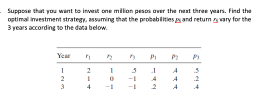 . Suppose that you want to invest one million pesos over the next three years. Find the optimal investment strategy, assuming that the probabilities pk and return rk vary for the 3 years according to the data below. Year 11 12 13 P1 P2 P3 1 1 2 1 4 .5 -1 2 3 0 -1 .1 .4 .2 .4 .4 .4 .5 .2 .4
 this is the entire question
Consider two possible investment plans: (i) Invest $1 in asset A and cash it next period; (ii) Invest $1 in asset B and earn interest of r dollars over the period. Derive no arbitrage condition. Consider two possible investment plans: (i) Invest $1 in asset A and cash it next period; (ii) Invest $1 in asset B and earn interest of r dollars over the period. Derive no arbitrage condition.
this is the entire question
Consider two possible investment plans: (i) Invest $1 in asset A and cash it next period; (ii) Invest $1 in asset B and earn interest of r dollars over the period. Derive no arbitrage condition. Consider two possible investment plans: (i) Invest $1 in asset A and cash it next period; (ii) Invest $1 in asset B and earn interest of r dollars over the period. Derive no arbitrage condition.
 You invest $ 2,000 at the end of each year for the next 3 years. Calculate the value of the investment at the end of 3 years assuming you earn 6% interest. Please use the table provided under the EC Time Value of Money Module otherwise you may be marked wrong due to rounding.
 an investor has a budget of $5 million. he can invest in the
projects shown above. if the cost of capital is 7%, what investment
or investments should he make?
Initial Investment Cash flow Project A $5 million $2 million per year for four years Project B 53 million $1 million per year for five years Project C $2 million $1 million per year for four years Project D $3 million $1.5 million per year for three years An investor...
an investor has a budget of $5 million. he can invest in the
projects shown above. if the cost of capital is 7%, what investment
or investments should he make?
Initial Investment Cash flow Project A $5 million $2 million per year for four years Project B 53 million $1 million per year for five years Project C $2 million $1 million per year for four years Project D $3 million $1.5 million per year for three years An investor...
 . Suppose that you want to invest one million pesos over the next three years. Find the optimal investment strategy, assuming that the probabilities pk and return rk vary for the 3 years according to the data below. Year 11 12 13 P1 P2 P3 1 1 2 1 4 .5 -1 2 3 0 -1 .1 .4 .2 .4 .4 .4 .5 .2 .4
Most questions answered within 3 hours.
-
Where is the error in this code sequence?
String s1 = "Hello";
String s2 = "ello";...
asked 11 months ago -
Financial data for Joel de Paris, Inc., for last year
follow:
Joel de Paris, Inc.
Balance...
asked 11 months ago -
Consider this reaction:
Al2(SO4)3 (aq)+ BaCl3
(aq) Al2Cl6 (aq)- +
3BaSO4(s) . What is the...
asked 11 months ago -
Suppose that Savneet is considering increasing her
recent random sample from 20 car rentals to 40...
asked 11 months ago -
Trucks arrive at an unloading terminal at an average rate of 120
per hour.
Trucks arrive...
asked 11 months ago -
Why are methanol and ethanol completely soluble in water while
octanol is not very little soluble....
asked 11 months ago -
A facilities manager at a university reads in a research report
that the mean amount of...
asked 11 months ago -
When the CuSO4 is rehydrated by adding water to the anhydrous
compound, is this an endothermic...
asked 11 months ago -
A ray of sunlight is passing from diamond into crown glass; the
angle of incidence is...
asked 11 months ago -
A block of mass 0.249 kg is placed on top of a light, vertical
spring of...
asked 11 months ago -
how do the kidneys compensate in the presences of acidosis
a) trigger hyperventilate
b) reserve acid...
asked 11 months ago -
Question 501 pts
The rental rate of capital to the firm increases. Which of the
following...
asked 11 months ago