How much propane, C5H12 (l), in both g and mL would you need to combust in...
How much propane, C5H12 (l), in both g and mL would you need to combust in order to produce enough heat to heat up 2 cups of water, or approximately 5.00 x 10² mL, from 22.0 ̊C to 95.0 ̊C? Assume that all the heat from the combustion directly goes to heating the water, no heat is lost to the surroundings. (density of water is 1.00 g/mL and density of C5H12 is 0.624 g/mL; ΔH°f, pentane = 121.7kJ/mol; use your book or notes to look of the values you need to calculate the heat of the reaction; assume gaseous water is produced).
Homework Answers
Hi,
Hope you are doing well.
__________________________________________________________________________
Given reaction is combustion reaction of pentane (C5H12):

Enthalpy change of this reaction is given by,



.


__________________________________________________________________________
This heat will be used to raise the temperature of water.
We have,
Change in temperature, 
Heat capacity of water, C=4.184 J/goC
Mass of water = density x volume, 
Heat required to raise the temperature of water from 22oC to 95oC is given by:


__________________________________________________________________________
No.of moles of propane required to produce this much heat is given by,
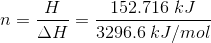

We have, molar mass of propane, M= 44 g/mol
Therefore, mass of propane required:

 |
Volume of propane:

 |
__________________________________________________________________________
Hope this helped for your studies. Keep learning. Have a good day.
Feel free to clear any doubts at the comment section.
Please don't forget to give a thumps
up.
Thank you. :)
Add Answer to:
How much propane, C5H12 (l), in both g and mL would you need to
combust in...
GIVEN INFO LP gas burns according to the following exothermic reaction: C3H8(g)+5O2(g)→3CO2(g)+4H2O(g) ΔH∘rxn= −2044kJ What mass...
GIVEN INFO LP gas burns according to the following exothermic reaction: C3H8(g)+5O2(g)→3CO2(g)+4H2O(g) ΔH∘rxn= −2044kJ What mass of LP gas is necessary to heat 1.4 L of water from room temperature (25.0 C) to boiling (100.0 C)? Assume that during heating, 16% of the heat emitted by the LP gas combustion goes to heat the water. The rest is lost as heat to the surroundings. Express your answer using two significant figures. FINAL ANWSER SHOULD BE IN GRAMS ?
A calorimeter contains 26.0 mL of water at 13.5 ∘C . When 2.50 g of X...
A calorimeter contains 26.0 mL of water at 13.5 ∘C . When 2.50 g of X (a substance with a molar mass of 51.0 g/mol ) is added, it dissolves via the reaction X(s)+H2O(l)→X(aq) and the temperature of the solution increases to 30.0 ∘C . Calculate the enthalpy change, ΔH, for this reaction per mole of X. Assume that the specific heat of the resulting solution is equal to that of water [4.18 J/(g⋅∘C)], that density of water is 1.00...
A calorimeter contains 25.0 mL of water at 13.0 ∘C . When 2.40 g of X...
A calorimeter contains 25.0 mL of water at 13.0 ∘C . When 2.40 g of X (a substance with a molar mass of 64.0 g/mol ) is added, it dissolves via the reaction X(s)+H2O(l)→X(aq) and the temperature of the solution increases to 30.0 ∘C . Calculate the enthalpy change, ΔH, for this reaction per mole of X. Assume that the specific heat of the resulting solution is equal to that of water [4.18 J/(g⋅∘C)], that density of water is 1.00...
A calorimeter contains 17.0 mL of water at 15.0 ∘C . When 1.40 g of X...
A calorimeter contains 17.0 mL of water at 15.0 ∘C . When 1.40 g of X (a substance with a molar mass of 42.0 g/mol ) is added, it dissolves via the reaction X(s)+H2O(l)→X(aq) and the temperature of the solution increases to 26.5 ∘C . Calculate the enthalpy change, ΔH, for this reaction per mole of X. Assume that the specific heat of the resulting solution is equal to that of water [4.18 J/(g⋅∘C)], that density of water is 1.00...
1a. A calorimeter contains 34.0 mL of water at 15.0 ∘C . When 2.40 g of...
1a. A calorimeter contains 34.0 mL of water at 15.0 ∘C . When 2.40 g of X (a substance with a molar mass of 62.0 g/mol ) is added, it dissolves via the reaction X(s)+H2O(l)→X(aq) and the temperature of the solution increases to 30.0 ∘C . Calculate the enthalpy change, ΔH, for this reaction per mole of X. Assume that the specific heat of the resulting solution is equal to that of water [4.18 J/(g⋅∘C)], that density of water is...
A calorimeter contains 35.0 mL of water at 14.5 ∘C . When 1.80 g of X...
A calorimeter contains 35.0 mL of water at 14.5 ∘C . When 1.80 g of X (a substance with a molar mass of 62.0 g/mol ) is added, it dissolves via the reaction X(s)+H2O(l)→X(aq) and the temperature of the solution increases to 28.5 ∘C . Calculate the enthalpy change, ΔH, for this reaction per mole of X. Assume that the specific heat of the resulting solution is equal to that of water [4.18 J/(g⋅∘C)], that density of water is 1.00...
A calorimeter contains 16.0 mL of water at 14.5 ∘C . When 2.50 g of X...
A calorimeter contains 16.0 mL of water at 14.5 ∘C . When 2.50 g of X (a substance with a molar mass of 48.0 g/mol ) is added, it dissolves via the reaction X(s)+H2O(l)→X(aq) and the temperature of the solution increases to 27.0 ∘C . Calculate the enthalpy change, ΔH, for this reaction per mole of X. Assume that the specific heat of the resulting solution is equal to that of water [4.18 J/(g⋅∘C)], that density of water is 1.00...
A calorimeter contains 23.0 mL of water at 11.5 ∘C . When 1.90 g of X...
A calorimeter contains 23.0 mL of water at 11.5 ∘C . When 1.90 g of X (a substance with a molar mass of 76.0 g/mol ) is added, it dissolves via the reaction X(s)+H2O(l)→X(aq) and the temperature of the solution increases to 25.5 ∘C . Calculate the enthalpy change, ΔH, for this reaction per mole of X. Assume that the specific heat of the resulting solution is equal to that of water [4.18 J/(g⋅∘C)], that density of water is 1.00...
A calorimeter contains 29.0 mL of water at 14.0 ∘C . When 1.30 g of X (a substance with a molar mass of 61.0 g/mol ) is...
A calorimeter contains 29.0 mL of water at 14.0 ∘C . When 1.30 g of X (a substance with a molar mass of 61.0 g/mol ) is added, it dissolves via the reaction X(s)+H2O(l)→X(aq) and the temperature of the solution increases to 27.0 ∘C . Calculate the enthalpy change, ΔH, for this reaction per mole of X. Assume that the specific heat of the resulting solution is equal to that of water [4.18 J/(g⋅∘C)], that density of water is 1.00...
A calorimeter contains 35.0 mL of water at 12.0 ∘C . When 2.30 g of X...
A calorimeter contains 35.0 mL of water at 12.0 ∘C . When 2.30 g of X (a substance with a molar mass of 70.0 g/mol ) is added, it dissolves via the reaction X(s)+H2O(l)→X(aq) and the temperature of the solution increases to 26.5 ∘C . Calculate the enthalpy change, ΔH, for this reaction per mole of X. Assume that the specific heat of the resulting solution is equal to that of water [4.18 J/(g⋅∘C)], that density of water is 1.00...
Most questions answered within 3 hours.
-
Where is the error in this code sequence?
String s1 = "Hello";
String s2 = "ello";...
asked 10 months ago -
Financial data for Joel de Paris, Inc., for last year
follow:
Joel de Paris, Inc.
Balance...
asked 10 months ago -
Consider this reaction:
Al2(SO4)3 (aq)+ BaCl3
(aq) Al2Cl6 (aq)- +
3BaSO4(s) . What is the...
asked 10 months ago -
Suppose that Savneet is considering increasing her
recent random sample from 20 car rentals to 40...
asked 10 months ago -
Trucks arrive at an unloading terminal at an average rate of 120
per hour.
Trucks arrive...
asked 10 months ago -
Why are methanol and ethanol completely soluble in water while
octanol is not very little soluble....
asked 10 months ago -
A facilities manager at a university reads in a research report
that the mean amount of...
asked 10 months ago -
When the CuSO4 is rehydrated by adding water to the anhydrous
compound, is this an endothermic...
asked 10 months ago -
A ray of sunlight is passing from diamond into crown glass; the
angle of incidence is...
asked 10 months ago -
A block of mass 0.249 kg is placed on top of a light, vertical
spring of...
asked 10 months ago -
how do the kidneys compensate in the presences of acidosis
a) trigger hyperventilate
b) reserve acid...
asked 10 months ago -
Question 501 pts
The rental rate of capital to the firm increases. Which of the
following...
asked 10 months ago