
Homework Answers
Lets number the reaction as 1, 2, 3, 4 from top to bottom
required reaction should be written in terms of other reaction
This is Hess Law
required reaction can be written as:
reaction 4 = -0.5 * (reaction 1) -0.5 * (reaction 2) +0.5 * (reaction 3)
So, ΔHo rxn for required reaction will be:
ΔHo rxn = -0.5 * ΔHo rxn(reaction 1) -0.5 * ΔHo rxn(reaction 2) +0.5 * ΔHo rxn(reaction 3)
= -0.5 * (436.4) -0.5 * (192.5) +0.5 * (-72.4)
= -350.65 KJ
Answer: -350.65 KJ
Add Answer to:
You are provided the following data: H2(g) → 2 H(g) Br(g) → 2 Br(g) H2(g) +...
Enter your answer in the provided box. You are given the following data: H2(g) → 2H(g)...
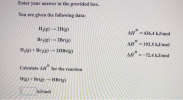 Enter your answer in the provided box. You are given the following data: H2(g) → 2H(g) Br2(g) → 2Br(g) AH = 436.4 kJ/mol AH = 192.5 kJ/mol H2(g) + Br2(g) → 2HBr(g) AH = -72.4 kJ/mol Calculate Ahº for the reaction H(g) + Br(g) — HBr(g) kJ/mol
8. A typical candy bar has 35.0 g of glucose. The human body generates energy from glucose by the thermochemical eq...
 8. A typical candy bar has 35.0 g of glucose. The human body generates energy from glucose by the thermochemical equation provided below CaH2O(s) +6 0;(g) 6 CO:(g ) + 6 H2O(0) AH 670 kcal How much energy is obtained from the digestion of a typical candy bar? Show your work Final Answer 9. You are provided the following data: H2(g) 2 H(g) Br(g) 2 Br(g) H2(g) + Br(g)2 HBr(g) AH 436.4 kJ/mol AH 192.5 kJ/mol AH-72.4 kJ/mol Calculate AH...
8. A typical candy bar has 35.0 g of glucose. The human body generates energy from...
 8. A typical candy bar has 35.0 g of glucose. The human body generates energy from glucose by the thermochemical equation provided below CH,204(s) + 6 02(g) → 6 CO2(g) + 6 H20(1) AH = -670 kcal How much energy is obtained from the digestion of a typical candy bar? Show your work Final Answer You are provided the following data: H2(g) → 2 Hg) Br(g) → 2 Br(g) H2(g) + Bra(g) → 2 HBr(g) AH = 436.4 kJ/mol AH...
Please write clearly and use sig figs. thanks in advance 8. A typical candy bar has 35.0 g of glucose. The human body g...
 Please write clearly and use sig figs. thanks in advance
8. A typical candy bar has 35.0 g of glucose. The human body generates energy from glucose by the thermochemical equation provided below C6H1206(S) + 6 O2(g) → 6 CO2(g) + 6 H2O(1) AH=-670 kcal How much energy is obtained from the digestion of a typical candy bar? Show your work Final Answer You are provided the following data: H2(g) → 2 H(g) Br(g) → 2 Br(g) H2(g) + Br2(g)...
Please write clearly and use sig figs. thanks in advance
8. A typical candy bar has 35.0 g of glucose. The human body generates energy from glucose by the thermochemical equation provided below C6H1206(S) + 6 O2(g) → 6 CO2(g) + 6 H2O(1) AH=-670 kcal How much energy is obtained from the digestion of a typical candy bar? Show your work Final Answer You are provided the following data: H2(g) → 2 H(g) Br(g) → 2 Br(g) H2(g) + Br2(g)...
You are provs the Rollow g dist AH-436.4 kJ/mol AH-192.5 kJ/nol AH-72.4 kJ/mol Hod) 2 H) RMEtC (8) H) + Br() 2 HBrg)...
 You are provs the Rollow g dist AH-436.4 kJ/mol AH-192.5 kJ/nol AH-72.4 kJ/mol Hod) 2 H) RMEtC (8) H) + Br() 2 HBrg) Caleulate At Ror the reaction (ह)।{।। - (त)।।। + ()। Show your work What is AH?
6. Given the following data: Brig) 2 Brig) ΔΗ'-192.5 kJ/mol H2(g) + Br2(g)-) 2HBr(g) ΔΜ"--72.4 k/mol...
 6. Given the following data: Brig) 2 Brig) ΔΗ'-192.5 kJ/mol H2(g) + Br2(g)-) 2HBr(g) ΔΜ"--72.4 k/mol Calculate ΔΗ' for the reaction below H(g) + Br(g) - HBr(g)
A chemist measures the enthalpy change AH during the following reaction: 3 CH,Br(g) + NH3(9) (CH3),N(1)...
 A chemist measures the enthalpy change AH during the following reaction: 3 CH,Br(g) + NH3(9) (CH3),N(1) + 3 HBr(9) AH=73. kJ Use this information to complete the table below. Round each of your answers to the nearest kJ/mol, reaction ΔΗ Ok CH,Br(g) + 3NH,(8) ► ? (ch,),N(!) + 2 H Br() 2(CH3),N(1) + 6HBr(g) — 6CH,Br(g) + 2NH, () x Ś ? A ПkJ (CHR),N(1) + 3H Br(g) — 3CH,Br(g) + NH3(8) OkJ
5. For the overall exothermic reaction: H2(g) + Br2(g) → 2HBr(g) the following mechanism was determined:...
 5. For the overall exothermic reaction: H2(g) + Br2(g) → 2HBr(g) the following mechanism was determined: fast Equilibrium Step 1: Brz(8) 2Br(g) Step 2: H2(g) + Br(g)_52HBr(g) + H(g) Step 3: H(g) + Br(g) k3 HBr(g) slow fast Use a plot of AH versus Reaction Pathway to illustrate the three step reaction profile.
For the reaction: H2(g)+C2H4(g)-->C2H6(g) Bond & Bond Enthalpy H-H 436.4 kJ/mole C-H 414 kJ/mol C-C 347...
For the reaction: H2(g)+C2H4(g)-->C2H6(g) Bond & Bond Enthalpy H-H 436.4 kJ/mole C-H 414 kJ/mol C-C 347 kJ/mol C=C 620 kJ/mol Substance & delta Hf H2 0 C2H4 52.3 C2H6 -84.7 (a) estimate the enthalpy of reaction, using the bond enthalpy values from the table in kJ/mol (b) Calculate the enthalpy of reaction, using standard enthalpies of formation
Consider the reaction: 2HBR(g) >H2(g) + Br2() Using standard thermodynamic data at 298K, calculate the free...
 Consider the reaction: 2HBR(g) >H2(g) + Br2() Using standard thermodynamic data at 298K, calculate the free energy change when 1.51 moles of HBr(g) react at standard conditions AG° kJ rxn AHof (kJ/mol) AG°F (kJ/mol) s° (J/mol K) Beryllium Вe(s) 0 9.5 -569.0 ВeO(s) -599.0 14.0 Be(ОН)2(s) -902.5 -815.0 51.9 AH°f (kJ/mol) AG°f (kJ/mol) s° (J/mol K) Bromine Br(g) 111.9 175.0 82.4 Br2() 152.2 0 0 Br2(g) 30.9 3.1 245.5 Br2(aq) -3.0 4.0 130.0 -121.0 -175.0 82.0 Br (aq) BrF3(g) -255.6...
 Enter your answer in the provided box. You are given the following data: H2(g) → 2H(g) Br2(g) → 2Br(g) AH = 436.4 kJ/mol AH = 192.5 kJ/mol H2(g) + Br2(g) → 2HBr(g) AH = -72.4 kJ/mol Calculate Ahº for the reaction H(g) + Br(g) — HBr(g) kJ/mol
 8. A typical candy bar has 35.0 g of glucose. The human body generates energy from glucose by the thermochemical equation provided below CaH2O(s) +6 0;(g) 6 CO:(g ) + 6 H2O(0) AH 670 kcal How much energy is obtained from the digestion of a typical candy bar? Show your work Final Answer 9. You are provided the following data: H2(g) 2 H(g) Br(g) 2 Br(g) H2(g) + Br(g)2 HBr(g) AH 436.4 kJ/mol AH 192.5 kJ/mol AH-72.4 kJ/mol Calculate AH...
 8. A typical candy bar has 35.0 g of glucose. The human body generates energy from glucose by the thermochemical equation provided below CH,204(s) + 6 02(g) → 6 CO2(g) + 6 H20(1) AH = -670 kcal How much energy is obtained from the digestion of a typical candy bar? Show your work Final Answer You are provided the following data: H2(g) → 2 Hg) Br(g) → 2 Br(g) H2(g) + Bra(g) → 2 HBr(g) AH = 436.4 kJ/mol AH...
 Please write clearly and use sig figs. thanks in advance
8. A typical candy bar has 35.0 g of glucose. The human body generates energy from glucose by the thermochemical equation provided below C6H1206(S) + 6 O2(g) → 6 CO2(g) + 6 H2O(1) AH=-670 kcal How much energy is obtained from the digestion of a typical candy bar? Show your work Final Answer You are provided the following data: H2(g) → 2 H(g) Br(g) → 2 Br(g) H2(g) + Br2(g)...
Please write clearly and use sig figs. thanks in advance
8. A typical candy bar has 35.0 g of glucose. The human body generates energy from glucose by the thermochemical equation provided below C6H1206(S) + 6 O2(g) → 6 CO2(g) + 6 H2O(1) AH=-670 kcal How much energy is obtained from the digestion of a typical candy bar? Show your work Final Answer You are provided the following data: H2(g) → 2 H(g) Br(g) → 2 Br(g) H2(g) + Br2(g)...
 You are provs the Rollow g dist AH-436.4 kJ/mol AH-192.5 kJ/nol AH-72.4 kJ/mol Hod) 2 H) RMEtC (8) H) + Br() 2 HBrg) Caleulate At Ror the reaction (ह)।{।। - (त)।।। + ()। Show your work What is AH?
 6. Given the following data: Brig) 2 Brig) ΔΗ'-192.5 kJ/mol H2(g) + Br2(g)-) 2HBr(g) ΔΜ"--72.4 k/mol Calculate ΔΗ' for the reaction below H(g) + Br(g) - HBr(g)
 A chemist measures the enthalpy change AH during the following reaction: 3 CH,Br(g) + NH3(9) (CH3),N(1) + 3 HBr(9) AH=73. kJ Use this information to complete the table below. Round each of your answers to the nearest kJ/mol, reaction ΔΗ Ok CH,Br(g) + 3NH,(8) ► ? (ch,),N(!) + 2 H Br() 2(CH3),N(1) + 6HBr(g) — 6CH,Br(g) + 2NH, () x Ś ? A ПkJ (CHR),N(1) + 3H Br(g) — 3CH,Br(g) + NH3(8) OkJ
 5. For the overall exothermic reaction: H2(g) + Br2(g) → 2HBr(g) the following mechanism was determined: fast Equilibrium Step 1: Brz(8) 2Br(g) Step 2: H2(g) + Br(g)_52HBr(g) + H(g) Step 3: H(g) + Br(g) k3 HBr(g) slow fast Use a plot of AH versus Reaction Pathway to illustrate the three step reaction profile.
 Consider the reaction: 2HBR(g) >H2(g) + Br2() Using standard thermodynamic data at 298K, calculate the free energy change when 1.51 moles of HBr(g) react at standard conditions AG° kJ rxn AHof (kJ/mol) AG°F (kJ/mol) s° (J/mol K) Beryllium Вe(s) 0 9.5 -569.0 ВeO(s) -599.0 14.0 Be(ОН)2(s) -902.5 -815.0 51.9 AH°f (kJ/mol) AG°f (kJ/mol) s° (J/mol K) Bromine Br(g) 111.9 175.0 82.4 Br2() 152.2 0 0 Br2(g) 30.9 3.1 245.5 Br2(aq) -3.0 4.0 130.0 -121.0 -175.0 82.0 Br (aq) BrF3(g) -255.6...
Most questions answered within 3 hours.
-
Where is the error in this code sequence?
String s1 = "Hello";
String s2 = "ello";...
asked 10 months ago -
Financial data for Joel de Paris, Inc., for last year
follow:
Joel de Paris, Inc.
Balance...
asked 10 months ago -
Consider this reaction:
Al2(SO4)3 (aq)+ BaCl3
(aq) Al2Cl6 (aq)- +
3BaSO4(s) . What is the...
asked 10 months ago -
Suppose that Savneet is considering increasing her
recent random sample from 20 car rentals to 40...
asked 10 months ago -
Trucks arrive at an unloading terminal at an average rate of 120
per hour.
Trucks arrive...
asked 10 months ago -
Why are methanol and ethanol completely soluble in water while
octanol is not very little soluble....
asked 10 months ago -
A facilities manager at a university reads in a research report
that the mean amount of...
asked 10 months ago -
When the CuSO4 is rehydrated by adding water to the anhydrous
compound, is this an endothermic...
asked 10 months ago -
A ray of sunlight is passing from diamond into crown glass; the
angle of incidence is...
asked 10 months ago -
A block of mass 0.249 kg is placed on top of a light, vertical
spring of...
asked 10 months ago -
how do the kidneys compensate in the presences of acidosis
a) trigger hyperventilate
b) reserve acid...
asked 10 months ago -
Question 501 pts
The rental rate of capital to the firm increases. Which of the
following...
asked 10 months ago