
Homework Answers
Add Answer to:
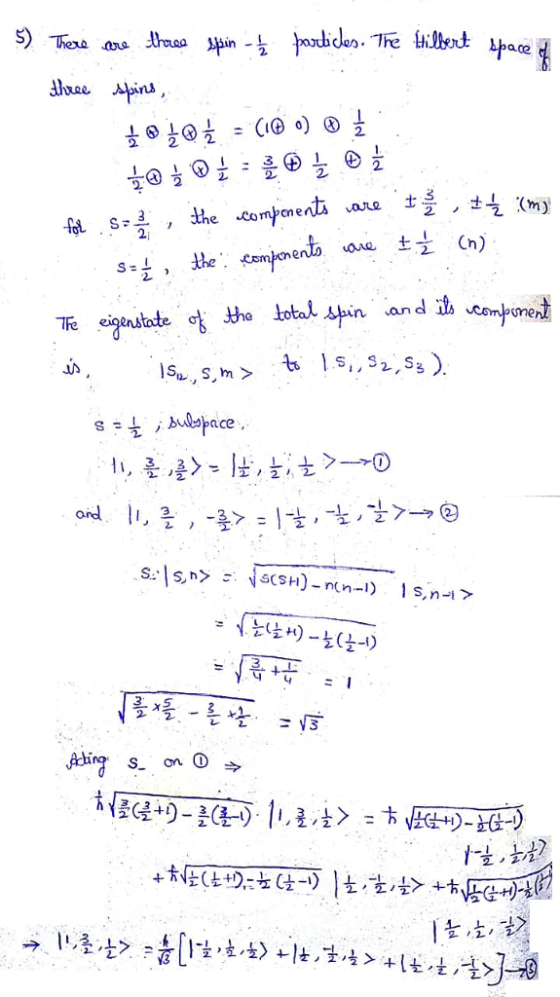
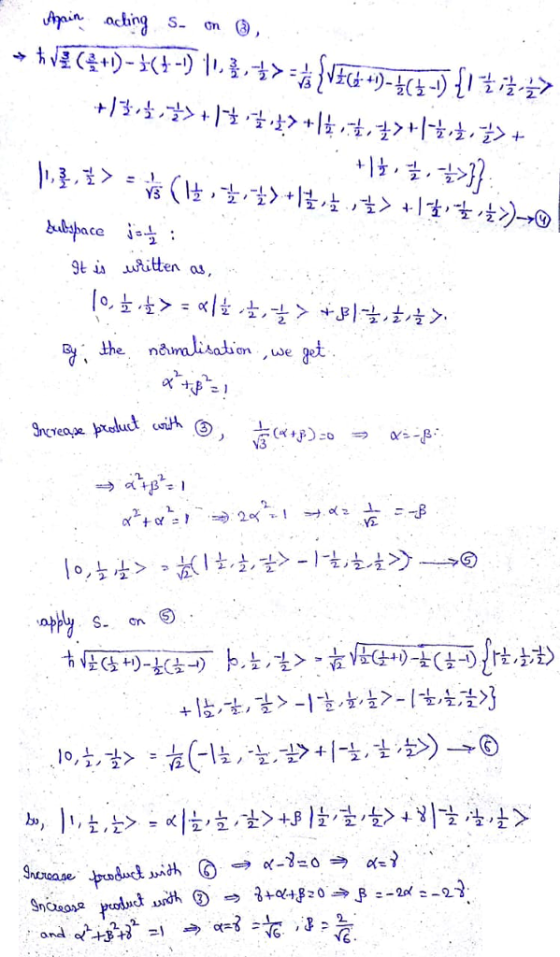
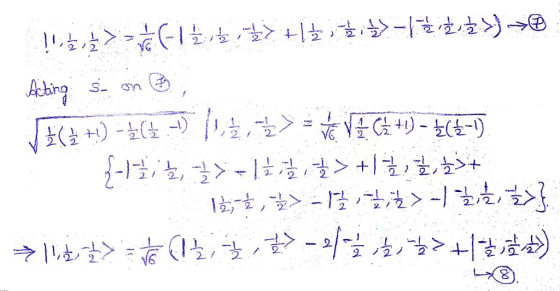
5. Let S-S, + S2 + S, be the total angular momentum of three spin 1/2...
Problem 1. (20 points) Consider two electrons, each with spin angular momentum s,-1/2 and orbital angular momentum ,-1....
 Problem 1. (20 points) Consider two electrons, each with spin angular momentum s,-1/2 and orbital angular momentum ,-1. (a) (3 points) What are the possible values of the quantum number L for the total orbital angular momentum L-L+L,? (b) ( 2 points) What are the possible values of the quantum number S for the total spin angular momentum S-S,+S, (c) Points) Using the results from (a) and (b), find the possible quantum number J for the total angular momentum J-L+S....
Find the eigenvalue of the total spin angular momentum operator, s^2. 2) Find the eigenvalue of...
 Find the eigenvalue of the total spin angular momentum
operator, s^2.
2) Find the eigenvalue of the total spin angular momentum operator, $2.
Find the eigenvalue of the total spin angular momentum
operator, s^2.
2) Find the eigenvalue of the total spin angular momentum operator, $2.
part A is right above part B. Both were uploaded together Write the four vectors S,...
 part A is right above part B. Both were uploaded together
Write the four vectors S, S = 1/2,m) (see Problem 21(b)] in terms of , ,) and determine the eigenvalues. (a) J, J2, and J3 are commuting angular momentum operators. Show that the operator § = (ſ* Ì2) İ3, commutes with the total angular momentum j = 31 +32 +33. (This implies that commutes with J? as well.) (b) S1, S2, and S3 are commuting spin-1/2 operators. Let 5,...
part A is right above part B. Both were uploaded together
Write the four vectors S, S = 1/2,m) (see Problem 21(b)] in terms of , ,) and determine the eigenvalues. (a) J, J2, and J3 are commuting angular momentum operators. Show that the operator § = (ſ* Ì2) İ3, commutes with the total angular momentum j = 31 +32 +33. (This implies that commutes with J? as well.) (b) S1, S2, and S3 are commuting spin-1/2 operators. Let 5,...
qm 2019.3 3. The Hamiltonian corresponding to the magnetic interaction of a spin 1/2 particle with...
 qm 2019.3
3. The Hamiltonian corresponding to the magnetic interaction of a spin 1/2 particle with charge e and mass m in a magnetic field B is À eB B. Ŝ, m where Ŝ are the spin angular momentum operators. You should make use of expres- sions for the spin operators that are given at the end of the question. (i) Write down the energy eigenvalue equation for this particle in a field directed along the y axis, i.e. B...
qm 2019.3
3. The Hamiltonian corresponding to the magnetic interaction of a spin 1/2 particle with charge e and mass m in a magnetic field B is À eB B. Ŝ, m where Ŝ are the spin angular momentum operators. You should make use of expres- sions for the spin operators that are given at the end of the question. (i) Write down the energy eigenvalue equation for this particle in a field directed along the y axis, i.e. B...
1. (20 points) Using the eigenstates of S, as the basis, (a) determine the eigenvalues and...
 1. (20 points) Using the eigenstates of S, as the basis, (a) determine the eigenvalues and eigenstates of Sy; (b) determine the eigenvalues and eigenstates of S.ñ, where S is the spin-1/2 angular momentum, ñ is an unit vector. 2.(30 points) Consider a system with j = 1. (a) Explicitly write down <j = 1, m'J j = 1, m > in 3 x 3 matrix form. (b) Determine the eigenstate and eigenvectors of Jr. (c) Consider the eigenstate of...
PLEASE COMPLETE B) and stay tuned for my following 2 questions where I will ask part c) and d). P...
 PLEASE COMPLETE B) and stay tuned for my
following 2 questions where I will ask part c) and d). Part a) has
already been posted.
The lowest energy state of a hydrogen-like atom has total angular momentum J-1/2 (from the l-O orbital angular momentum and the electron spin s 1/2). Furthermore, the nucleus also has a spin, conventionally labeled I (for hydrogen, this is the proton spin, 1 1/2). This spin leads to an additional degeneracy. For example, in the...
PLEASE COMPLETE B) and stay tuned for my
following 2 questions where I will ask part c) and d). Part a) has
already been posted.
The lowest energy state of a hydrogen-like atom has total angular momentum J-1/2 (from the l-O orbital angular momentum and the electron spin s 1/2). Furthermore, the nucleus also has a spin, conventionally labeled I (for hydrogen, this is the proton spin, 1 1/2). This spin leads to an additional degeneracy. For example, in the...
Question #2: 6 pts] Find the eigenvalues and the normalized eigenvectors of the matrix 21 2...
 Question #2: 6 pts] Find the eigenvalues and the normalized eigenvectors of the matrix 21 2 -1 2 Question #3: 10 pts] The electron in a hydrogen atom is a linear combination of eigenstates. Let us assume a limited linear combination to provide some sample calculations $(r, θ, φ) 2 ,1,0,0 + '2,1,0 (a) Normalize the above equation. (b) What are the possible results of individual measurements of energy, angular momentum, and the z-component of angular momentum? (c) What are...
2. Spin-1/2 system: (20 points) The Pauli matrices are, 0 -1 from which we can define...
 2. Spin-1/2 system: (20 points) The Pauli matrices are, 0 -1 from which we can define the spin matrices, s.-슬&z, Šv = , S.-출.. We'll use the eigenkets of S that, for the spin half system, they can be represented by the spinors, a) Show, by matrix multiplication that |+) and |-) are eigenstates of the S operator and determine the eigenvalues. Show that they are not eigenstates of S and Sy b) Show that the matrix squares s ,...
(L43*) Spin can be represented by matrices. Show that all three spin matrices l 0 2 0 -1 0),"2=2 1 have eigenval...
 (L43*) Spin can be represented by matrices. Show that all three spin matrices l 0 2 0 -1 0),"2=2 1 have eigenvalues of +1/2h and -1/2h. Calculate the corresponding eigenfunctions which we will denote as α-and β-eigenfunctions corresponding to spin l/2 particles. Show that Sj can be determined by the commutation of the other two matrices sn and sm, n, maj. Prove that the (2×2) matrix sz-s' +ss+s, commutes with all spin matrices, ie. s2s,-sis-. Calculate the eigenvalues of s2....
A spin-1 particle interacts with an external magnetic field B = B. The interaction Hamiltonian for the system is H = gB-S, where S-Si + Sỳ + SE is the spin operator. (Ignore all degrees of freedom ot...
 A spin-1 particle interacts with an external magnetic field B = B. The interaction Hamiltonian for the system is H = gB-S, where S-Si + Sỳ + SE is the spin operator. (Ignore all degrees of freedom other than spin.) (a) Find the spin matrices in the basis of the S. S eigenstates, |s, m)) . (Hint: Use the ladder operators, S -S, iS, and S_-S-iS,, and show first that s_ | 1,0-ћ /2 | 1.-1)) . Then use these...
 Problem 1. (20 points) Consider two electrons, each with spin angular momentum s,-1/2 and orbital angular momentum ,-1. (a) (3 points) What are the possible values of the quantum number L for the total orbital angular momentum L-L+L,? (b) ( 2 points) What are the possible values of the quantum number S for the total spin angular momentum S-S,+S, (c) Points) Using the results from (a) and (b), find the possible quantum number J for the total angular momentum J-L+S....
 Find the eigenvalue of the total spin angular momentum
operator, s^2.
2) Find the eigenvalue of the total spin angular momentum operator, $2.
Find the eigenvalue of the total spin angular momentum
operator, s^2.
2) Find the eigenvalue of the total spin angular momentum operator, $2.
 part A is right above part B. Both were uploaded together
Write the four vectors S, S = 1/2,m) (see Problem 21(b)] in terms of , ,) and determine the eigenvalues. (a) J, J2, and J3 are commuting angular momentum operators. Show that the operator § = (ſ* Ì2) İ3, commutes with the total angular momentum j = 31 +32 +33. (This implies that commutes with J? as well.) (b) S1, S2, and S3 are commuting spin-1/2 operators. Let 5,...
part A is right above part B. Both were uploaded together
Write the four vectors S, S = 1/2,m) (see Problem 21(b)] in terms of , ,) and determine the eigenvalues. (a) J, J2, and J3 are commuting angular momentum operators. Show that the operator § = (ſ* Ì2) İ3, commutes with the total angular momentum j = 31 +32 +33. (This implies that commutes with J? as well.) (b) S1, S2, and S3 are commuting spin-1/2 operators. Let 5,...
 qm 2019.3
3. The Hamiltonian corresponding to the magnetic interaction of a spin 1/2 particle with charge e and mass m in a magnetic field B is À eB B. Ŝ, m where Ŝ are the spin angular momentum operators. You should make use of expres- sions for the spin operators that are given at the end of the question. (i) Write down the energy eigenvalue equation for this particle in a field directed along the y axis, i.e. B...
qm 2019.3
3. The Hamiltonian corresponding to the magnetic interaction of a spin 1/2 particle with charge e and mass m in a magnetic field B is À eB B. Ŝ, m where Ŝ are the spin angular momentum operators. You should make use of expres- sions for the spin operators that are given at the end of the question. (i) Write down the energy eigenvalue equation for this particle in a field directed along the y axis, i.e. B...
 1. (20 points) Using the eigenstates of S, as the basis, (a) determine the eigenvalues and eigenstates of Sy; (b) determine the eigenvalues and eigenstates of S.ñ, where S is the spin-1/2 angular momentum, ñ is an unit vector. 2.(30 points) Consider a system with j = 1. (a) Explicitly write down <j = 1, m'J j = 1, m > in 3 x 3 matrix form. (b) Determine the eigenstate and eigenvectors of Jr. (c) Consider the eigenstate of...
 PLEASE COMPLETE B) and stay tuned for my
following 2 questions where I will ask part c) and d). Part a) has
already been posted.
The lowest energy state of a hydrogen-like atom has total angular momentum J-1/2 (from the l-O orbital angular momentum and the electron spin s 1/2). Furthermore, the nucleus also has a spin, conventionally labeled I (for hydrogen, this is the proton spin, 1 1/2). This spin leads to an additional degeneracy. For example, in the...
PLEASE COMPLETE B) and stay tuned for my
following 2 questions where I will ask part c) and d). Part a) has
already been posted.
The lowest energy state of a hydrogen-like atom has total angular momentum J-1/2 (from the l-O orbital angular momentum and the electron spin s 1/2). Furthermore, the nucleus also has a spin, conventionally labeled I (for hydrogen, this is the proton spin, 1 1/2). This spin leads to an additional degeneracy. For example, in the...
 Question #2: 6 pts] Find the eigenvalues and the normalized eigenvectors of the matrix 21 2 -1 2 Question #3: 10 pts] The electron in a hydrogen atom is a linear combination of eigenstates. Let us assume a limited linear combination to provide some sample calculations $(r, θ, φ) 2 ,1,0,0 + '2,1,0 (a) Normalize the above equation. (b) What are the possible results of individual measurements of energy, angular momentum, and the z-component of angular momentum? (c) What are...
 2. Spin-1/2 system: (20 points) The Pauli matrices are, 0 -1 from which we can define the spin matrices, s.-슬&z, Šv = , S.-출.. We'll use the eigenkets of S that, for the spin half system, they can be represented by the spinors, a) Show, by matrix multiplication that |+) and |-) are eigenstates of the S operator and determine the eigenvalues. Show that they are not eigenstates of S and Sy b) Show that the matrix squares s ,...
 (L43*) Spin can be represented by matrices. Show that all three spin matrices l 0 2 0 -1 0),"2=2 1 have eigenvalues of +1/2h and -1/2h. Calculate the corresponding eigenfunctions which we will denote as α-and β-eigenfunctions corresponding to spin l/2 particles. Show that Sj can be determined by the commutation of the other two matrices sn and sm, n, maj. Prove that the (2×2) matrix sz-s' +ss+s, commutes with all spin matrices, ie. s2s,-sis-. Calculate the eigenvalues of s2....
 A spin-1 particle interacts with an external magnetic field B = B. The interaction Hamiltonian for the system is H = gB-S, where S-Si + Sỳ + SE is the spin operator. (Ignore all degrees of freedom other than spin.) (a) Find the spin matrices in the basis of the S. S eigenstates, |s, m)) . (Hint: Use the ladder operators, S -S, iS, and S_-S-iS,, and show first that s_ | 1,0-ћ /2 | 1.-1)) . Then use these...
Most questions answered within 3 hours.
-
Where is the error in this code sequence?
String s1 = "Hello";
String s2 = "ello";...
asked 10 months ago -
Financial data for Joel de Paris, Inc., for last year
follow:
Joel de Paris, Inc.
Balance...
asked 10 months ago -
Consider this reaction:
Al2(SO4)3 (aq)+ BaCl3
(aq) Al2Cl6 (aq)- +
3BaSO4(s) . What is the...
asked 10 months ago -
Suppose that Savneet is considering increasing her
recent random sample from 20 car rentals to 40...
asked 10 months ago -
Trucks arrive at an unloading terminal at an average rate of 120
per hour.
Trucks arrive...
asked 10 months ago -
Why are methanol and ethanol completely soluble in water while
octanol is not very little soluble....
asked 10 months ago -
A facilities manager at a university reads in a research report
that the mean amount of...
asked 10 months ago -
When the CuSO4 is rehydrated by adding water to the anhydrous
compound, is this an endothermic...
asked 10 months ago -
A ray of sunlight is passing from diamond into crown glass; the
angle of incidence is...
asked 10 months ago -
A block of mass 0.249 kg is placed on top of a light, vertical
spring of...
asked 10 months ago -
how do the kidneys compensate in the presences of acidosis
a) trigger hyperventilate
b) reserve acid...
asked 10 months ago -
Question 501 pts
The rental rate of capital to the firm increases. Which of the
following...
asked 10 months ago