
Homework Answers
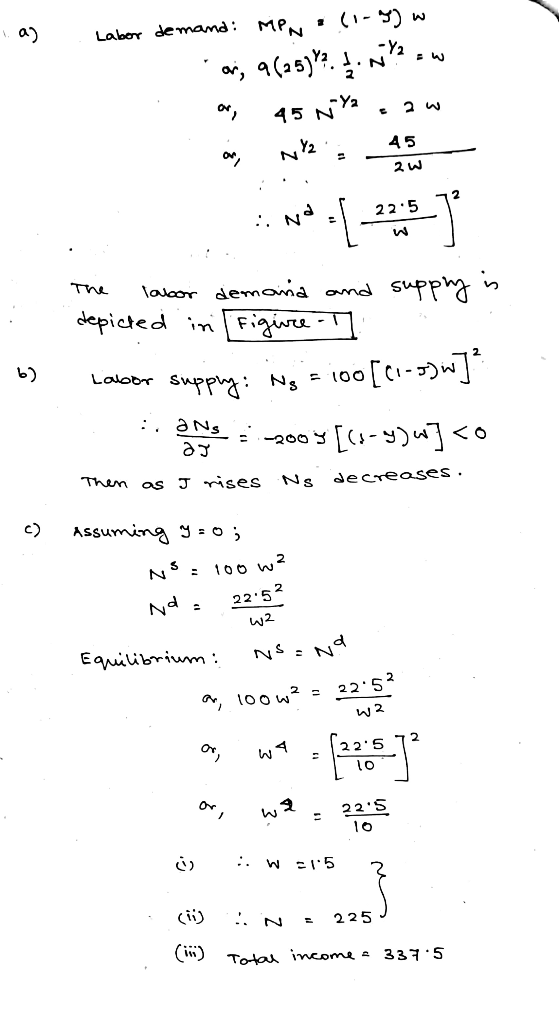
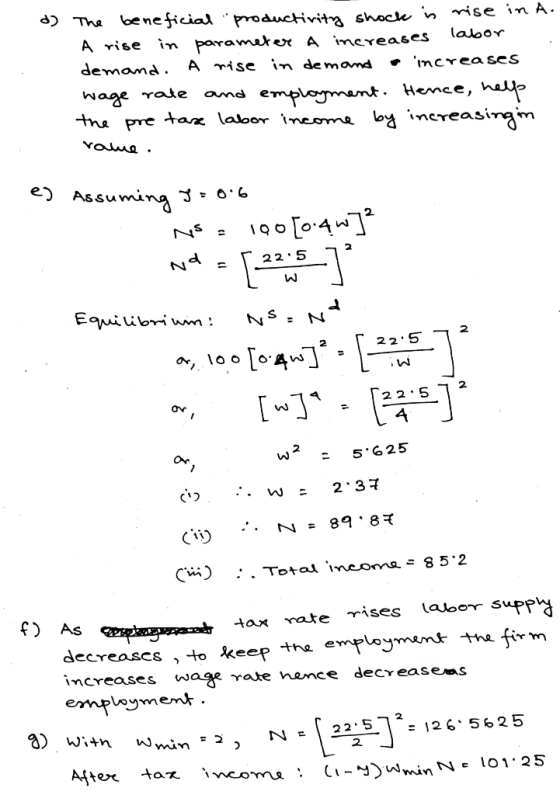
Then, with a minimum wage, the after-tax income of the worker rises with a tax rate of 0.6.
h)
With wmin=2, the market wage rate is 1.5 with t=0.6. Then the minimum wage is not binding and total income remains the same.
Add Answer to:
1. The production function for Belgium is given by Y = AKIN and K 25. 4...
8. Suppose that the production function is Y=5K0.5N0.5. With the production function, the marginal product of...
8. Suppose that the production function is Y=5K0.5N0.5. With the production function, the marginal product of labor is MPN=0.5K0.5N-0.5. The capital stock is K=30. The labor supply curve is NS=100[(1-t)w]2, where w is the real wage rate, t is the tax rate on labor income, and hence (1-t)w is the after-tax real wage rate. a) Assume that the tax rate on labor income, t, equals zero. Find the equation of the labor demand curve. Calculate the equilibrium levels of the real...
3. (55 points total) An economy's aggregate production function is given by Y- A K N-N2....
 3. (55 points total) An economy's aggregate production function is given by Y- A K N-N2. The marginal product of labor for this production function is MPN A K- 2N. (a) (10 points) Assume that A- 8 and K- 10. Suppose that the labor supply function for this economy is given by NS 20+ 2w. Find the equilibrium real wage rate, the full employment level of employment, and the full-employment level of output for this economy Draw a production function...
Suppose that the production function is Y = 9 60.500.5 With this production function, the marginal...
 Suppose that the production function is Y = 9 60.500.5 With this production function, the marginal product of labor is MPN = 4.5 K.5/10.5 The labor supply curve is NS = 105 x[(1 – t)xw], where w is the real wage rate, t is the tax rate on labor income, and hence (1 – t) xw is the after-tax real wage rate. The capital stock is K = 25. Assume that the tax rate on labor income, t, equals zero...
This Question: 2 pts < 26 of 64 (10 complete) Real wage rate (2000 dollars per...
 This Question: 2 pts < 26 of 64 (10 complete) Real wage rate (2000 dollars per hour Draw a labor supply curve and a labor demand ourve. Label them LS, and LD Draw a point the equilibrium quantity of labor and the equilibrium real wage rate. Labelt 1. Draw and label a curve that shows the effect of an increase in labor productivity Draw a point at the new equilibrium quantity of labor and the equilibrium real wage rate Labelit...
EQUILIBRIUM OUTPUT AND EMPLOYMENT 1. Derive the aggregate supply curve in the classical case. (Draw on the critical...
 EQUILIBRIUM OUTPUT AND EMPLOYMENT 1. Derive the aggregate supply curve in the classical case. (Draw on the critical assumptions of classical economists in your explanation). 2. Within the classical model, analyze the following changes to the output equilibrium, price, real wage and employment: (a) decrease in technology (b) influx of foreign workers (c) decrease in money supply. 3. What is the role of money supply in classical theory? If money supply declines, what are the effects on income and price?...
Problem #4: Own-price elasticity Suppose the market labor demand curve is given by LD = 20-(1/2,W...
 Problem #4: Own-price elasticity Suppose the market labor demand curve is given by LD = 20-(1/2,W and the market labor supply curve is given by LS 2 1. Graph the labor demand curve and the labor supply curve on the same graph (with L on the horizontal axis and W on the vertical axis, as we have done in class) 2. Determine the equilibrium employment (L and wage (W in this market 3. Now suppose the government implements a minimum...
Problem #4: Own-price elasticity Suppose the market labor demand curve is given by LD 20- (1/2)W...
 Problem #4: Own-price elasticity Suppose the market labor demand curve is given by LD 20- (1/2)W and the market labor supply curve is given by LS-2W 1. Graph the labor demand curve and the labor supply curve on the same graph (with L on the horizontal axis and W on the vertical axis, as we have done in class). 2. Determine the equilibrium employment (L") and wage (W") in this market. Now suppose the government implements a minimum wage (WM)...
Suppose that under a new law all businesses must pay a tax equal to 6% of...
 Suppose that under a new law all businesses must pay a tax equal
to 6% of their sales revenue. Assume that this tax is not passed
on to consumers. Instead, consumers pay the same prices after the
tax is imposed as they did before.
1.) Use the line drawing tool to show the effect of this change
on the labor market. Properly label your new line.
2.) Use the point drawing tool to identify the new equilibrium
real wage and...
Suppose that under a new law all businesses must pay a tax equal
to 6% of their sales revenue. Assume that this tax is not passed
on to consumers. Instead, consumers pay the same prices after the
tax is imposed as they did before.
1.) Use the line drawing tool to show the effect of this change
on the labor market. Properly label your new line.
2.) Use the point drawing tool to identify the new equilibrium
real wage and...
Consider an economy where the aggregate production function is characterized by the following equation: Y=2N^1/2. The...
Consider an economy where the aggregate production function is characterized by the following equation: Y=2N^1/2. The labor supply curve is given by the following equation: Ns=8(W/P). Derive the labor demand curve and calculate the equilibrium real wage and the equilibrium level of labor.
50 of 64 (28 complete) This Question: 2 pts Real wage rate (2009 dollars per hour)...
 50 of 64 (28 complete) This Question: 2 pts Real wage rate (2009 dollars per hour) a large increase in investment increases labor productivity, explain what happens to a. Potential GDP. b. Employment The real wage rate When labor productivity increases, there is the production function and in potential GDP. O an upwards of an increase OB. a movement up along; an increase OC. a movement up along; no change OD an upward shino, no change Draw a later supply...
 3. (55 points total) An economy's aggregate production function is given by Y- A K N-N2. The marginal product of labor for this production function is MPN A K- 2N. (a) (10 points) Assume that A- 8 and K- 10. Suppose that the labor supply function for this economy is given by NS 20+ 2w. Find the equilibrium real wage rate, the full employment level of employment, and the full-employment level of output for this economy Draw a production function...
 Suppose that the production function is Y = 9 60.500.5 With this production function, the marginal product of labor is MPN = 4.5 K.5/10.5 The labor supply curve is NS = 105 x[(1 – t)xw], where w is the real wage rate, t is the tax rate on labor income, and hence (1 – t) xw is the after-tax real wage rate. The capital stock is K = 25. Assume that the tax rate on labor income, t, equals zero...
 This Question: 2 pts < 26 of 64 (10 complete) Real wage rate (2000 dollars per hour Draw a labor supply curve and a labor demand ourve. Label them LS, and LD Draw a point the equilibrium quantity of labor and the equilibrium real wage rate. Labelt 1. Draw and label a curve that shows the effect of an increase in labor productivity Draw a point at the new equilibrium quantity of labor and the equilibrium real wage rate Labelit...
 EQUILIBRIUM OUTPUT AND EMPLOYMENT 1. Derive the aggregate supply curve in the classical case. (Draw on the critical assumptions of classical economists in your explanation). 2. Within the classical model, analyze the following changes to the output equilibrium, price, real wage and employment: (a) decrease in technology (b) influx of foreign workers (c) decrease in money supply. 3. What is the role of money supply in classical theory? If money supply declines, what are the effects on income and price?...
 Problem #4: Own-price elasticity Suppose the market labor demand curve is given by LD = 20-(1/2,W and the market labor supply curve is given by LS 2 1. Graph the labor demand curve and the labor supply curve on the same graph (with L on the horizontal axis and W on the vertical axis, as we have done in class) 2. Determine the equilibrium employment (L and wage (W in this market 3. Now suppose the government implements a minimum...
 Problem #4: Own-price elasticity Suppose the market labor demand curve is given by LD 20- (1/2)W and the market labor supply curve is given by LS-2W 1. Graph the labor demand curve and the labor supply curve on the same graph (with L on the horizontal axis and W on the vertical axis, as we have done in class). 2. Determine the equilibrium employment (L") and wage (W") in this market. Now suppose the government implements a minimum wage (WM)...
 Suppose that under a new law all businesses must pay a tax equal
to 6% of their sales revenue. Assume that this tax is not passed
on to consumers. Instead, consumers pay the same prices after the
tax is imposed as they did before.
1.) Use the line drawing tool to show the effect of this change
on the labor market. Properly label your new line.
2.) Use the point drawing tool to identify the new equilibrium
real wage and...
Suppose that under a new law all businesses must pay a tax equal
to 6% of their sales revenue. Assume that this tax is not passed
on to consumers. Instead, consumers pay the same prices after the
tax is imposed as they did before.
1.) Use the line drawing tool to show the effect of this change
on the labor market. Properly label your new line.
2.) Use the point drawing tool to identify the new equilibrium
real wage and...
 50 of 64 (28 complete) This Question: 2 pts Real wage rate (2009 dollars per hour) a large increase in investment increases labor productivity, explain what happens to a. Potential GDP. b. Employment The real wage rate When labor productivity increases, there is the production function and in potential GDP. O an upwards of an increase OB. a movement up along; an increase OC. a movement up along; no change OD an upward shino, no change Draw a later supply...
Most questions answered within 3 hours.
-
Where is the error in this code sequence?
String s1 = "Hello";
String s2 = "ello";...
asked 10 months ago -
Financial data for Joel de Paris, Inc., for last year
follow:
Joel de Paris, Inc.
Balance...
asked 10 months ago -
Consider this reaction:
Al2(SO4)3 (aq)+ BaCl3
(aq) Al2Cl6 (aq)- +
3BaSO4(s) . What is the...
asked 10 months ago -
Suppose that Savneet is considering increasing her
recent random sample from 20 car rentals to 40...
asked 10 months ago -
Trucks arrive at an unloading terminal at an average rate of 120
per hour.
Trucks arrive...
asked 10 months ago -
Why are methanol and ethanol completely soluble in water while
octanol is not very little soluble....
asked 10 months ago -
A facilities manager at a university reads in a research report
that the mean amount of...
asked 10 months ago -
When the CuSO4 is rehydrated by adding water to the anhydrous
compound, is this an endothermic...
asked 10 months ago -
A ray of sunlight is passing from diamond into crown glass; the
angle of incidence is...
asked 10 months ago -
A block of mass 0.249 kg is placed on top of a light, vertical
spring of...
asked 10 months ago -
how do the kidneys compensate in the presences of acidosis
a) trigger hyperventilate
b) reserve acid...
asked 10 months ago -
Question 501 pts
The rental rate of capital to the firm increases. Which of the
following...
asked 10 months ago