
Homework Answers
Add Answer to:
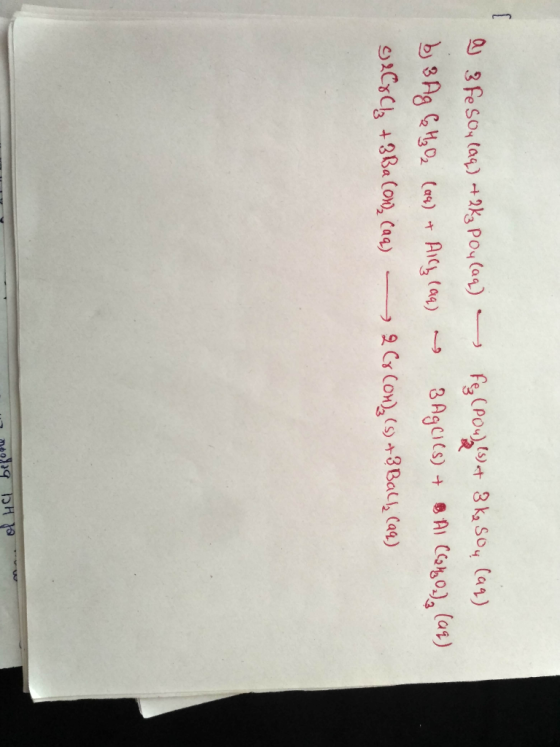
Complete and balance the following molecular equations, being careful to apply the solubility rules. Write balanced...
Please complete the following reactions, and show the balanced molecular, complete ionic, and net ionic equations:...
 Please complete the following reactions, and show the balanced molecular, complete ionic, and net ionic equations: 1. K3PO4 (aq) + Al(NO3)3 (aq) 2. Bel2 (aq) Cu2SO4 (aq) 3. Ni(NO3)3 (aq) + KBr (aq) 4. cobalt(lll)bromide potassium sulfide 5. barium nitrate ammonium phosphate 6. calcium hydroxide iron(Il)chloride 7. rubidium fluoride + copper(II)sulfate Use solubility rules from your periodic table and mention them for precipitates as well as aqueous solutions Return to TOC
INS 1. For the following reactions, write the balanced molecular equation, complete ionic equation, and net...
 INS 1. For the following reactions, write the balanced molecular equation, complete ionic equation, and net ionic equation a) barium chloride(aq) + sodium sulfate(aq) + Balanced Molecular Equation: Complete Ionic Equation: Net Ionic Equation: b) nitric acid(aq) + sodium hydroxide(aq) → Balanced Molecular Equation: Complete Ionic Equation: Net Ionic Equation:
3. Write the balanced molecular and net ionic equations for each of the following to Identify...
 3. Write the balanced molecular and net ionic equations for each of the following to Identify the spectator ions. C O CINU3)2(aq) -> precipitation 2 eactin unite ppt. equations for each of the following reactions. Cr(OH)3 (6 points) HNO3 crcoH)3 + HNO3- CrNO3 + Hy a. Solid chromium(III) hydroxide reacts with nitric acid H - No 3 b. Solid magnesium carbonate reacts with an aqueous solution of sulfuric
Write balanced molecular equations for the following potential precipitation reactions. Indicate the states of reactants and...
Write balanced molecular equations for the following potential precipitation reactions. Indicate the states of reactants and products [(aq) or (s)]. (b) In those cases where a precipitate forms, write the net ionic equation. If there is no reaction, state "No reaction." (i) (NH4)2SO4 (aq) + Cr(NO3)3 (aq) → (ii) K2SO4 (aq) + AgNO3 (aq) → (iii) Cr(CH3CO2)3 (aq) + KOH (aq) → (iv) Mg(ClO3)2 (aq) + K3PO4 (aq) → Each of the following salts can be prepared from an acid...
17. On the basis of the general solubility rules given in Table 7.1, write a balanced...
 17. On the basis of the general solubility rules given in Table 7.1, write a balanced molecular equation for the precipitation reactions that take place when the following aqueous solutions are mixed. Underline the formula of the precipitate (solid) that forms. If no precipitation reaction is likely for the reactants given, explain why. a. ammonium chloride, NH,CI, and sulfuric acid, H,SO b. potassium carbonate, K,CO3, and tin(IV) chloride, Snc c. ammonium chloride, NH CI, and lead(II) nitrate, Pb(NO3) d. copper(II)...
Using the Solubility Rules, write the balanced molecular, total ionic, and net ionic equations (including physical...
Using the Solubility Rules, write the balanced molecular, total ionic, and net ionic equations (including physical states) for the following: Hints: There is no such thing as Na2+ or Na3+. Na is in group 1A, so you know it can only form a +1 charge. (For example, it will form 3 Na+ ions for each Na3PO4.) There is a diatomic molecule Cl2. But when ionic compounds are dissolved in water, they form ions so the dissociation of MgCl2 is to...
Grade (9 points) Write molecular, total lonic, and net ionic equations for the following aqueous double-...
 Grade (9 points) Write molecular, total lonic, and net ionic equations for the following aqueous double- displacement reactions. a. Iron(II) iodide + lithium phosphate Molecular Total lonie: Net lonic: manganese(IT) hydroxide + hydrobromic acid Molecular: Total lonic Net Ionic: c. potassium sulfite + nitrous acid Molecular Total lonic: Net lonic: - 2. (12 points) Write balanced molecular, total ionic, and net ionic equations for the following aqueous single- displacement reactions. Also tell what is oxidized and what is reduced in...
Use your knowledge about solubility rules and reactions to write (1) a balanced chemical equation (molecular...
 Use your knowledge about solubility rules and reactions to write
(1) a balanced chemical equation (molecular equation), (2) a total
ionic equation, and (3) a net ionic equation for th reactions
below. Include the appropriate phase for each species.
(m) NaCO3(aq) + SrCla) - (n) Na2CO3(aq) + H2SO4(aq) (o) SrCl(aq) + H2SO4(aq) →
Use your knowledge about solubility rules and reactions to write
(1) a balanced chemical equation (molecular equation), (2) a total
ionic equation, and (3) a net ionic equation for th reactions
below. Include the appropriate phase for each species.
(m) NaCO3(aq) + SrCla) - (n) Na2CO3(aq) + H2SO4(aq) (o) SrCl(aq) + H2SO4(aq) →
Writing Balanced Molecular, Ionic, And Net Ionic Equations Write Balanced Net-Ionic Equations for the following Reactions...
Writing Balanced Molecular, Ionic, And Net Ionic Equations Write Balanced Net-Ionic Equations for the following Reactions in Aqueous Solution: 1. Copper metal (Cu(s)) is immersed in an aqueous solution of silver nitrate (AgNO3). The solution turns light blue and a silver coating appears on the copper. 2. Dilute solutions of antimony(III) chloride and sodium sulfide are mixed to give a precipitate. 3. Dilute solutions of silver nitrate and potassium iodide are combined and give a yellow precipitate. 4. Dilute solutions...
Net lonic Equations: For each of the following reactions, you will need to write (a) the...
 Net lonic Equations: For each of the following reactions, you will need to write (a) the molecular equation, (b) the ionic equation, and (c) the net ionic equation. You will need to interpret the chemical names into (neutral chemical) formulas and complete the reactions. Be sure to write balanced chemical reactions as well as provide the correct state of matter for each compound in all of your reactions (solubility rules.) Please attach images of your work to receive credit. 5)...
 Please complete the following reactions, and show the balanced molecular, complete ionic, and net ionic equations: 1. K3PO4 (aq) + Al(NO3)3 (aq) 2. Bel2 (aq) Cu2SO4 (aq) 3. Ni(NO3)3 (aq) + KBr (aq) 4. cobalt(lll)bromide potassium sulfide 5. barium nitrate ammonium phosphate 6. calcium hydroxide iron(Il)chloride 7. rubidium fluoride + copper(II)sulfate Use solubility rules from your periodic table and mention them for precipitates as well as aqueous solutions Return to TOC
 INS 1. For the following reactions, write the balanced molecular equation, complete ionic equation, and net ionic equation a) barium chloride(aq) + sodium sulfate(aq) + Balanced Molecular Equation: Complete Ionic Equation: Net Ionic Equation: b) nitric acid(aq) + sodium hydroxide(aq) → Balanced Molecular Equation: Complete Ionic Equation: Net Ionic Equation:
 3. Write the balanced molecular and net ionic equations for each of the following to Identify the spectator ions. C O CINU3)2(aq) -> precipitation 2 eactin unite ppt. equations for each of the following reactions. Cr(OH)3 (6 points) HNO3 crcoH)3 + HNO3- CrNO3 + Hy a. Solid chromium(III) hydroxide reacts with nitric acid H - No 3 b. Solid magnesium carbonate reacts with an aqueous solution of sulfuric
 17. On the basis of the general solubility rules given in Table 7.1, write a balanced molecular equation for the precipitation reactions that take place when the following aqueous solutions are mixed. Underline the formula of the precipitate (solid) that forms. If no precipitation reaction is likely for the reactants given, explain why. a. ammonium chloride, NH,CI, and sulfuric acid, H,SO b. potassium carbonate, K,CO3, and tin(IV) chloride, Snc c. ammonium chloride, NH CI, and lead(II) nitrate, Pb(NO3) d. copper(II)...
 Grade (9 points) Write molecular, total lonic, and net ionic equations for the following aqueous double- displacement reactions. a. Iron(II) iodide + lithium phosphate Molecular Total lonie: Net lonic: manganese(IT) hydroxide + hydrobromic acid Molecular: Total lonic Net Ionic: c. potassium sulfite + nitrous acid Molecular Total lonic: Net lonic: - 2. (12 points) Write balanced molecular, total ionic, and net ionic equations for the following aqueous single- displacement reactions. Also tell what is oxidized and what is reduced in...
 Use your knowledge about solubility rules and reactions to write
(1) a balanced chemical equation (molecular equation), (2) a total
ionic equation, and (3) a net ionic equation for th reactions
below. Include the appropriate phase for each species.
(m) NaCO3(aq) + SrCla) - (n) Na2CO3(aq) + H2SO4(aq) (o) SrCl(aq) + H2SO4(aq) →
Use your knowledge about solubility rules and reactions to write
(1) a balanced chemical equation (molecular equation), (2) a total
ionic equation, and (3) a net ionic equation for th reactions
below. Include the appropriate phase for each species.
(m) NaCO3(aq) + SrCla) - (n) Na2CO3(aq) + H2SO4(aq) (o) SrCl(aq) + H2SO4(aq) →
 Net lonic Equations: For each of the following reactions, you will need to write (a) the molecular equation, (b) the ionic equation, and (c) the net ionic equation. You will need to interpret the chemical names into (neutral chemical) formulas and complete the reactions. Be sure to write balanced chemical reactions as well as provide the correct state of matter for each compound in all of your reactions (solubility rules.) Please attach images of your work to receive credit. 5)...
Most questions answered within 3 hours.
-
Where is the error in this code sequence?
String s1 = "Hello";
String s2 = "ello";...
asked 10 months ago -
Financial data for Joel de Paris, Inc., for last year
follow:
Joel de Paris, Inc.
Balance...
asked 10 months ago -
Consider this reaction:
Al2(SO4)3 (aq)+ BaCl3
(aq) Al2Cl6 (aq)- +
3BaSO4(s) . What is the...
asked 10 months ago -
Suppose that Savneet is considering increasing her
recent random sample from 20 car rentals to 40...
asked 10 months ago -
Trucks arrive at an unloading terminal at an average rate of 120
per hour.
Trucks arrive...
asked 10 months ago -
Why are methanol and ethanol completely soluble in water while
octanol is not very little soluble....
asked 10 months ago -
A facilities manager at a university reads in a research report
that the mean amount of...
asked 10 months ago -
When the CuSO4 is rehydrated by adding water to the anhydrous
compound, is this an endothermic...
asked 10 months ago -
A ray of sunlight is passing from diamond into crown glass; the
angle of incidence is...
asked 10 months ago -
A block of mass 0.249 kg is placed on top of a light, vertical
spring of...
asked 10 months ago -
how do the kidneys compensate in the presences of acidosis
a) trigger hyperventilate
b) reserve acid...
asked 10 months ago -
Question 501 pts
The rental rate of capital to the firm increases. Which of the
following...
asked 10 months ago