
Homework Answers
TOPIC:Markov's inequality.
Add Answer to:
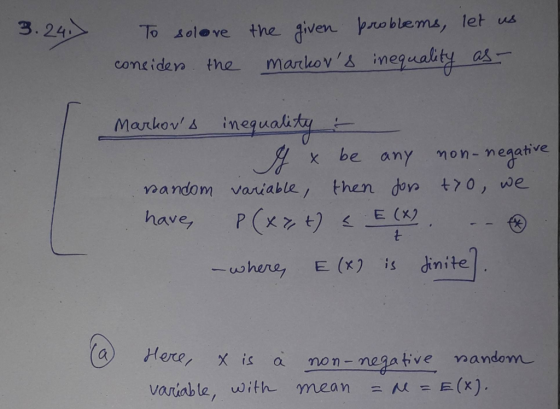
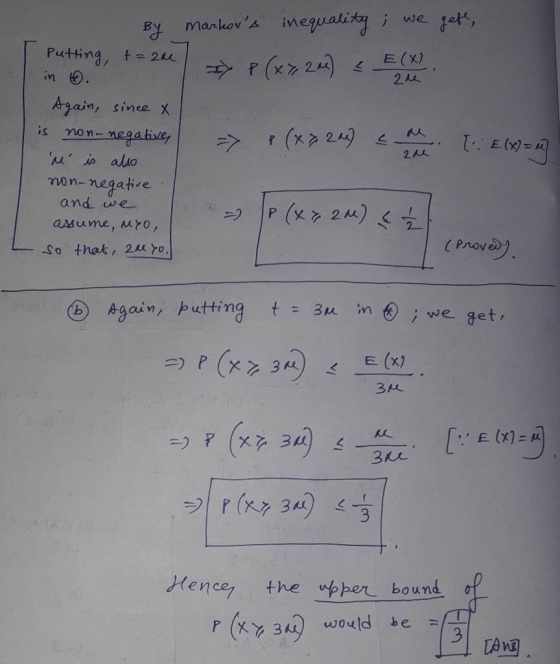
3.24. Problem*. (Section 11.3) (a) Show that for a nonnegative random variable X with mean, P(X...
3. For a nonnegative integer-valued random variable X show that i-0 4. A coin comes up heads with...
 Problem 3.
3. For a nonnegative integer-valued random variable X show that i-0 4. A coin comes up heads with probability p. It is flipped until two consecutive heads or two consecutive tails occur. Find the expected number of flips 5. Suppose that PX a)p, P[Xb-p, a b. Show that (X-b)/(a-b) is a Bernoulli variable, and find its variance
3. For a nonnegative integer-valued random variable X show that i-0 4. A coin comes up heads with probability p. It...
Problem 3.
3. For a nonnegative integer-valued random variable X show that i-0 4. A coin comes up heads with probability p. It is flipped until two consecutive heads or two consecutive tails occur. Find the expected number of flips 5. Suppose that PX a)p, P[Xb-p, a b. Show that (X-b)/(a-b) is a Bernoulli variable, and find its variance
3. For a nonnegative integer-valued random variable X show that i-0 4. A coin comes up heads with probability p. It...
If X is a nonnegative integer-valued random variable then the function P(z), defined for lzl s...
 If X is a nonnegative integer-valued random variable then the function P(z), defined for lzl s 1 by is called the probability generating function of X (a) Show that d* (b) With 0 being considered even, show that PX is even) = P(-1) + P(1) (c) If X is binomial with parameters n and p, show that Pix is even) -1+12p (d) If X is Poisson with mean A, show that 1+ e-24 2 P[X is even)- (e) If X...
Q1. Assume that X is a continuous and nonnegative random variable with the cumulative distribution function...
 Q1. Assume that X is a continuous and nonnegative random variable with the cumulative distribution function Fx and density fx, and let c>O. Verify that for the Value-at-Risk we have VaR,x (p) = cVaRx (p)
c) calculate p(x less than or equal to -3. A random variable X follows the continuous...
 c) calculate p(x less than or equal to -3.
A random variable X follows the continuous uniform distribution with a lower bound of -6 and an upper bound of 9. a. What is the height of the density function f(x)? (Round your answer to 4 decimal places.) 1x) 0.0667 ferences b. What are the mean and the standard deviation for the distribution? (Round your answers to 2 decimal places.) Mean Standard deviation 1.50 4.33 < Prev 2 of 61 Next...
c) calculate p(x less than or equal to -3.
A random variable X follows the continuous uniform distribution with a lower bound of -6 and an upper bound of 9. a. What is the height of the density function f(x)? (Round your answer to 4 decimal places.) 1x) 0.0667 ferences b. What are the mean and the standard deviation for the distribution? (Round your answers to 2 decimal places.) Mean Standard deviation 1.50 4.33 < Prev 2 of 61 Next...
X Y Z iid Suppose for random variable X, P(X > a) - exp( random variable...
 X Y Z iid
Suppose for random variable X, P(X > a) - exp( random variable Y, P(Y > y) exp(-0y) for y > 0, and for random variable , P(Z > z)--exp(-фа) for z > 0. (a) Obtain the moment generating functions of X, Y and Z. (b) Evaluate E(X2IX > 1) and show it is equal to a quadratic function of λ. (c) Calculate P(X > Y Z) if λ-1, θ--2 and φ--3. -λα) for x > 0,...
X Y Z iid
Suppose for random variable X, P(X > a) - exp( random variable Y, P(Y > y) exp(-0y) for y > 0, and for random variable , P(Z > z)--exp(-фа) for z > 0. (a) Obtain the moment generating functions of X, Y and Z. (b) Evaluate E(X2IX > 1) and show it is equal to a quadratic function of λ. (c) Calculate P(X > Y Z) if λ-1, θ--2 and φ--3. -λα) for x > 0,...
1. If X is a nonnegative integer valued random variable, show that n-1 n-0 Hint: Define...
 1. If X is a nonnegative integer valued random variable, show that n-1 n-0 Hint: Define the sequence of random variables I, n 1, by 1, if n X 10, ifn>X Now express X in terms of the I
5. Let X > 0 be a random variable with EX = 10 and EX2 =...
 5. Let X > 0 be a random variable with EX = 10 and EX2 = 140. a. Find an upper bound on P(X > 14) involving EX using Markov's inequality. b. Modify the proof of Markov's inequality to find an upper bound on P(X > 14) in- volving EX? c. Compare the results in (a) and (b) above to what you find from Chebyshev's inequality.
7. (1 point) Let X be the mean of a random sample of size 36 from...
 7. (1 point) Let X be the mean of a random sample of size 36 from the uniform distribution U(7,15) Find P(11.3 <X < 11.5)
show steps thank you . Additional Problem 6. Let X be a continuous random variable with...
 show steps thank you
. Additional Problem 6. Let X be a continuous random variable with pdf f(x) = (z + 1), -1 x 2. (a) Compute E(X), the mean of X. (b) Compute Var(X), the variance of X (c) Find an expression for Fx(), the edf of X. (d) Calculate P(X > 0). (e) Compute the mean of Y, where Y (f) Find mp, the pth quantile of X X-1 X+1
show steps thank you
. Additional Problem 6. Let X be a continuous random variable with pdf f(x) = (z + 1), -1 x 2. (a) Compute E(X), the mean of X. (b) Compute Var(X), the variance of X (c) Find an expression for Fx(), the edf of X. (d) Calculate P(X > 0). (e) Compute the mean of Y, where Y (f) Find mp, the pth quantile of X X-1 X+1
Please show your work with a brief but logical explanation. Suppose X is a random variable with p(X 0) 4/5, p(X-1) 1/10, p(X-9) 1/10. Then (a) Compute Var [X] and B [X] (b) What is the upper bound on...
 Please show your work with a brief but logical explanation.
Suppose X is a random variable with p(X 0) 4/5, p(X-1) 1/10, p(X-9) 1/10. Then (a) Compute Var [X] and B [X] (b) What is the upper bound on the probability that X is at least 20 obained by applying Markov's inequality? c) What is the upper bound on the probability that X is at least 20 obained by applying Chebychev's inequality'?
Suppose X is a random variable with p(X...
Please show your work with a brief but logical explanation.
Suppose X is a random variable with p(X 0) 4/5, p(X-1) 1/10, p(X-9) 1/10. Then (a) Compute Var [X] and B [X] (b) What is the upper bound on the probability that X is at least 20 obained by applying Markov's inequality? c) What is the upper bound on the probability that X is at least 20 obained by applying Chebychev's inequality'?
Suppose X is a random variable with p(X...
 Problem 3.
3. For a nonnegative integer-valued random variable X show that i-0 4. A coin comes up heads with probability p. It is flipped until two consecutive heads or two consecutive tails occur. Find the expected number of flips 5. Suppose that PX a)p, P[Xb-p, a b. Show that (X-b)/(a-b) is a Bernoulli variable, and find its variance
3. For a nonnegative integer-valued random variable X show that i-0 4. A coin comes up heads with probability p. It...
Problem 3.
3. For a nonnegative integer-valued random variable X show that i-0 4. A coin comes up heads with probability p. It is flipped until two consecutive heads or two consecutive tails occur. Find the expected number of flips 5. Suppose that PX a)p, P[Xb-p, a b. Show that (X-b)/(a-b) is a Bernoulli variable, and find its variance
3. For a nonnegative integer-valued random variable X show that i-0 4. A coin comes up heads with probability p. It...
 If X is a nonnegative integer-valued random variable then the function P(z), defined for lzl s 1 by is called the probability generating function of X (a) Show that d* (b) With 0 being considered even, show that PX is even) = P(-1) + P(1) (c) If X is binomial with parameters n and p, show that Pix is even) -1+12p (d) If X is Poisson with mean A, show that 1+ e-24 2 P[X is even)- (e) If X...
 Q1. Assume that X is a continuous and nonnegative random variable with the cumulative distribution function Fx and density fx, and let c>O. Verify that for the Value-at-Risk we have VaR,x (p) = cVaRx (p)
 c) calculate p(x less than or equal to -3.
A random variable X follows the continuous uniform distribution with a lower bound of -6 and an upper bound of 9. a. What is the height of the density function f(x)? (Round your answer to 4 decimal places.) 1x) 0.0667 ferences b. What are the mean and the standard deviation for the distribution? (Round your answers to 2 decimal places.) Mean Standard deviation 1.50 4.33 < Prev 2 of 61 Next...
c) calculate p(x less than or equal to -3.
A random variable X follows the continuous uniform distribution with a lower bound of -6 and an upper bound of 9. a. What is the height of the density function f(x)? (Round your answer to 4 decimal places.) 1x) 0.0667 ferences b. What are the mean and the standard deviation for the distribution? (Round your answers to 2 decimal places.) Mean Standard deviation 1.50 4.33 < Prev 2 of 61 Next...
 X Y Z iid
Suppose for random variable X, P(X > a) - exp( random variable Y, P(Y > y) exp(-0y) for y > 0, and for random variable , P(Z > z)--exp(-фа) for z > 0. (a) Obtain the moment generating functions of X, Y and Z. (b) Evaluate E(X2IX > 1) and show it is equal to a quadratic function of λ. (c) Calculate P(X > Y Z) if λ-1, θ--2 and φ--3. -λα) for x > 0,...
X Y Z iid
Suppose for random variable X, P(X > a) - exp( random variable Y, P(Y > y) exp(-0y) for y > 0, and for random variable , P(Z > z)--exp(-фа) for z > 0. (a) Obtain the moment generating functions of X, Y and Z. (b) Evaluate E(X2IX > 1) and show it is equal to a quadratic function of λ. (c) Calculate P(X > Y Z) if λ-1, θ--2 and φ--3. -λα) for x > 0,...
 1. If X is a nonnegative integer valued random variable, show that n-1 n-0 Hint: Define the sequence of random variables I, n 1, by 1, if n X 10, ifn>X Now express X in terms of the I
 5. Let X > 0 be a random variable with EX = 10 and EX2 = 140. a. Find an upper bound on P(X > 14) involving EX using Markov's inequality. b. Modify the proof of Markov's inequality to find an upper bound on P(X > 14) in- volving EX? c. Compare the results in (a) and (b) above to what you find from Chebyshev's inequality.
 7. (1 point) Let X be the mean of a random sample of size 36 from the uniform distribution U(7,15) Find P(11.3 <X < 11.5)
 show steps thank you
. Additional Problem 6. Let X be a continuous random variable with pdf f(x) = (z + 1), -1 x 2. (a) Compute E(X), the mean of X. (b) Compute Var(X), the variance of X (c) Find an expression for Fx(), the edf of X. (d) Calculate P(X > 0). (e) Compute the mean of Y, where Y (f) Find mp, the pth quantile of X X-1 X+1
show steps thank you
. Additional Problem 6. Let X be a continuous random variable with pdf f(x) = (z + 1), -1 x 2. (a) Compute E(X), the mean of X. (b) Compute Var(X), the variance of X (c) Find an expression for Fx(), the edf of X. (d) Calculate P(X > 0). (e) Compute the mean of Y, where Y (f) Find mp, the pth quantile of X X-1 X+1
 Please show your work with a brief but logical explanation.
Suppose X is a random variable with p(X 0) 4/5, p(X-1) 1/10, p(X-9) 1/10. Then (a) Compute Var [X] and B [X] (b) What is the upper bound on the probability that X is at least 20 obained by applying Markov's inequality? c) What is the upper bound on the probability that X is at least 20 obained by applying Chebychev's inequality'?
Suppose X is a random variable with p(X...
Please show your work with a brief but logical explanation.
Suppose X is a random variable with p(X 0) 4/5, p(X-1) 1/10, p(X-9) 1/10. Then (a) Compute Var [X] and B [X] (b) What is the upper bound on the probability that X is at least 20 obained by applying Markov's inequality? c) What is the upper bound on the probability that X is at least 20 obained by applying Chebychev's inequality'?
Suppose X is a random variable with p(X...
Most questions answered within 3 hours.
-
Where is the error in this code sequence?
String s1 = "Hello";
String s2 = "ello";...
asked 10 months ago -
Financial data for Joel de Paris, Inc., for last year
follow:
Joel de Paris, Inc.
Balance...
asked 10 months ago -
Consider this reaction:
Al2(SO4)3 (aq)+ BaCl3
(aq) Al2Cl6 (aq)- +
3BaSO4(s) . What is the...
asked 10 months ago -
Suppose that Savneet is considering increasing her
recent random sample from 20 car rentals to 40...
asked 10 months ago -
Trucks arrive at an unloading terminal at an average rate of 120
per hour.
Trucks arrive...
asked 10 months ago -
Why are methanol and ethanol completely soluble in water while
octanol is not very little soluble....
asked 10 months ago -
A facilities manager at a university reads in a research report
that the mean amount of...
asked 10 months ago -
When the CuSO4 is rehydrated by adding water to the anhydrous
compound, is this an endothermic...
asked 10 months ago -
A ray of sunlight is passing from diamond into crown glass; the
angle of incidence is...
asked 10 months ago -
A block of mass 0.249 kg is placed on top of a light, vertical
spring of...
asked 10 months ago -
how do the kidneys compensate in the presences of acidosis
a) trigger hyperventilate
b) reserve acid...
asked 10 months ago -
Question 501 pts
The rental rate of capital to the firm increases. Which of the
following...
asked 10 months ago