
Homework Answers
Add Answer to:
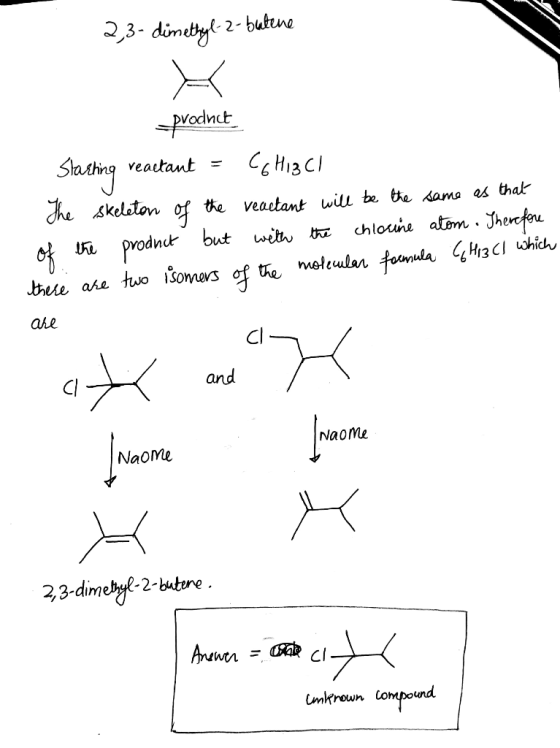
An unknown compound with molecular formula CHC1 is treated with sodium methoxide to produce 2,3-dimethyl-2-butene as...
6. An unknown compound with molecular formula CH CI is treated with sodium methoxide to produce 2,3-dimethyl-2-bute...
 6. An unknown compound with molecular formula CH CI is treated with sodium methoxide to produce 2,3-dimethyl-2-butene as the major product. Identify the structure of the unknown compound (20pts).
(ochem) please provide major organic product 2,3-dimethyl-2-butene
 (ochem) please provide major organic product
2,3-dimethyl-2-butene
(ochem) please provide major organic product
2,3-dimethyl-2-butene
Question 40 Get help answering Molecular Drawing questions. Your answer is partially correct. Try again. Compound...
 Question 40 Get help answering Molecular Drawing questions. Your answer is partially correct. Try again. Compound A and compound B are constitutional isomers with molecular formula C4H9Cl. Treatment of compound A with sodium methoxide gives trans-2- butene as the major product, while treatment of compound B with sodium methoxide gives a different disubstituted alkene as the major product. Draw the structure of compound A. CH3 HzĆ CI Propose two structures for compound B. H&C CH2 Edit HC H3
2. Acid-catalyzed hydration of 3,3-dimethyl-1-butene produces 2,3-dimethyl-2-butanol. Show a mechanism for this reaction. 3. Acid-catalyzed hydration...
 2. Acid-catalyzed hydration of 3,3-dimethyl-1-butene produces 2,3-dimethyl-2-butanol. Show a mechanism for this reaction. 3. Acid-catalyzed hydration of 1-methylcyclohexene yields two alcohols. The major product does not undergo oxidation, while the minor product will undergo oxidation. Explain.
Need help with the questions Circle the compound with the highest heat of combustion 2,3-dimethyl-2-butene 2-methyl-2-pentene...
 Need help with the questions
Circle the compound with the highest heat of combustion 2,3-dimethyl-2-butene 2-methyl-2-pentene (E) 2-hexene (Z) 2-hexene (Z) 3-methyl-2-pentene 8. What are the three hydration reactions for alkenes? What is the regiochemistry for each one? Which one(s) do(es) not go through a carbocation intermediate? 9. 10. Which compound below is more reactive towards E2 elimination? Neomenthyl Chloride Menthyl Chloride Cyclohexane 11. Draw the following structures Acetylene Acetylide lon Part 2. Roactions (Each structure is worth 5 points)....
Need help with the questions
Circle the compound with the highest heat of combustion 2,3-dimethyl-2-butene 2-methyl-2-pentene (E) 2-hexene (Z) 2-hexene (Z) 3-methyl-2-pentene 8. What are the three hydration reactions for alkenes? What is the regiochemistry for each one? Which one(s) do(es) not go through a carbocation intermediate? 9. 10. Which compound below is more reactive towards E2 elimination? Neomenthyl Chloride Menthyl Chloride Cyclohexane 11. Draw the following structures Acetylene Acetylide lon Part 2. Roactions (Each structure is worth 5 points)....
2. Acid-catalyzed hydration of 3,3-dimethyl-1-butene produces 2,3-dimethyl-2-butanol Show a mechanism for this reaction. 3. Acid-catalyzed hydration...
 2. Acid-catalyzed hydration of 3,3-dimethyl-1-butene produces 2,3-dimethyl-2-butanol Show a mechanism for this reaction. 3. Acid-catalyzed hydration of 1-methylcyclohexene yields two alcohols. The major product does not undergo oxidation, while the minor product will undergo oxidation. Explain. 4. Using 2-propanol as your only source of carbon, show how you would prepare 2-methyl- 2-pentanol
1) An unknown organic compound has the molecular formula C4H10O. It resists oxidation and it can...
1) An unknown organic compound has the molecular formula C4H10O. It resists oxidation and it can undergo dehydration to form an alkene.Draw the structure for the compound and write equations for the reactions described. Name the reactant and product. 2) An unknown organic compound has the molecular formula C4H8O. It resists oxidation and it can be reduced with H2 to form an alcohol. Draw the structure for the compound and write equations for the reactions described. Name the reactant and...
1) When 3-iodo-3-ethylpentane is treated with sodium methoxide in methanol, the major organic product is an...
 1) When 3-iodo-3-ethylpentane is treated with sodium methoxide in methanol, the major organic product is an ___that is generated through an __mechanism. A) ether, Sw1 B) ether, SN2 C) ether, E1 D) alkene, E2 E) alkene, E1 2) Which compound produces only one alkene when treated with sodium methoxide? A) 2-chloro-2-methylpentane B) 3-chloro-3-ethylpentane C) 3-chloro-2-methylpentane D) 2-chloro-4-methylpentane E) 2-chloro-3-ethylpentane 3) What is the difference between Hoffmann and Zaitsev? When is Hoffmann favored?
1) When 3-iodo-3-ethylpentane is treated with sodium methoxide in methanol, the major organic product is an...
 1) When 3-iodo-3-ethylpentane is treated with sodium methoxide in methanol, the major organic product is an ___ that is generated through an ____mechanism. A) ether, SN1 B) ether, Sn2 C) ether, E1 D) alkene, E2 E) alkene, E1 2) Which compound produces only one alkene when treated with sodium methoxide? A) 2-chloro-2-methylpentane B) 3-chloro-3-ethylpentane C) 3-chloro-2-methylpentane D) 2-chloro-4-methylpentane E) 2-chloro-3-ethylpentane 3) What is the difference between Hoffmann and Zaitsev? When is Hoffmann favored?
Predict the predominant alkene product that would form when 2-bromo-2-methylpentane is treated with sodium methoxide in...
Predict the predominant alkene product that would form when 2-bromo-2-methylpentane is treated with sodium methoxide in methanol. If the base were changed to KOC(CH2CH3)3 would the same alkene predominate? If not, why? What would be the structure of this alternate product be, if it formed?
 6. An unknown compound with molecular formula CH CI is treated with sodium methoxide to produce 2,3-dimethyl-2-butene as the major product. Identify the structure of the unknown compound (20pts).
 (ochem) please provide major organic product
2,3-dimethyl-2-butene
(ochem) please provide major organic product
2,3-dimethyl-2-butene
 Question 40 Get help answering Molecular Drawing questions. Your answer is partially correct. Try again. Compound A and compound B are constitutional isomers with molecular formula C4H9Cl. Treatment of compound A with sodium methoxide gives trans-2- butene as the major product, while treatment of compound B with sodium methoxide gives a different disubstituted alkene as the major product. Draw the structure of compound A. CH3 HzĆ CI Propose two structures for compound B. H&C CH2 Edit HC H3
 2. Acid-catalyzed hydration of 3,3-dimethyl-1-butene produces 2,3-dimethyl-2-butanol. Show a mechanism for this reaction. 3. Acid-catalyzed hydration of 1-methylcyclohexene yields two alcohols. The major product does not undergo oxidation, while the minor product will undergo oxidation. Explain.
 Need help with the questions
Circle the compound with the highest heat of combustion 2,3-dimethyl-2-butene 2-methyl-2-pentene (E) 2-hexene (Z) 2-hexene (Z) 3-methyl-2-pentene 8. What are the three hydration reactions for alkenes? What is the regiochemistry for each one? Which one(s) do(es) not go through a carbocation intermediate? 9. 10. Which compound below is more reactive towards E2 elimination? Neomenthyl Chloride Menthyl Chloride Cyclohexane 11. Draw the following structures Acetylene Acetylide lon Part 2. Roactions (Each structure is worth 5 points)....
Need help with the questions
Circle the compound with the highest heat of combustion 2,3-dimethyl-2-butene 2-methyl-2-pentene (E) 2-hexene (Z) 2-hexene (Z) 3-methyl-2-pentene 8. What are the three hydration reactions for alkenes? What is the regiochemistry for each one? Which one(s) do(es) not go through a carbocation intermediate? 9. 10. Which compound below is more reactive towards E2 elimination? Neomenthyl Chloride Menthyl Chloride Cyclohexane 11. Draw the following structures Acetylene Acetylide lon Part 2. Roactions (Each structure is worth 5 points)....
 2. Acid-catalyzed hydration of 3,3-dimethyl-1-butene produces 2,3-dimethyl-2-butanol Show a mechanism for this reaction. 3. Acid-catalyzed hydration of 1-methylcyclohexene yields two alcohols. The major product does not undergo oxidation, while the minor product will undergo oxidation. Explain. 4. Using 2-propanol as your only source of carbon, show how you would prepare 2-methyl- 2-pentanol
 1) When 3-iodo-3-ethylpentane is treated with sodium methoxide in methanol, the major organic product is an ___that is generated through an __mechanism. A) ether, Sw1 B) ether, SN2 C) ether, E1 D) alkene, E2 E) alkene, E1 2) Which compound produces only one alkene when treated with sodium methoxide? A) 2-chloro-2-methylpentane B) 3-chloro-3-ethylpentane C) 3-chloro-2-methylpentane D) 2-chloro-4-methylpentane E) 2-chloro-3-ethylpentane 3) What is the difference between Hoffmann and Zaitsev? When is Hoffmann favored?
 1) When 3-iodo-3-ethylpentane is treated with sodium methoxide in methanol, the major organic product is an ___ that is generated through an ____mechanism. A) ether, SN1 B) ether, Sn2 C) ether, E1 D) alkene, E2 E) alkene, E1 2) Which compound produces only one alkene when treated with sodium methoxide? A) 2-chloro-2-methylpentane B) 3-chloro-3-ethylpentane C) 3-chloro-2-methylpentane D) 2-chloro-4-methylpentane E) 2-chloro-3-ethylpentane 3) What is the difference between Hoffmann and Zaitsev? When is Hoffmann favored?
Most questions answered within 3 hours.
-
Where is the error in this code sequence?
String s1 = "Hello";
String s2 = "ello";...
asked 10 months ago -
Financial data for Joel de Paris, Inc., for last year
follow:
Joel de Paris, Inc.
Balance...
asked 10 months ago -
Consider this reaction:
Al2(SO4)3 (aq)+ BaCl3
(aq) Al2Cl6 (aq)- +
3BaSO4(s) . What is the...
asked 10 months ago -
Suppose that Savneet is considering increasing her
recent random sample from 20 car rentals to 40...
asked 10 months ago -
Trucks arrive at an unloading terminal at an average rate of 120
per hour.
Trucks arrive...
asked 10 months ago -
Why are methanol and ethanol completely soluble in water while
octanol is not very little soluble....
asked 10 months ago -
A facilities manager at a university reads in a research report
that the mean amount of...
asked 10 months ago -
When the CuSO4 is rehydrated by adding water to the anhydrous
compound, is this an endothermic...
asked 10 months ago -
A ray of sunlight is passing from diamond into crown glass; the
angle of incidence is...
asked 10 months ago -
A block of mass 0.249 kg is placed on top of a light, vertical
spring of...
asked 10 months ago -
how do the kidneys compensate in the presences of acidosis
a) trigger hyperventilate
b) reserve acid...
asked 10 months ago -
Question 501 pts
The rental rate of capital to the firm increases. Which of the
following...
asked 10 months ago