
Homework Answers

Add Answer to:
Need work step by step please!
Heat Capacity of a Gas at Constant Pressure A system...
Heat Capacity of a Gas at Constant Pressure A system comprised of 5.500x101 g of Ar(g)...
 Heat Capacity of a Gas at Constant Pressure A system comprised of 5.500x101 g of Ar(g) cools from 165.0°C to 30.0°C at a constant pressure of 3.0 atm. The molar heat capacity at constant pressure for Ar(g) is 20.80 J K-1 mol-1. Calculate q. 1pts Submit Answer Tries 0/5 Calculate w 1pts Submit Answer Tries 0/5 Calculate ΔΕ. 1 pts Submit Answer Tries 0/5 Calculate ΔΗ. 1pts Submit Answer Tries 0/5
Need work step by step please! Specific Heat Capacity The specific heat capacity of lead at...
 Need work step by step please!
Specific Heat Capacity The specific heat capacity of lead at 25°C is 1.290x10⁻¹ J/g/K. For a 6.75x10² g sample of lead, how much energy is required to raise the temperature from 19.0°C to 31.8°C? (Assume that the heat capacity is constant over this temperature range.) 1 pts Submit Answer Tries 0/5 What is the molar heat capacity of lead? 1 pts Submit Answer Tries 0/5
Need work step by step please!
Specific Heat Capacity The specific heat capacity of lead at 25°C is 1.290x10⁻¹ J/g/K. For a 6.75x10² g sample of lead, how much energy is required to raise the temperature from 19.0°C to 31.8°C? (Assume that the heat capacity is constant over this temperature range.) 1 pts Submit Answer Tries 0/5 What is the molar heat capacity of lead? 1 pts Submit Answer Tries 0/5
Heat Capacity of a Gas at Constant Pressure A system comprised of 7.900×101 g of H2(g)...
 Heat Capacity of a Gas at Constant Pressure
A system comprised of 7.900×101 g of
H2(g) cools from 170.0°C to
35.0°C at a constant pressure of 4.5
atm.
The molar heat capacity at constant pressure for
H2(g) is 28.86 J K−1
mol−1.
a) Calculate q.
b) Calculate w.
c) Calculate
.
d) Calculate
.
Note - for part a) I have tried -1.54*10^5 J, 1.54*10^5 J and
-3.08*10^5 J (these are all wrong). I'm on my last try, please
help!
Heat Capacity of a Gas at Constant Pressure
A system comprised of 7.900×101 g of
H2(g) cools from 170.0°C to
35.0°C at a constant pressure of 4.5
atm.
The molar heat capacity at constant pressure for
H2(g) is 28.86 J K−1
mol−1.
a) Calculate q.
b) Calculate w.
c) Calculate
.
d) Calculate
.
Note - for part a) I have tried -1.54*10^5 J, 1.54*10^5 J and
-3.08*10^5 J (these are all wrong). I'm on my last try, please
help!
Please show work step by step and final answer. Free Energy and Equlibrium Consider the system:...
 Please show work step by step
and final answer.
Free Energy and Equlibrium Consider the system: A(9) = B(9) at 25°C. Assume that GºA = 7082 J/mol and GºB = 12192 J/mol. Calculate the value of the equilibrium constant for this reaction. 1.27x10⁻¹ 1pts You are correct. Previous Tries A non-equilibrium mixture of 1.00 mol of A(9) (partial pressure 1.00 atm) and 1.00 mol of B(9) (partial pressure 1.00 atm) is allowed to equilibrate at 25°C. Calculate the partial pressure...
Please show work step by step
and final answer.
Free Energy and Equlibrium Consider the system: A(9) = B(9) at 25°C. Assume that GºA = 7082 J/mol and GºB = 12192 J/mol. Calculate the value of the equilibrium constant for this reaction. 1.27x10⁻¹ 1pts You are correct. Previous Tries A non-equilibrium mixture of 1.00 mol of A(9) (partial pressure 1.00 atm) and 1.00 mol of B(9) (partial pressure 1.00 atm) is allowed to equilibrate at 25°C. Calculate the partial pressure...
Heat Evolved During Combustion and Heat Capacity of a Gas at Constant Pressure A. Consider the...
 Heat Evolved During Combustion and Heat Capacity of a
Gas at Constant Pressure
A.
Consider the following reaction:
2 C2H2(g) + 5
O2(g)
4 CO2(g) + 2H2O(l)
Use standard heats of formation from Zumdahl 'Chemical
Principles' 8th ed. Appendix Four pp A19 - A21.
a) How much heat is evolved when
1.440×101 moles of
C2H2(g) is burned in excess oxygen.
Answer to 4 sig figs.
b) How much heat is evolved when
2.250×10² g of CO2(g) is produced
from the...
Heat Evolved During Combustion and Heat Capacity of a
Gas at Constant Pressure
A.
Consider the following reaction:
2 C2H2(g) + 5
O2(g)
4 CO2(g) + 2H2O(l)
Use standard heats of formation from Zumdahl 'Chemical
Principles' 8th ed. Appendix Four pp A19 - A21.
a) How much heat is evolved when
1.440×101 moles of
C2H2(g) is burned in excess oxygen.
Answer to 4 sig figs.
b) How much heat is evolved when
2.250×10² g of CO2(g) is produced
from the...
Need work step by step please! Heat Evolved During Combustion Consider the following reaction: 2 C2H6(g)7...
 Need work step by step please!
Heat Evolved During Combustion Consider the following reaction: 2 C2H6(g)7 02(g) 4 CO2(g) 6H2O(I) Use standard heats of formation from Zumdahl 'Chemical Principles' 8th ed. Appendix Four pp A19 - A21 How much heat is evolved when 5.820 moles of C2H6(g) is burned in excess oxygen. Answer to 4 sig figs. 1pts Tries 0/5 Submit Answer How much heat is evolved when 1.136 moles of CO2(g) is produced from the combustion of C2H6(g) Answer...
Need work step by step please!
Heat Evolved During Combustion Consider the following reaction: 2 C2H6(g)7 02(g) 4 CO2(g) 6H2O(I) Use standard heats of formation from Zumdahl 'Chemical Principles' 8th ed. Appendix Four pp A19 - A21 How much heat is evolved when 5.820 moles of C2H6(g) is burned in excess oxygen. Answer to 4 sig figs. 1pts Tries 0/5 Submit Answer How much heat is evolved when 1.136 moles of CO2(g) is produced from the combustion of C2H6(g) Answer...
Please show work step by step Consider the following reaction: 2 C2H6(9) + 7 02(9) —...
 Please show work step by step
Consider the following reaction: 2 C2H6(9) + 7 02(9) — 4 CO2(g) + 6H2O(1) Use standard heats of formation from Zumdahl 'Chemical Principles' 8th ed. Appendix Four pp A19 - A21. How much heat is evolved when 5.820 moles of C2H6(9) is burned in excess oxygen. Answer to 4 sig figs. Assume standard conditions. Note that, by convention, a decrease in enthalpy of the system will result in a positive quantity of heat being...
Please show work step by step
Consider the following reaction: 2 C2H6(9) + 7 02(9) — 4 CO2(g) + 6H2O(1) Use standard heats of formation from Zumdahl 'Chemical Principles' 8th ed. Appendix Four pp A19 - A21. How much heat is evolved when 5.820 moles of C2H6(9) is burned in excess oxygen. Answer to 4 sig figs. Assume standard conditions. Note that, by convention, a decrease in enthalpy of the system will result in a positive quantity of heat being...
2 point(s) Specific Heat Capacity The specific heat capacity of lead at 25°C is 1.290x10⁻¹ J/g/K....
 2 point(s) Specific Heat Capacity The specific heat capacity of lead at 25°C is 1.290x10⁻¹ J/g/K. For a 3.00x 10² g sample of lead, how much will the temperature increase if 3.096x10² ) of energy is put into the system? (Assume that the heat capacity is constant over this temperature range.) 1pts Submit Answer Tries 0/5 What is the molar heat capacity of lead? 1 pts Submit Answer Tries 0/5 e Post Discussion
A system comprised of 2.100 Times 10^1 g of C0_2(g) cools from 155.0^degree C to 45.0^degree...
 A system comprised of 2.100 Times 10^1 g of C0_2(g) cools from 155.0^degree C to 45.0^degree C at a constant pressure of 4.5 atm. The molar heat capacity at constant pressure for CO_2(g) is 37.27 J K^-1 mol^-1. Calculate q. Calculate w. Calculate delta E. Calculate delta H.
Free Energy and Equlibrium Consider the system: A(g) = B(9) at 25°C. Assume that GºA =...
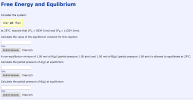 Free Energy and Equlibrium Consider the system: A(g) = B(9) at 25°C. Assume that GºA = 8334 J/mol and GºB = 11324 J/mol. Calculate the value of the equilibrium constant for this reaction. 1 pts Submit Answer Tries 0/5 A non-equilibrium mixture of 1.00 mol of A(g) (partial pressure 1.00 atm) and 1.00 mol of B(g) (partial pressure 1.00 atm) is allowed to equilibrate at 25°C. Calculate the partial pressure of A(g) at equilibrium. 1pts Submit Answer Tries 0/5 Calculate...
 Heat Capacity of a Gas at Constant Pressure A system comprised of 5.500x101 g of Ar(g) cools from 165.0°C to 30.0°C at a constant pressure of 3.0 atm. The molar heat capacity at constant pressure for Ar(g) is 20.80 J K-1 mol-1. Calculate q. 1pts Submit Answer Tries 0/5 Calculate w 1pts Submit Answer Tries 0/5 Calculate ΔΕ. 1 pts Submit Answer Tries 0/5 Calculate ΔΗ. 1pts Submit Answer Tries 0/5
 Need work step by step please!
Specific Heat Capacity The specific heat capacity of lead at 25°C is 1.290x10⁻¹ J/g/K. For a 6.75x10² g sample of lead, how much energy is required to raise the temperature from 19.0°C to 31.8°C? (Assume that the heat capacity is constant over this temperature range.) 1 pts Submit Answer Tries 0/5 What is the molar heat capacity of lead? 1 pts Submit Answer Tries 0/5
Need work step by step please!
Specific Heat Capacity The specific heat capacity of lead at 25°C is 1.290x10⁻¹ J/g/K. For a 6.75x10² g sample of lead, how much energy is required to raise the temperature from 19.0°C to 31.8°C? (Assume that the heat capacity is constant over this temperature range.) 1 pts Submit Answer Tries 0/5 What is the molar heat capacity of lead? 1 pts Submit Answer Tries 0/5
 Please show work step by step
and final answer.
Free Energy and Equlibrium Consider the system: A(9) = B(9) at 25°C. Assume that GºA = 7082 J/mol and GºB = 12192 J/mol. Calculate the value of the equilibrium constant for this reaction. 1.27x10⁻¹ 1pts You are correct. Previous Tries A non-equilibrium mixture of 1.00 mol of A(9) (partial pressure 1.00 atm) and 1.00 mol of B(9) (partial pressure 1.00 atm) is allowed to equilibrate at 25°C. Calculate the partial pressure...
Please show work step by step
and final answer.
Free Energy and Equlibrium Consider the system: A(9) = B(9) at 25°C. Assume that GºA = 7082 J/mol and GºB = 12192 J/mol. Calculate the value of the equilibrium constant for this reaction. 1.27x10⁻¹ 1pts You are correct. Previous Tries A non-equilibrium mixture of 1.00 mol of A(9) (partial pressure 1.00 atm) and 1.00 mol of B(9) (partial pressure 1.00 atm) is allowed to equilibrate at 25°C. Calculate the partial pressure...
 Heat Evolved During Combustion and Heat Capacity of a
Gas at Constant Pressure
A.
Consider the following reaction:
2 C2H2(g) + 5
O2(g)
4 CO2(g) + 2H2O(l)
Use standard heats of formation from Zumdahl 'Chemical
Principles' 8th ed. Appendix Four pp A19 - A21.
a) How much heat is evolved when
1.440×101 moles of
C2H2(g) is burned in excess oxygen.
Answer to 4 sig figs.
b) How much heat is evolved when
2.250×10² g of CO2(g) is produced
from the...
Heat Evolved During Combustion and Heat Capacity of a
Gas at Constant Pressure
A.
Consider the following reaction:
2 C2H2(g) + 5
O2(g)
4 CO2(g) + 2H2O(l)
Use standard heats of formation from Zumdahl 'Chemical
Principles' 8th ed. Appendix Four pp A19 - A21.
a) How much heat is evolved when
1.440×101 moles of
C2H2(g) is burned in excess oxygen.
Answer to 4 sig figs.
b) How much heat is evolved when
2.250×10² g of CO2(g) is produced
from the...
 Need work step by step please!
Heat Evolved During Combustion Consider the following reaction: 2 C2H6(g)7 02(g) 4 CO2(g) 6H2O(I) Use standard heats of formation from Zumdahl 'Chemical Principles' 8th ed. Appendix Four pp A19 - A21 How much heat is evolved when 5.820 moles of C2H6(g) is burned in excess oxygen. Answer to 4 sig figs. 1pts Tries 0/5 Submit Answer How much heat is evolved when 1.136 moles of CO2(g) is produced from the combustion of C2H6(g) Answer...
Need work step by step please!
Heat Evolved During Combustion Consider the following reaction: 2 C2H6(g)7 02(g) 4 CO2(g) 6H2O(I) Use standard heats of formation from Zumdahl 'Chemical Principles' 8th ed. Appendix Four pp A19 - A21 How much heat is evolved when 5.820 moles of C2H6(g) is burned in excess oxygen. Answer to 4 sig figs. 1pts Tries 0/5 Submit Answer How much heat is evolved when 1.136 moles of CO2(g) is produced from the combustion of C2H6(g) Answer...
 Please show work step by step
Consider the following reaction: 2 C2H6(9) + 7 02(9) — 4 CO2(g) + 6H2O(1) Use standard heats of formation from Zumdahl 'Chemical Principles' 8th ed. Appendix Four pp A19 - A21. How much heat is evolved when 5.820 moles of C2H6(9) is burned in excess oxygen. Answer to 4 sig figs. Assume standard conditions. Note that, by convention, a decrease in enthalpy of the system will result in a positive quantity of heat being...
Please show work step by step
Consider the following reaction: 2 C2H6(9) + 7 02(9) — 4 CO2(g) + 6H2O(1) Use standard heats of formation from Zumdahl 'Chemical Principles' 8th ed. Appendix Four pp A19 - A21. How much heat is evolved when 5.820 moles of C2H6(9) is burned in excess oxygen. Answer to 4 sig figs. Assume standard conditions. Note that, by convention, a decrease in enthalpy of the system will result in a positive quantity of heat being...
 2 point(s) Specific Heat Capacity The specific heat capacity of lead at 25°C is 1.290x10⁻¹ J/g/K. For a 3.00x 10² g sample of lead, how much will the temperature increase if 3.096x10² ) of energy is put into the system? (Assume that the heat capacity is constant over this temperature range.) 1pts Submit Answer Tries 0/5 What is the molar heat capacity of lead? 1 pts Submit Answer Tries 0/5 e Post Discussion
 A system comprised of 2.100 Times 10^1 g of C0_2(g) cools from 155.0^degree C to 45.0^degree C at a constant pressure of 4.5 atm. The molar heat capacity at constant pressure for CO_2(g) is 37.27 J K^-1 mol^-1. Calculate q. Calculate w. Calculate delta E. Calculate delta H.
 Free Energy and Equlibrium Consider the system: A(g) = B(9) at 25°C. Assume that GºA = 8334 J/mol and GºB = 11324 J/mol. Calculate the value of the equilibrium constant for this reaction. 1 pts Submit Answer Tries 0/5 A non-equilibrium mixture of 1.00 mol of A(g) (partial pressure 1.00 atm) and 1.00 mol of B(g) (partial pressure 1.00 atm) is allowed to equilibrate at 25°C. Calculate the partial pressure of A(g) at equilibrium. 1pts Submit Answer Tries 0/5 Calculate...
Most questions answered within 3 hours.
-
Where is the error in this code sequence?
String s1 = "Hello";
String s2 = "ello";...
asked 10 months ago -
Financial data for Joel de Paris, Inc., for last year
follow:
Joel de Paris, Inc.
Balance...
asked 10 months ago -
Consider this reaction:
Al2(SO4)3 (aq)+ BaCl3
(aq) Al2Cl6 (aq)- +
3BaSO4(s) . What is the...
asked 10 months ago -
Suppose that Savneet is considering increasing her
recent random sample from 20 car rentals to 40...
asked 10 months ago -
Trucks arrive at an unloading terminal at an average rate of 120
per hour.
Trucks arrive...
asked 10 months ago -
Why are methanol and ethanol completely soluble in water while
octanol is not very little soluble....
asked 10 months ago -
A facilities manager at a university reads in a research report
that the mean amount of...
asked 10 months ago -
When the CuSO4 is rehydrated by adding water to the anhydrous
compound, is this an endothermic...
asked 10 months ago -
A ray of sunlight is passing from diamond into crown glass; the
angle of incidence is...
asked 10 months ago -
A block of mass 0.249 kg is placed on top of a light, vertical
spring of...
asked 10 months ago -
how do the kidneys compensate in the presences of acidosis
a) trigger hyperventilate
b) reserve acid...
asked 10 months ago -
Question 501 pts
The rental rate of capital to the firm increases. Which of the
following...
asked 10 months ago