A charge +q is located at the origin, while an identical charge is located on the...
A charge +q is located at the origin, while an identical charge is located on the x axis at x = +0.83 m. A third charge of +2q is located on the x axis at such a place that the net electrostatic force on the charge at the origin doubles, its direction remaining unchanged. Where should the third charge be located?
When I tried doing this question, I got an answer of 1.2 m, but it shows that it is wrong.
Homework Answers
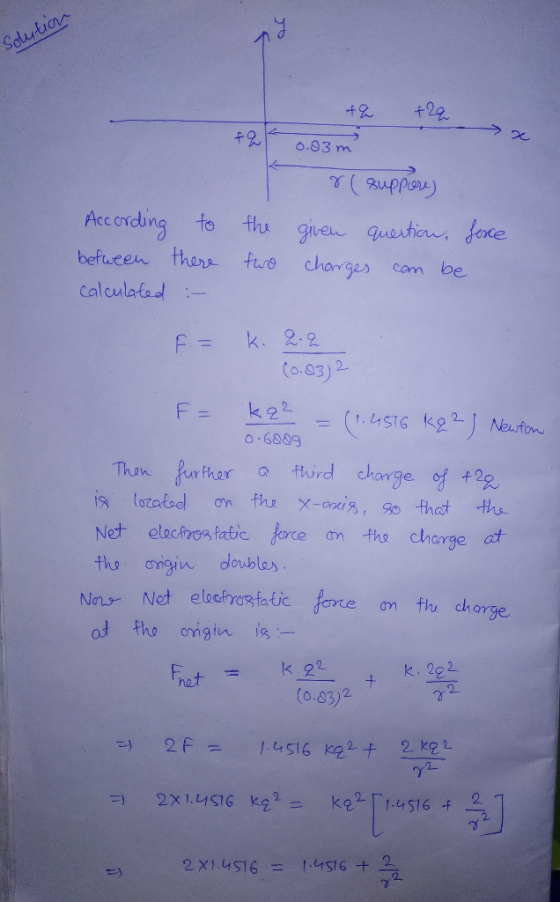
 ya ,you are correct but you
have taken approx value .
ya ,you are correct but you
have taken approx value .
For any doubt please comment and please give an up vote.Thank You
Add Answer to:
A charge +q is located at the origin, while an identical charge
is located on the...
A charge +q is located at the origin, while an identical charge is located on the...
A charge +q is located at the origin, while an identical charge is located on the x axis at x = +0.54 m. A third charge of +2q is located on the x axis at such a place that the net electrostatic force on the charge at the origin doubles, its direction remaining unchanged. Where should the third charge be located?
A charge +q is located at the origin, while an identical charge is located on the...
A charge +q is located at the origin, while an identical charge is located on the x axis at x = +0.84 m. A third charge of +2q is located on the x axis at such a place that the net electrostatic force on the charge at the origin doubles, its direction remaining unchanged. Where should the third charge be located?
Chapter 18, Problem 16 GO A charge +q is located at the origin, while an identical...
 Chapter 18, Problem 16 GO A charge +q is located at the origin, while an identical charge is located on the x axis at x-+0.66 m. A third charge of +2q is located on the x axis at such a place that the net electrostatic force on the charge at the origin doubles, its direction remaining unchanged. Where should the third charge be located? d Number Units
il Call the charges have? ichie He charge magnitude. 16. G A charge +q is located...
 il Call the charges have? ichie He charge magnitude. 16. G A charge +q is located at the origin, while an identical charge is located on the x axis at x = +0.50 m. A third charge of +24 is located on the x axis at such a place that the net electrostatic force on the charge at the origin doubles, its direction remaining unchanged. Where should the third charge be located? 17. ssm Two narticls i
A plate carries a charge of -3.1 µC, while a rod carries a charge of 3.5...
A plate carries a charge of -3.1 µC, while a rod carries a charge of 3.5 µC. How many electrons must be transferred from the plate to the rod, so that both objects have the same charge? The answer needs to be in N. A charge +q is located at the origin, while an identical charge is located on the x axis at x = +0.12 m. A third charge of +4q is located on the x axis at such...
(1) A charge +Q is located at the origin and a second charge, +2Q, is located...
(1) A charge +Q is located at the origin and a second charge, +2Q, is located at x= 17.0 cm . Where should a third charge q be placed so that the net force on q is zero? Find q 's position on x -axis.
A particle with charge q is located at the origin, and a particle with charge 3q...
A particle with charge q is located at the origin, and a particle with charge 3q is on the positive x axis, a distance d from the origin. The particles are not free to move. In terms of q and d, at what coordinates should a third particle with charge q be placed so that it experiences no net electrostatic force? (Assume r is the location of the third particle away from the origin, along the positive x axis.) r=
A point charge +2Q is at the origin and a point charge −Q is located along...
 A point charge +2Q is at the origin and a point charge
−Q is located along the x axis at x =
d as in the figure below. Find a symbolic expression for
the net force on a third point charge +Q located along the
y axis at y = d. (Use the following as
necessary: ke, the Coulomb constant,
Q, and d.)
net
=_____________
A point charge +2Q is at the origin and a point charge
−Q is located along the x axis at x =
d as in the figure below. Find a symbolic expression for
the net force on a third point charge +Q located along the
y axis at y = d. (Use the following as
necessary: ke, the Coulomb constant,
Q, and d.)
net
=_____________
A charge is located at the origin... A charge, q,-79.7 nC is located at the origin...
 A charge is located at the origin...
A charge, q,-79.7 nC is located at the origin (z 0, y = 0), a second charge, q2 146 nC is located on the x-axis at (x 4 m, y 0 m), and a third charge, 93--20.5 nC is located on the y- axis at (0 m, y 4 m). Calculate the magnitude of the electric field at the location marked by the letter "X" on the figure below (x-4 m, y =...
A charge is located at the origin...
A charge, q,-79.7 nC is located at the origin (z 0, y = 0), a second charge, q2 146 nC is located on the x-axis at (x 4 m, y 0 m), and a third charge, 93--20.5 nC is located on the y- axis at (0 m, y 4 m). Calculate the magnitude of the electric field at the location marked by the letter "X" on the figure below (x-4 m, y =...
A charge +Q is located at the origin and a negative charge, -9Q, is located at...
A charge +Q is located at the origin and a negative charge, -9Q, is located at a distance x= 11.0 cm . Where should a third charge q be placed so that the net force on q is zero? Find q 's position on x-axis.
 Chapter 18, Problem 16 GO A charge +q is located at the origin, while an identical charge is located on the x axis at x-+0.66 m. A third charge of +2q is located on the x axis at such a place that the net electrostatic force on the charge at the origin doubles, its direction remaining unchanged. Where should the third charge be located? d Number Units
 il Call the charges have? ichie He charge magnitude. 16. G A charge +q is located at the origin, while an identical charge is located on the x axis at x = +0.50 m. A third charge of +24 is located on the x axis at such a place that the net electrostatic force on the charge at the origin doubles, its direction remaining unchanged. Where should the third charge be located? 17. ssm Two narticls i
 A point charge +2Q is at the origin and a point charge
−Q is located along the x axis at x =
d as in the figure below. Find a symbolic expression for
the net force on a third point charge +Q located along the
y axis at y = d. (Use the following as
necessary: ke, the Coulomb constant,
Q, and d.)
net
=_____________
A point charge +2Q is at the origin and a point charge
−Q is located along the x axis at x =
d as in the figure below. Find a symbolic expression for
the net force on a third point charge +Q located along the
y axis at y = d. (Use the following as
necessary: ke, the Coulomb constant,
Q, and d.)
net
=_____________
 A charge is located at the origin...
A charge, q,-79.7 nC is located at the origin (z 0, y = 0), a second charge, q2 146 nC is located on the x-axis at (x 4 m, y 0 m), and a third charge, 93--20.5 nC is located on the y- axis at (0 m, y 4 m). Calculate the magnitude of the electric field at the location marked by the letter "X" on the figure below (x-4 m, y =...
A charge is located at the origin...
A charge, q,-79.7 nC is located at the origin (z 0, y = 0), a second charge, q2 146 nC is located on the x-axis at (x 4 m, y 0 m), and a third charge, 93--20.5 nC is located on the y- axis at (0 m, y 4 m). Calculate the magnitude of the electric field at the location marked by the letter "X" on the figure below (x-4 m, y =...
Most questions answered within 3 hours.
-
Where is the error in this code sequence?
String s1 = "Hello";
String s2 = "ello";...
asked 10 months ago -
Financial data for Joel de Paris, Inc., for last year
follow:
Joel de Paris, Inc.
Balance...
asked 10 months ago -
Consider this reaction:
Al2(SO4)3 (aq)+ BaCl3
(aq) Al2Cl6 (aq)- +
3BaSO4(s) . What is the...
asked 10 months ago -
Suppose that Savneet is considering increasing her
recent random sample from 20 car rentals to 40...
asked 10 months ago -
Trucks arrive at an unloading terminal at an average rate of 120
per hour.
Trucks arrive...
asked 10 months ago -
Why are methanol and ethanol completely soluble in water while
octanol is not very little soluble....
asked 10 months ago -
A facilities manager at a university reads in a research report
that the mean amount of...
asked 10 months ago -
When the CuSO4 is rehydrated by adding water to the anhydrous
compound, is this an endothermic...
asked 10 months ago -
A ray of sunlight is passing from diamond into crown glass; the
angle of incidence is...
asked 10 months ago -
A block of mass 0.249 kg is placed on top of a light, vertical
spring of...
asked 10 months ago -
how do the kidneys compensate in the presences of acidosis
a) trigger hyperventilate
b) reserve acid...
asked 10 months ago -
Question 501 pts
The rental rate of capital to the firm increases. Which of the
following...
asked 10 months ago