
Homework Answers
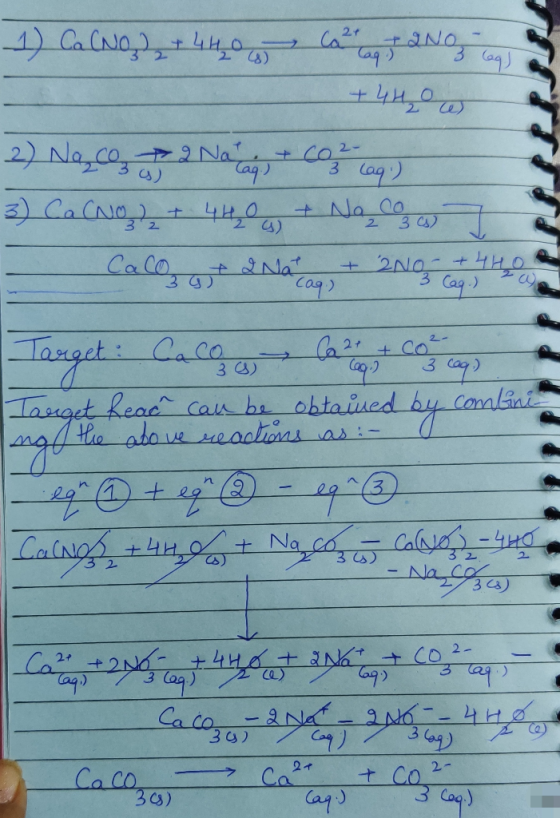
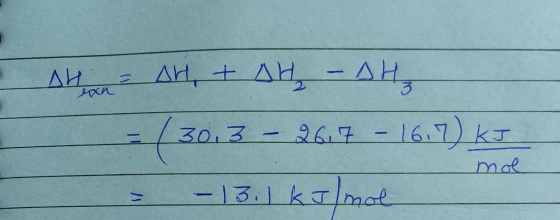
The target equation is obtained by combining the given three equations as:-
Eqn 1 + Eqn 2 - Eqn 3
Add Answer to:
Given the three reactions that you will measure (below) with the reaction enthalpies reported in the...
Identify the spectator ions in the following reaction. Ca2+(aq) + 2NO3(aq) + 2Na+ (aq) + CO32-(aq)...
 Identify the spectator ions in the following reaction. Ca2+(aq) + 2NO3(aq) + 2Na+ (aq) + CO32-(aq) → CaCO3(s) + 2Na+(aq) + NO3(aq) a. Na+ and NO 3 - Ob. NO 3 - and CO 3 2- Oc. Ca 2+ and CO 3 d. Ca 2+ and Na+ e. Ca 2+ and NO 3
Question 14 Which of the reactions is/are redox reactions Question 14 1 pts Which of the...
 Question 14 Which of the reactions is/are redox
reactions
Question 14 1 pts Which of the reactions is/are redox reactions? 2Li(s) + Cl2(e) - 2LiCl(s) HCl(aq) + LiOH(aq) -> H2O(1) + LiCl(aq) KCIO3(s) →KCIO(s) + O2(g) Ca(NO3)2(aq) + Na2CO3(aq) - 2NaNO3(aq) +CaCO3(s) Ca(NO3)2(s) → 2NO3- (aq) + Ca2+(aq)
Question 14 Which of the reactions is/are redox
reactions
Question 14 1 pts Which of the reactions is/are redox reactions? 2Li(s) + Cl2(e) - 2LiCl(s) HCl(aq) + LiOH(aq) -> H2O(1) + LiCl(aq) KCIO3(s) →KCIO(s) + O2(g) Ca(NO3)2(aq) + Na2CO3(aq) - 2NaNO3(aq) +CaCO3(s) Ca(NO3)2(s) → 2NO3- (aq) + Ca2+(aq)
Ksp refers to the dissolution reaction of the ionic salts. (a) Write the dissolution reaction for...
 Ksp refers to the dissolution reaction of the ionic salts. (a) Write the dissolution reaction for the ionic solids below. (Use the lowest possible coefficients. Include states-of-matter under the given conditions in your answer.) (i) NaNO3 chemPad Help X.Xº = =+ Greek NaNO3(s) +H20(1) - Na +(aq) + NO3(aq) NaNO_3(s) +H_20(1)-->Na^-+(aq) + NO_34- (aq) Your answer contains an ambiguous or incomplete reaction equation. Check all the components on the reactant-side of the equation. Check all the components on the product-side...
if you can't answer all ,please don't answer 1) of the reactions below, which one is...
 if you can't answer all ,please don't answer
1) of the reactions below, which one is a decomposition reaction? A) Ca(NO3)2 + Na2S -- CdS +2NaNO3 B) NH4Cl- NH3 + HCI C) 2Mg + 02 - 2MgO D) 2N2 + 3H2 → 2NH3 E) 2CH4 + 402 - 2002 + 4H20 miches of - x 1? 2 2) Calculate the percentage by mass of ammonia in cisplatin, PtCl2/NH3 12. A) 12.53 B) 5.68 C) 18.09 D) 11.35 E) 4.67 3)...
if you can't answer all ,please don't answer
1) of the reactions below, which one is a decomposition reaction? A) Ca(NO3)2 + Na2S -- CdS +2NaNO3 B) NH4Cl- NH3 + HCI C) 2Mg + 02 - 2MgO D) 2N2 + 3H2 → 2NH3 E) 2CH4 + 402 - 2002 + 4H20 miches of - x 1? 2 2) Calculate the percentage by mass of ammonia in cisplatin, PtCl2/NH3 12. A) 12.53 B) 5.68 C) 18.09 D) 11.35 E) 4.67 3)...
DATA ANALYSIS I. You conducted the following three reactions in this experiment Reaction I(AHN): An aqueous...
 DATA ANALYSIS I. You conducted the following three reactions in this experiment Reaction I(AHN): An aqueous solution of sodium hydroxide reacts with an aqueous solution of hydrochloric acid, yielding water and an aqueous salt Reaction 2 (AHs): Solid sodium hydroxide reacts with water, yielding aqueous sodium hydroxide . Reaction 3 (AHR): An aqueous solution of hydrochloric acid reacts with solid sodiu Reaction 1 (AHN)HCl(aq)+ NaOH(aq) NaCl(aq) + H20() 2 (AHs) hydroxide, yielding water and an aqueous salt AH (kJ/mol) Balanced...
Calculate the cell potential for the following reaction as written at 25.00 °C, given that [Mg2...
Calculate the cell potential for the following reaction as written at 25.00 °C, given that [Mg2 ] = 0.774 M and [Sn2 ] = 0.0190 M. Standard reduction potentials can be found here. Reduction Half-Reaction Standard Potential Ered° (V) F2(g) + 2e– → 2F–(aq) +2.87 O3(g) + 2H3O+(aq) + 2e– → O2(g) + 3H2O(l) +2.076 Co3+(aq) + e– → Co2+(aq) +1.92 H2O2(aq) + 2H3O+(aq) + 2e– → 2H2O(l) +1.776 N2O(g) + 2H3O+(aq) + 2e– → N2(g) + 3H2O(l) +1.766 Ce4+(aq) + e– → Ce3+(aq)...
Using enthalpies of formation (Appendix C), calculate ΔH ° for the following reaction at 25°C. Also...
 Using enthalpies of formation
(Appendix C), calculate ΔH ° for the following reaction at 25°C.
Also calculate ΔS ° for this reaction from standard entropies at
25°C. Use these values to calculate ΔG ° for the reaction at this
temperature. COCl2(g) + H2O(l ) h CO2(g) + 2HCl(g).
Appendix C Thermodynamic Quantities for Substances and Ions at 25°C Substance or lon AH; (kW/mol) 0 AG: (kJ/mol) 0 S° (J/mol-K) 20.87 ΔΗ, (kJ/mol) -946.3 - 33422 AG; {kj/mol) --859,3 -2793 (J/mol-K)...
Using enthalpies of formation
(Appendix C), calculate ΔH ° for the following reaction at 25°C.
Also calculate ΔS ° for this reaction from standard entropies at
25°C. Use these values to calculate ΔG ° for the reaction at this
temperature. COCl2(g) + H2O(l ) h CO2(g) + 2HCl(g).
Appendix C Thermodynamic Quantities for Substances and Ions at 25°C Substance or lon AH; (kW/mol) 0 AG: (kJ/mol) 0 S° (J/mol-K) 20.87 ΔΗ, (kJ/mol) -946.3 - 33422 AG; {kj/mol) --859,3 -2793 (J/mol-K)...
I wasn't given the partial pressures so why do you need it? can the problem really not be solved without it? 1 ba...
 I
wasn't given the partial pressures so why do you need it? can the
problem really not be solved without it?
1
bar for each
4. (11.11) The combustion of hydrogen is a reaction that is known to "go to completion." a. Use data in Appendix H to evaluate the thermodynamic equilibrium constant at 298.15 K for the reaction H2(g) + {O2(g) → H2O(1) b. Assume that the reaction is at equilibrium at 298.15 K in a system in which...
I
wasn't given the partial pressures so why do you need it? can the
problem really not be solved without it?
1
bar for each
4. (11.11) The combustion of hydrogen is a reaction that is known to "go to completion." a. Use data in Appendix H to evaluate the thermodynamic equilibrium constant at 298.15 K for the reaction H2(g) + {O2(g) → H2O(1) b. Assume that the reaction is at equilibrium at 298.15 K in a system in which...
#6-9 6. Calculate the enthalpy change for the reaction given below, using thermodynamic tables in your...
 #6-9
6. Calculate the enthalpy change for the reaction given below, using thermodynamic tables in your book (Appendix 2): CH(g)+02(B) HO(g) + CO,(g) (not balanced) 7. Calcium carbonate decomposes at high temperature to form carbon dioxide and calcium oxide: CaCO3 CO2+ CaO Using data from the textbook (Apendix 2), determine the heat of reaction. 8. When potassium chloride reacts with oxygen under the right conditions, potassium chlorate is formed: 2 KCI+3 02 2KCIO3 Using data from the textbook (Appendix 2),...
#6-9
6. Calculate the enthalpy change for the reaction given below, using thermodynamic tables in your book (Appendix 2): CH(g)+02(B) HO(g) + CO,(g) (not balanced) 7. Calcium carbonate decomposes at high temperature to form carbon dioxide and calcium oxide: CaCO3 CO2+ CaO Using data from the textbook (Apendix 2), determine the heat of reaction. 8. When potassium chloride reacts with oxygen under the right conditions, potassium chlorate is formed: 2 KCI+3 02 2KCIO3 Using data from the textbook (Appendix 2),...
 Identify the spectator ions in the following reaction. Ca2+(aq) + 2NO3(aq) + 2Na+ (aq) + CO32-(aq) → CaCO3(s) + 2Na+(aq) + NO3(aq) a. Na+ and NO 3 - Ob. NO 3 - and CO 3 2- Oc. Ca 2+ and CO 3 d. Ca 2+ and Na+ e. Ca 2+ and NO 3
 Question 14 Which of the reactions is/are redox
reactions
Question 14 1 pts Which of the reactions is/are redox reactions? 2Li(s) + Cl2(e) - 2LiCl(s) HCl(aq) + LiOH(aq) -> H2O(1) + LiCl(aq) KCIO3(s) →KCIO(s) + O2(g) Ca(NO3)2(aq) + Na2CO3(aq) - 2NaNO3(aq) +CaCO3(s) Ca(NO3)2(s) → 2NO3- (aq) + Ca2+(aq)
Question 14 Which of the reactions is/are redox
reactions
Question 14 1 pts Which of the reactions is/are redox reactions? 2Li(s) + Cl2(e) - 2LiCl(s) HCl(aq) + LiOH(aq) -> H2O(1) + LiCl(aq) KCIO3(s) →KCIO(s) + O2(g) Ca(NO3)2(aq) + Na2CO3(aq) - 2NaNO3(aq) +CaCO3(s) Ca(NO3)2(s) → 2NO3- (aq) + Ca2+(aq)
 Ksp refers to the dissolution reaction of the ionic salts. (a) Write the dissolution reaction for the ionic solids below. (Use the lowest possible coefficients. Include states-of-matter under the given conditions in your answer.) (i) NaNO3 chemPad Help X.Xº = =+ Greek NaNO3(s) +H20(1) - Na +(aq) + NO3(aq) NaNO_3(s) +H_20(1)-->Na^-+(aq) + NO_34- (aq) Your answer contains an ambiguous or incomplete reaction equation. Check all the components on the reactant-side of the equation. Check all the components on the product-side...
 if you can't answer all ,please don't answer
1) of the reactions below, which one is a decomposition reaction? A) Ca(NO3)2 + Na2S -- CdS +2NaNO3 B) NH4Cl- NH3 + HCI C) 2Mg + 02 - 2MgO D) 2N2 + 3H2 → 2NH3 E) 2CH4 + 402 - 2002 + 4H20 miches of - x 1? 2 2) Calculate the percentage by mass of ammonia in cisplatin, PtCl2/NH3 12. A) 12.53 B) 5.68 C) 18.09 D) 11.35 E) 4.67 3)...
if you can't answer all ,please don't answer
1) of the reactions below, which one is a decomposition reaction? A) Ca(NO3)2 + Na2S -- CdS +2NaNO3 B) NH4Cl- NH3 + HCI C) 2Mg + 02 - 2MgO D) 2N2 + 3H2 → 2NH3 E) 2CH4 + 402 - 2002 + 4H20 miches of - x 1? 2 2) Calculate the percentage by mass of ammonia in cisplatin, PtCl2/NH3 12. A) 12.53 B) 5.68 C) 18.09 D) 11.35 E) 4.67 3)...
 DATA ANALYSIS I. You conducted the following three reactions in this experiment Reaction I(AHN): An aqueous solution of sodium hydroxide reacts with an aqueous solution of hydrochloric acid, yielding water and an aqueous salt Reaction 2 (AHs): Solid sodium hydroxide reacts with water, yielding aqueous sodium hydroxide . Reaction 3 (AHR): An aqueous solution of hydrochloric acid reacts with solid sodiu Reaction 1 (AHN)HCl(aq)+ NaOH(aq) NaCl(aq) + H20() 2 (AHs) hydroxide, yielding water and an aqueous salt AH (kJ/mol) Balanced...
 Using enthalpies of formation
(Appendix C), calculate ΔH ° for the following reaction at 25°C.
Also calculate ΔS ° for this reaction from standard entropies at
25°C. Use these values to calculate ΔG ° for the reaction at this
temperature. COCl2(g) + H2O(l ) h CO2(g) + 2HCl(g).
Appendix C Thermodynamic Quantities for Substances and Ions at 25°C Substance or lon AH; (kW/mol) 0 AG: (kJ/mol) 0 S° (J/mol-K) 20.87 ΔΗ, (kJ/mol) -946.3 - 33422 AG; {kj/mol) --859,3 -2793 (J/mol-K)...
Using enthalpies of formation
(Appendix C), calculate ΔH ° for the following reaction at 25°C.
Also calculate ΔS ° for this reaction from standard entropies at
25°C. Use these values to calculate ΔG ° for the reaction at this
temperature. COCl2(g) + H2O(l ) h CO2(g) + 2HCl(g).
Appendix C Thermodynamic Quantities for Substances and Ions at 25°C Substance or lon AH; (kW/mol) 0 AG: (kJ/mol) 0 S° (J/mol-K) 20.87 ΔΗ, (kJ/mol) -946.3 - 33422 AG; {kj/mol) --859,3 -2793 (J/mol-K)...
 I
wasn't given the partial pressures so why do you need it? can the
problem really not be solved without it?
1
bar for each
4. (11.11) The combustion of hydrogen is a reaction that is known to "go to completion." a. Use data in Appendix H to evaluate the thermodynamic equilibrium constant at 298.15 K for the reaction H2(g) + {O2(g) → H2O(1) b. Assume that the reaction is at equilibrium at 298.15 K in a system in which...
I
wasn't given the partial pressures so why do you need it? can the
problem really not be solved without it?
1
bar for each
4. (11.11) The combustion of hydrogen is a reaction that is known to "go to completion." a. Use data in Appendix H to evaluate the thermodynamic equilibrium constant at 298.15 K for the reaction H2(g) + {O2(g) → H2O(1) b. Assume that the reaction is at equilibrium at 298.15 K in a system in which...
 #6-9
6. Calculate the enthalpy change for the reaction given below, using thermodynamic tables in your book (Appendix 2): CH(g)+02(B) HO(g) + CO,(g) (not balanced) 7. Calcium carbonate decomposes at high temperature to form carbon dioxide and calcium oxide: CaCO3 CO2+ CaO Using data from the textbook (Apendix 2), determine the heat of reaction. 8. When potassium chloride reacts with oxygen under the right conditions, potassium chlorate is formed: 2 KCI+3 02 2KCIO3 Using data from the textbook (Appendix 2),...
#6-9
6. Calculate the enthalpy change for the reaction given below, using thermodynamic tables in your book (Appendix 2): CH(g)+02(B) HO(g) + CO,(g) (not balanced) 7. Calcium carbonate decomposes at high temperature to form carbon dioxide and calcium oxide: CaCO3 CO2+ CaO Using data from the textbook (Apendix 2), determine the heat of reaction. 8. When potassium chloride reacts with oxygen under the right conditions, potassium chlorate is formed: 2 KCI+3 02 2KCIO3 Using data from the textbook (Appendix 2),...
Most questions answered within 3 hours.
-
Where is the error in this code sequence?
String s1 = "Hello";
String s2 = "ello";...
asked 10 months ago -
Financial data for Joel de Paris, Inc., for last year
follow:
Joel de Paris, Inc.
Balance...
asked 10 months ago -
Consider this reaction:
Al2(SO4)3 (aq)+ BaCl3
(aq) Al2Cl6 (aq)- +
3BaSO4(s) . What is the...
asked 10 months ago -
Suppose that Savneet is considering increasing her
recent random sample from 20 car rentals to 40...
asked 10 months ago -
Trucks arrive at an unloading terminal at an average rate of 120
per hour.
Trucks arrive...
asked 10 months ago -
Why are methanol and ethanol completely soluble in water while
octanol is not very little soluble....
asked 10 months ago -
A facilities manager at a university reads in a research report
that the mean amount of...
asked 10 months ago -
When the CuSO4 is rehydrated by adding water to the anhydrous
compound, is this an endothermic...
asked 10 months ago -
A ray of sunlight is passing from diamond into crown glass; the
angle of incidence is...
asked 10 months ago -
A block of mass 0.249 kg is placed on top of a light, vertical
spring of...
asked 10 months ago -
how do the kidneys compensate in the presences of acidosis
a) trigger hyperventilate
b) reserve acid...
asked 10 months ago -
Question 501 pts
The rental rate of capital to the firm increases. Which of the
following...
asked 10 months ago