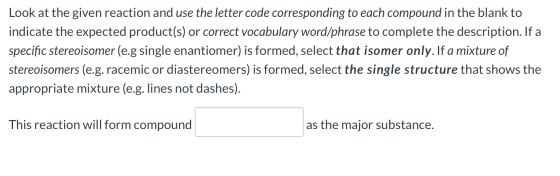
For the first six blanks, please choose options only from the dropdown menus provided below the pictures.

Dropdown Menus:
1. methyl, primary (unhindered), primary (hindered), secondary, tertiary
2. poor, weakly basic, strongly basic (hindered), strongly basic (unhindered)
3. protic, aprotic
4. SN2, SN1, E1, E2, SN2 AND E2, SN1 AND E1, No Reaction
5. randomized, inverted, predictable but not inverted, unchanged
6. a planar carbocation intermediate, backside attack transition state, anti-periplanar transition state, other
Homework Answers

Add Answer to:
For the first six blanks, please choose options only from the
dropdown menus provided below the...
For the first six blanks, please choose only options from the dropdown menus provided below the...
 For the first six blanks, please choose only options from the
dropdown menus provided below the pictures.
Dropdown Menus:
1. methyl, primary (unhindered), primary (hindered), secondary,
tertiary
2. poor, weakly basic, strongly basic (hindered), strongly basic
(unhindered)
3. protic, aprotic
4. SN2, SN1, E1, E2, SN2 AND E2, SN1 AND E1, No Reaction
5. randomized, inverted, predictable but not inverted,
unchanged
6. a planar carbocation intermediate, backside attack transition
state, anti-periplanar transition state, other
CH3OH ~ ??? Br - în...
For the first six blanks, please choose only options from the
dropdown menus provided below the pictures.
Dropdown Menus:
1. methyl, primary (unhindered), primary (hindered), secondary,
tertiary
2. poor, weakly basic, strongly basic (hindered), strongly basic
(unhindered)
3. protic, aprotic
4. SN2, SN1, E1, E2, SN2 AND E2, SN1 AND E1, No Reaction
5. randomized, inverted, predictable but not inverted,
unchanged
6. a planar carbocation intermediate, backside attack transition
state, anti-periplanar transition state, other
CH3OH ~ ??? Br - în...
Look at the given reaction and select the most appropriate answer from the dropdown menus to...
 Look at the given reaction and
select the most appropriate answer from the dropdown menus to fill
in the analysis.
The substrate haloalkane is a ["methyl", "primary (unhindered)",
"primary (hindered)", "secondary", "tertiary"] haloalkane. The
nucleophile is a ["poor", "weakly basic", "strongly basic
(unhindered)", "strongly basic (hindered)"] nucleophile. And the
solvent is ["protic", "aprotic"].
This means the reaction likely follows a(n) ["SN2", "SN1", "E2",
"E1", "SN2 and E2", "SN1 and E1", "No reaction"] mechanism(s),
which will result in the stereochemistry at...
Look at the given reaction and
select the most appropriate answer from the dropdown menus to fill
in the analysis.
The substrate haloalkane is a ["methyl", "primary (unhindered)",
"primary (hindered)", "secondary", "tertiary"] haloalkane. The
nucleophile is a ["poor", "weakly basic", "strongly basic
(unhindered)", "strongly basic (hindered)"] nucleophile. And the
solvent is ["protic", "aprotic"].
This means the reaction likely follows a(n) ["SN2", "SN1", "E2",
"E1", "SN2 and E2", "SN1 and E1", "No reaction"] mechanism(s),
which will result in the stereochemistry at...
Look at the given reaction and select the most appropriate answer from the dropdown menus to...
 Look at the given reaction and select the most appropriate
answer from the dropdown menus to fill in the analysis. Choose one
of the answers in the bracket:
The substrate haloalkane is a ["methyl", "primary (unhindered)",
"primary (hindered)", "secondary", "tertiary"] haloalkane. The
nucleophile is a ["poor", "weakly basic", "strongly basic
(unhindered)", "strongly basic (hindered)"] nucleophile. And the
solvent is ["protic", "aprotic"] .
This means the reaction likely follows a(n) ["SN2", "SN1", "E2",
"E1", "SN2 and E2", "SN1 and E1", "No...
Look at the given reaction and select the most appropriate
answer from the dropdown menus to fill in the analysis. Choose one
of the answers in the bracket:
The substrate haloalkane is a ["methyl", "primary (unhindered)",
"primary (hindered)", "secondary", "tertiary"] haloalkane. The
nucleophile is a ["poor", "weakly basic", "strongly basic
(unhindered)", "strongly basic (hindered)"] nucleophile. And the
solvent is ["protic", "aprotic"] .
This means the reaction likely follows a(n) ["SN2", "SN1", "E2",
"E1", "SN2 and E2", "SN1 and E1", "No...
Dropdown Menus: 1. methyl, primary (unhindered), primary (hindered), secondary, tertiary 2. poor, weakly basic, strong...
 Dropdown Menus:
1. methyl, primary (unhindered), primary (hindered), secondary,
tertiary
2. poor, weakly basic, strongly basic (hindered), strongly basic
(unhindered)
3. protic, aprotic
4. SN2, SN1, E1, E2, SN2 AND E2, SN1 AND E1, No Reaction
5. randomized, inverted, predictable but not inverted,
unchanged
6. a planar carbocation intermediate, backside attack transition
state, anti-periplanar transition state, other
CH3CH2ONa ??? CH3CH2OH Br OH OH OH De on an or rega ang Look at the given reaction and select the most appropriate...
Dropdown Menus:
1. methyl, primary (unhindered), primary (hindered), secondary,
tertiary
2. poor, weakly basic, strongly basic (hindered), strongly basic
(unhindered)
3. protic, aprotic
4. SN2, SN1, E1, E2, SN2 AND E2, SN1 AND E1, No Reaction
5. randomized, inverted, predictable but not inverted,
unchanged
6. a planar carbocation intermediate, backside attack transition
state, anti-periplanar transition state, other
CH3CH2ONa ??? CH3CH2OH Br OH OH OH De on an or rega ang Look at the given reaction and select the most appropriate...
Dropdown Menus: 1. methyl, primary (unhindered), primary (hindered), secondary, tertiary 2. poor, weakly basic, strongly basic...
 Dropdown Menus:
1. methyl, primary (unhindered), primary (hindered), secondary,
tertiary
2. poor, weakly basic, strongly basic (hindered), strongly basic
(unhindered)
3. protic, aprotic
4. SN2, SN1, E1, E2, SN2 AND E2, SN1 AND E1, No Reaction
5. randomized, inverted, predictable but not inverted,
unchanged
6. a planar carbocation intermediate, backside attack transition
state, anti-periplanar transition state, other
OH Hom 유 용 The Tone The ♡ ♡ Tñ y OH H OH E OH F HO3 G Look at the given...
Dropdown Menus:
1. methyl, primary (unhindered), primary (hindered), secondary,
tertiary
2. poor, weakly basic, strongly basic (hindered), strongly basic
(unhindered)
3. protic, aprotic
4. SN2, SN1, E1, E2, SN2 AND E2, SN1 AND E1, No Reaction
5. randomized, inverted, predictable but not inverted,
unchanged
6. a planar carbocation intermediate, backside attack transition
state, anti-periplanar transition state, other
OH Hom 유 용 The Tone The ♡ ♡ Tñ y OH H OH E OH F HO3 G Look at the given...
Organic Chemistry: Vocabulary: i.) If we have a weakly basic nucleophile and a secondary haloalkane we’ll...
Organic Chemistry: Vocabulary: i.) If we have a weakly basic nucleophile and a secondary haloalkane we’ll generally get _ mechanism(s). a. SN1 only b. SN2 c. E2 d. E1 only e. SN1 and E1 f. no reaction This mechanism will have ____ stereochemistry, a. predictable b. random due to the ____. a. planar intermediate b. backside attack transition state c. frontside attack transition state d. anti-periplanar transition state _____________________________________________________ ii.) Carbocation rearrangements will tend to form the __ stable intermediate....
need help with 1-21 1) Label the steps below as "slow" and "fast". HCH 013 10...
 need help with 1-21
1) Label the steps below as "slow" and "fast". HCH 013 10 = H. C + + H-LG H-LG 2) Why are they slow/fast? Explain using chemical terms. Stereochemistry of the Sn1 reaction 3) What type of intermediate does the Sn1 reaction proceed through? 4) What is the geometry of the carbon that the nucleophile coordinates to in the 2 step? 5) From how many directions would it be reasonable for the nucleophile to approach the...
need help with 1-21
1) Label the steps below as "slow" and "fast". HCH 013 10 = H. C + + H-LG H-LG 2) Why are they slow/fast? Explain using chemical terms. Stereochemistry of the Sn1 reaction 3) What type of intermediate does the Sn1 reaction proceed through? 4) What is the geometry of the carbon that the nucleophile coordinates to in the 2 step? 5) From how many directions would it be reasonable for the nucleophile to approach the...
Part 2 Multiple Choice. Select the best answer for each of the questions below: 1. Which...
 Part 2 Multiple Choice. Select the best answer for each of the questions below: 1. Which of these molecules is not an electrophile? a) CH4 b) CH3+ c) H* d) BF3 2. Which of these molecules is not a nucleophile ? a) NH3 b) OH c) CN d) H* 3. Water behaves as: a) a nucleophile b) an electrophile c) both d) neither 4. The SN2 reaction has how many steps? a) 1 b) 2 c) 3 d) 4 5....
 For the first six blanks, please choose only options from the
dropdown menus provided below the pictures.
Dropdown Menus:
1. methyl, primary (unhindered), primary (hindered), secondary,
tertiary
2. poor, weakly basic, strongly basic (hindered), strongly basic
(unhindered)
3. protic, aprotic
4. SN2, SN1, E1, E2, SN2 AND E2, SN1 AND E1, No Reaction
5. randomized, inverted, predictable but not inverted,
unchanged
6. a planar carbocation intermediate, backside attack transition
state, anti-periplanar transition state, other
CH3OH ~ ??? Br - în...
For the first six blanks, please choose only options from the
dropdown menus provided below the pictures.
Dropdown Menus:
1. methyl, primary (unhindered), primary (hindered), secondary,
tertiary
2. poor, weakly basic, strongly basic (hindered), strongly basic
(unhindered)
3. protic, aprotic
4. SN2, SN1, E1, E2, SN2 AND E2, SN1 AND E1, No Reaction
5. randomized, inverted, predictable but not inverted,
unchanged
6. a planar carbocation intermediate, backside attack transition
state, anti-periplanar transition state, other
CH3OH ~ ??? Br - în...
 Look at the given reaction and
select the most appropriate answer from the dropdown menus to fill
in the analysis.
The substrate haloalkane is a ["methyl", "primary (unhindered)",
"primary (hindered)", "secondary", "tertiary"] haloalkane. The
nucleophile is a ["poor", "weakly basic", "strongly basic
(unhindered)", "strongly basic (hindered)"] nucleophile. And the
solvent is ["protic", "aprotic"].
This means the reaction likely follows a(n) ["SN2", "SN1", "E2",
"E1", "SN2 and E2", "SN1 and E1", "No reaction"] mechanism(s),
which will result in the stereochemistry at...
Look at the given reaction and
select the most appropriate answer from the dropdown menus to fill
in the analysis.
The substrate haloalkane is a ["methyl", "primary (unhindered)",
"primary (hindered)", "secondary", "tertiary"] haloalkane. The
nucleophile is a ["poor", "weakly basic", "strongly basic
(unhindered)", "strongly basic (hindered)"] nucleophile. And the
solvent is ["protic", "aprotic"].
This means the reaction likely follows a(n) ["SN2", "SN1", "E2",
"E1", "SN2 and E2", "SN1 and E1", "No reaction"] mechanism(s),
which will result in the stereochemistry at...
 Look at the given reaction and select the most appropriate
answer from the dropdown menus to fill in the analysis. Choose one
of the answers in the bracket:
The substrate haloalkane is a ["methyl", "primary (unhindered)",
"primary (hindered)", "secondary", "tertiary"] haloalkane. The
nucleophile is a ["poor", "weakly basic", "strongly basic
(unhindered)", "strongly basic (hindered)"] nucleophile. And the
solvent is ["protic", "aprotic"] .
This means the reaction likely follows a(n) ["SN2", "SN1", "E2",
"E1", "SN2 and E2", "SN1 and E1", "No...
Look at the given reaction and select the most appropriate
answer from the dropdown menus to fill in the analysis. Choose one
of the answers in the bracket:
The substrate haloalkane is a ["methyl", "primary (unhindered)",
"primary (hindered)", "secondary", "tertiary"] haloalkane. The
nucleophile is a ["poor", "weakly basic", "strongly basic
(unhindered)", "strongly basic (hindered)"] nucleophile. And the
solvent is ["protic", "aprotic"] .
This means the reaction likely follows a(n) ["SN2", "SN1", "E2",
"E1", "SN2 and E2", "SN1 and E1", "No...
 Dropdown Menus:
1. methyl, primary (unhindered), primary (hindered), secondary,
tertiary
2. poor, weakly basic, strongly basic (hindered), strongly basic
(unhindered)
3. protic, aprotic
4. SN2, SN1, E1, E2, SN2 AND E2, SN1 AND E1, No Reaction
5. randomized, inverted, predictable but not inverted,
unchanged
6. a planar carbocation intermediate, backside attack transition
state, anti-periplanar transition state, other
CH3CH2ONa ??? CH3CH2OH Br OH OH OH De on an or rega ang Look at the given reaction and select the most appropriate...
Dropdown Menus:
1. methyl, primary (unhindered), primary (hindered), secondary,
tertiary
2. poor, weakly basic, strongly basic (hindered), strongly basic
(unhindered)
3. protic, aprotic
4. SN2, SN1, E1, E2, SN2 AND E2, SN1 AND E1, No Reaction
5. randomized, inverted, predictable but not inverted,
unchanged
6. a planar carbocation intermediate, backside attack transition
state, anti-periplanar transition state, other
CH3CH2ONa ??? CH3CH2OH Br OH OH OH De on an or rega ang Look at the given reaction and select the most appropriate...
 Dropdown Menus:
1. methyl, primary (unhindered), primary (hindered), secondary,
tertiary
2. poor, weakly basic, strongly basic (hindered), strongly basic
(unhindered)
3. protic, aprotic
4. SN2, SN1, E1, E2, SN2 AND E2, SN1 AND E1, No Reaction
5. randomized, inverted, predictable but not inverted,
unchanged
6. a planar carbocation intermediate, backside attack transition
state, anti-periplanar transition state, other
OH Hom 유 용 The Tone The ♡ ♡ Tñ y OH H OH E OH F HO3 G Look at the given...
Dropdown Menus:
1. methyl, primary (unhindered), primary (hindered), secondary,
tertiary
2. poor, weakly basic, strongly basic (hindered), strongly basic
(unhindered)
3. protic, aprotic
4. SN2, SN1, E1, E2, SN2 AND E2, SN1 AND E1, No Reaction
5. randomized, inverted, predictable but not inverted,
unchanged
6. a planar carbocation intermediate, backside attack transition
state, anti-periplanar transition state, other
OH Hom 유 용 The Tone The ♡ ♡ Tñ y OH H OH E OH F HO3 G Look at the given...
 need help with 1-21
1) Label the steps below as "slow" and "fast". HCH 013 10 = H. C + + H-LG H-LG 2) Why are they slow/fast? Explain using chemical terms. Stereochemistry of the Sn1 reaction 3) What type of intermediate does the Sn1 reaction proceed through? 4) What is the geometry of the carbon that the nucleophile coordinates to in the 2 step? 5) From how many directions would it be reasonable for the nucleophile to approach the...
need help with 1-21
1) Label the steps below as "slow" and "fast". HCH 013 10 = H. C + + H-LG H-LG 2) Why are they slow/fast? Explain using chemical terms. Stereochemistry of the Sn1 reaction 3) What type of intermediate does the Sn1 reaction proceed through? 4) What is the geometry of the carbon that the nucleophile coordinates to in the 2 step? 5) From how many directions would it be reasonable for the nucleophile to approach the...
 Part 2 Multiple Choice. Select the best answer for each of the questions below: 1. Which of these molecules is not an electrophile? a) CH4 b) CH3+ c) H* d) BF3 2. Which of these molecules is not a nucleophile ? a) NH3 b) OH c) CN d) H* 3. Water behaves as: a) a nucleophile b) an electrophile c) both d) neither 4. The SN2 reaction has how many steps? a) 1 b) 2 c) 3 d) 4 5....
Most questions answered within 3 hours.
-
Where is the error in this code sequence?
String s1 = "Hello";
String s2 = "ello";...
asked 10 months ago -
Financial data for Joel de Paris, Inc., for last year
follow:
Joel de Paris, Inc.
Balance...
asked 10 months ago -
Consider this reaction:
Al2(SO4)3 (aq)+ BaCl3
(aq) Al2Cl6 (aq)- +
3BaSO4(s) . What is the...
asked 10 months ago -
Suppose that Savneet is considering increasing her
recent random sample from 20 car rentals to 40...
asked 10 months ago -
Trucks arrive at an unloading terminal at an average rate of 120
per hour.
Trucks arrive...
asked 10 months ago -
Why are methanol and ethanol completely soluble in water while
octanol is not very little soluble....
asked 10 months ago -
A facilities manager at a university reads in a research report
that the mean amount of...
asked 10 months ago -
When the CuSO4 is rehydrated by adding water to the anhydrous
compound, is this an endothermic...
asked 10 months ago -
A ray of sunlight is passing from diamond into crown glass; the
angle of incidence is...
asked 10 months ago -
A block of mass 0.249 kg is placed on top of a light, vertical
spring of...
asked 10 months ago -
how do the kidneys compensate in the presences of acidosis
a) trigger hyperventilate
b) reserve acid...
asked 10 months ago -
Question 501 pts
The rental rate of capital to the firm increases. Which of the
following...
asked 10 months ago