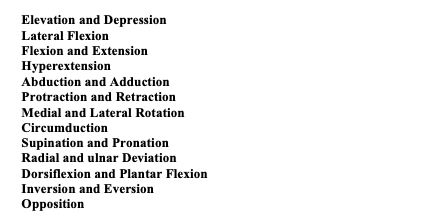
Go through some of your body's joints and determine which of the following pairs of movements are relevant/possible at each. (Be sure you can demonstrate each of the following movements at an appropriate joint.)
Homework Answers
- FLEXION & EXTENSION takes place at the shoulder,hip,elbow,knee,wrist,metacarpophalangeal,metatarsophalangeal and interphalangeal joints.
HYPER EXTENSION is the excessive extension of a joint more than the normal range of motion,resulting in injury.
LATERAL FLEXION is the bending of the body to the left or right side.
- ADDUCTION,ABDUCTION & CIRCUMDUCTION could be done at the shoulder,hip,wrist,metacarpophalangeal and metatarsophalangeal joints
- SUPINATION & PRONATION,RADIAL & ULNAR DEVIATION are the movements of the forearm/wrist.
- DORSIFLEXION & PLANTAR FLEXION are the movements at the ankle joint.
- PROTRACTION &RETRACTION,DEPRESSION & ELEVATION movements are of the scapula or mandible.
- OPPOSITION is the movement of the thumb.
- MEDIAL & LATERAL ROTATION involves movement of the limbs.
- INVERSION & EVERSION are the movements involving tarsal bones of the posterior foot.
Add Answer to:
Go through some of your body's joints and determine which of the
following pairs of movements...
ARTICULATIONS "Handout" II. D. Types of synovial joints TYPE DESCRIPTION OF BONY SURFACES AXES OF MOTION...
 ARTICULATIONS "Handout" II. D. Types of synovial joints TYPE DESCRIPTION OF BONY SURFACES AXES OF MOTION 2 EXAMPLES opposing flat surfaces spool in half-moon pointed or rounded surface of one bone fits into bone/ligament ring of another oval surface of one bone fits into complementary depression of another saddle on back of horse ball-shaped end of one bone fits into cup-shaped end of another IV. Movements at synovial joints Complete the following chart, defining each movement and naming a joint...
Articulations and Body Movements LMrie n ter thantha right column. Name of joint (any one) Movement...
 Articulations and Body Movements LMrie n ter thantha right column. Name of joint (any one) Movement allowed flexion and extension Rotation Rotation flexion and extension dorsiflexion and plantar flexion flexion and extension elevation and depression flexion, extension abduction, adduction flexion, extension abduction, adduction flexion, extension lateral flexion, circumduction flexion, extension abduction, adduction flexion, extension some rotation flexion, extension abduction, adduction flexion, extension abduction, adduction rotation, circumduction flexion, extension abduction, adduction rotation, circumduction
Match each of the following statements with its description. Drag the terms on the left to...
 Match each of the following statements with its description. Drag the terms on the left to the appropriate blanks on the right to complete the sentences. Reset Help anterior movement of a body part Flexion: Pronation: rotation of the forearm and hand medially so that the palm faces posteriorly Abduction: movement of a body part away from the midline Dorsiflexion: Circumduction: movement of the foot so that the toes are pulled up toward the head Protraction: movement of the distal...
Matching 1. Extension Circumduction Plantar flexion 4. Dorsiflexion 5. Eversion 6. Adduction 7. Hyperextension opment term...
 Matching 1. Extension Circumduction Plantar flexion 4. Dorsiflexion 5. Eversion 6. Adduction 7. Hyperextension opment term listed below to its proper definition A Moving the arm so the palm is up B. Moving a body part outward C. Straightening of a body part D. Motion toward the midline of the body E. Moving a body part inward F. Turning a body part around its axis G. A position of maximum extension, or extending a body part beyond its normal limits...
match the joint -Plantar Flexion -Antagonistic muscles -Flexion -Extension -Pronation -Torticollis -Supination -Bone -Hyperextension -Abduction -Adduction...
 match the joint
-Plantar Flexion -Antagonistic muscles -Flexion -Extension -Pronation -Torticollis -Supination -Bone -Hyperextension -Abduction -Adduction - Internal Rotation -Eversion -Inversion -External Rotation -Dersiflexion -Bursitis - Muscle -Joint -Dislocation -Subluxation 1. The most common signs and symptoms of disease are pain, swelling, decreased mobility, and deformity. 2. Weakness is the most common sign or symptom of disorders. cause movement at a joint. is the complete separation of a bone from its normal position in a joint. is the inflammation of...
match the joint
-Plantar Flexion -Antagonistic muscles -Flexion -Extension -Pronation -Torticollis -Supination -Bone -Hyperextension -Abduction -Adduction - Internal Rotation -Eversion -Inversion -External Rotation -Dersiflexion -Bursitis - Muscle -Joint -Dislocation -Subluxation 1. The most common signs and symptoms of disease are pain, swelling, decreased mobility, and deformity. 2. Weakness is the most common sign or symptom of disorders. cause movement at a joint. is the complete separation of a bone from its normal position in a joint. is the inflammation of...
1. Kinetics is the study of forces acting on a system. True False 2. Kinematics is...
 1. Kinetics is the study of forces acting on a system.
True
False
2. Kinematics is the study of motion without regard to its
causes (forces).
True
False
3. The similarity between the Macrocycle Flowchart, the Training
Pyramid and the Goals for Performance pyramid can be best described
as an athlete should have a structured foundation and not proceed
too early.
True
False
4. When should static stretching be performed?
Minutes before event performance
Hours prior to event or the...
1. Kinetics is the study of forces acting on a system.
True
False
2. Kinematics is the study of motion without regard to its
causes (forces).
True
False
3. The similarity between the Macrocycle Flowchart, the Training
Pyramid and the Goals for Performance pyramid can be best described
as an athlete should have a structured foundation and not proceed
too early.
True
False
4. When should static stretching be performed?
Minutes before event performance
Hours prior to event or the...
 ARTICULATIONS "Handout" II. D. Types of synovial joints TYPE DESCRIPTION OF BONY SURFACES AXES OF MOTION 2 EXAMPLES opposing flat surfaces spool in half-moon pointed or rounded surface of one bone fits into bone/ligament ring of another oval surface of one bone fits into complementary depression of another saddle on back of horse ball-shaped end of one bone fits into cup-shaped end of another IV. Movements at synovial joints Complete the following chart, defining each movement and naming a joint...
 Articulations and Body Movements LMrie n ter thantha right column. Name of joint (any one) Movement allowed flexion and extension Rotation Rotation flexion and extension dorsiflexion and plantar flexion flexion and extension elevation and depression flexion, extension abduction, adduction flexion, extension abduction, adduction flexion, extension lateral flexion, circumduction flexion, extension abduction, adduction flexion, extension some rotation flexion, extension abduction, adduction flexion, extension abduction, adduction rotation, circumduction flexion, extension abduction, adduction rotation, circumduction
 Match each of the following statements with its description. Drag the terms on the left to the appropriate blanks on the right to complete the sentences. Reset Help anterior movement of a body part Flexion: Pronation: rotation of the forearm and hand medially so that the palm faces posteriorly Abduction: movement of a body part away from the midline Dorsiflexion: Circumduction: movement of the foot so that the toes are pulled up toward the head Protraction: movement of the distal...
 Matching 1. Extension Circumduction Plantar flexion 4. Dorsiflexion 5. Eversion 6. Adduction 7. Hyperextension opment term listed below to its proper definition A Moving the arm so the palm is up B. Moving a body part outward C. Straightening of a body part D. Motion toward the midline of the body E. Moving a body part inward F. Turning a body part around its axis G. A position of maximum extension, or extending a body part beyond its normal limits...
 match the joint
-Plantar Flexion -Antagonistic muscles -Flexion -Extension -Pronation -Torticollis -Supination -Bone -Hyperextension -Abduction -Adduction - Internal Rotation -Eversion -Inversion -External Rotation -Dersiflexion -Bursitis - Muscle -Joint -Dislocation -Subluxation 1. The most common signs and symptoms of disease are pain, swelling, decreased mobility, and deformity. 2. Weakness is the most common sign or symptom of disorders. cause movement at a joint. is the complete separation of a bone from its normal position in a joint. is the inflammation of...
match the joint
-Plantar Flexion -Antagonistic muscles -Flexion -Extension -Pronation -Torticollis -Supination -Bone -Hyperextension -Abduction -Adduction - Internal Rotation -Eversion -Inversion -External Rotation -Dersiflexion -Bursitis - Muscle -Joint -Dislocation -Subluxation 1. The most common signs and symptoms of disease are pain, swelling, decreased mobility, and deformity. 2. Weakness is the most common sign or symptom of disorders. cause movement at a joint. is the complete separation of a bone from its normal position in a joint. is the inflammation of...
 1. Kinetics is the study of forces acting on a system.
True
False
2. Kinematics is the study of motion without regard to its
causes (forces).
True
False
3. The similarity between the Macrocycle Flowchart, the Training
Pyramid and the Goals for Performance pyramid can be best described
as an athlete should have a structured foundation and not proceed
too early.
True
False
4. When should static stretching be performed?
Minutes before event performance
Hours prior to event or the...
1. Kinetics is the study of forces acting on a system.
True
False
2. Kinematics is the study of motion without regard to its
causes (forces).
True
False
3. The similarity between the Macrocycle Flowchart, the Training
Pyramid and the Goals for Performance pyramid can be best described
as an athlete should have a structured foundation and not proceed
too early.
True
False
4. When should static stretching be performed?
Minutes before event performance
Hours prior to event or the...
Most questions answered within 3 hours.
-
Where is the error in this code sequence?
String s1 = "Hello";
String s2 = "ello";...
asked 11 months ago -
Financial data for Joel de Paris, Inc., for last year
follow:
Joel de Paris, Inc.
Balance...
asked 11 months ago -
Consider this reaction:
Al2(SO4)3 (aq)+ BaCl3
(aq) Al2Cl6 (aq)- +
3BaSO4(s) . What is the...
asked 11 months ago -
Suppose that Savneet is considering increasing her
recent random sample from 20 car rentals to 40...
asked 11 months ago -
Trucks arrive at an unloading terminal at an average rate of 120
per hour.
Trucks arrive...
asked 11 months ago -
Why are methanol and ethanol completely soluble in water while
octanol is not very little soluble....
asked 11 months ago -
A facilities manager at a university reads in a research report
that the mean amount of...
asked 11 months ago -
When the CuSO4 is rehydrated by adding water to the anhydrous
compound, is this an endothermic...
asked 11 months ago -
A ray of sunlight is passing from diamond into crown glass; the
angle of incidence is...
asked 11 months ago -
A block of mass 0.249 kg is placed on top of a light, vertical
spring of...
asked 11 months ago -
how do the kidneys compensate in the presences of acidosis
a) trigger hyperventilate
b) reserve acid...
asked 11 months ago -
Question 501 pts
The rental rate of capital to the firm increases. Which of the
following...
asked 11 months ago