Which bonds are the most illiquid? (1) Corporate bonds issued through traditional private placement (2) Corporate...
Which bonds are the most illiquid?
(1) Corporate bonds issued through traditional private placement
(2) Corporate bonds issued through the SEC Rule 144A
(3) Corporate bonds issued through public offerings
(4) TIPS
Homework Answers
Correct answer: (1) Corporate bonds issued through traditional private placement
Corporate bonds issued through traditional private placement do not trade on the secondary market thus it is most illiquid.
A illiquid bond refers to a bond which cannot be easily sold or exchanged for cash. When a bond is not listed on secondary market then it is very difficult for bond holder to sell the bond.
Hope it will help, please do comment if you need any further explanation. Your feedback would be highly appreciated.
Add Answer to:
Which bonds are the most illiquid?
(1) Corporate bonds issued through traditional private
placement
(2) Corporate...
1. Using the FINRA Bond Center search engine, search for SEC 144A private placement corporate bonds....
1. Using the FINRA Bond Center search engine, search for SEC 144A private placement corporate bonds. Using the advanced search engine, set sub-product type to “Corporate Bond”, check the box to “include” 144A Bonds, set the Moody’s rating from C to Caa, the Standard and Poor’s rating from D to BBB-, and the Trace Grade to “High Yield”. Click on SHOW RESULTS and sort from highest to lowest maturity. Display the details for the bond issued by “Chesapeake Energy Corp”....
QUESTION 53 Which of the following are exempt transactions? 1. Private placements II. Securities issued by...
 QUESTION 53 Which of the following are exempt transactions? 1. Private placements II. Securities issued by the U.S. government III. Municipal bonds IV. Intrastate offerings land IV 1, II, III, and IV Il and I II, III, and IV QUESTION 54 Which of the following individuals who work for a brokerage firm must be fingerprinted? Principals People who handle cash or certificates Registered representatives All provided answers are correct
III. Bonds Payable issue and amortization Carson Company issued $1,000,000 of corporate bonds on January...
III. Bonds Payable issue and amortization Carson Company issued $1,000,000 of corporate bonds on January 1, 2016. The bonds have a stated rate of 4 percent, and a 10 year life. The bonds were issued to yield 3 percent. The bonds pay interest annually, each December 31, starting December 31, 2016. A. Calculate the issue price of the bonds at 1/1/16. Show your assumptions for your calculations. B. Prepare an amortization schedule for the bonds through...
Question 15 1 pts Put most simply providers (ex.doctors) can be paid through private sources or...
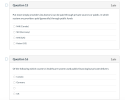 Question 15 1 pts Put most simply providers (ex.doctors) can be paid through private sources or public, in which system are providers paid (generally) through public funds O NHI (Canada) OSHI (Germany) NHS (UK) Kaiser (US) Question 16 1 pts Of the following which country's healthcare system used public financing but private delivery O Canada Germany O UK
4 points Save Answer Public-Private Inc. issued $200 million of 30 year bonds and is contractually...
 4 points Save Answer Public-Private Inc. issued $200 million of 30 year bonds and is contractually obligated to call $ 7 million of bonds each year. The company can retire/call bonds ($7 million each year) by calling for redemption at par value OR buy those bonds in the market. Your are the Public-Private Inc. 's Chief Financial Officer responsible for determining which option to choose (i) please explain under what conditions would you retire the bonds at par value? (u)...
III. Bonds Payable issue and amortization Carson Company issued $1,000,000 of corporate bonds on January...
III. Bonds Payable issue and amortization Carson Company issued $1,000,000 of corporate bonds on January 1, 2016. The bonds have a stated rate of 4 percent, and a 10 year life. The bonds were issued to yield 3 percent. The bonds pay interest annually, each December 31, starting December 31, 2016. A. Calculate the issue price of the bonds at 1/1/16. Show your assumptions for your calculations. B. Prepare an amortization schedule for the bonds through...
What are the differences between the following alternatives??? 1- Obtain private debt financing 2- Seek out...
What are the differences between the following alternatives??? 1- Obtain private debt financing 2- Seek out a private investor(s) who would be willing to share ownership 3- Seek out offers for a private buy-out 4- Issue public debt (corporate bonds) 5- Issue public common stock
Even though most corporate bonds in the United States make coupon payments semiannually, bonds issued elsewhere...
Even though most corporate bonds in the United States make coupon payments semiannually, bonds issued elsewhere often have annual coupon payments. Suppose a German company issues a bond with a par value of €1,000, 25 years to maturity, and a coupon rate of 6.3 percent paid annually. If the yield to maturity is 7.4 percent, what is the current price of the bond? (Do not round intermediate calculations and round your answer to 2 decimal places, e.g., 32.16.) Bond price...
Even though most corporate bonds in the United States make coupon payments semiannually, bonds issued elsewhere...
Even though most corporate bonds in the United States make coupon payments semiannually, bonds issued elsewhere often have annual coupon payments. Suppose a German company issues a bond with a par value of €1,000, 20 years to maturity, and a coupon rate of 7.8 percent paid annually. If the yield to maturity is 8.9 percent, what is the current price of the bond? (Do not round intermediate calculations and round your answer to 2 decimal places, e.g., 32.16.)
Even though most corporate bonds in the United States make coupon payments semiannually, bonds issued elsewhere...
Even though most corporate bonds in the United States make coupon payments semiannually, bonds issued elsewhere often have annual coupon payments. Suppose a German company issues a bond with a par value of €1,000, 10 years to maturity, and a coupon rate of 6.4 percent paid annually. If the yield to maturity is 7.5 percent, what is the current price of the bond? (Do not round intermediate calculations and round your answer to 2 decimal places, e.g., 32.16.)
 QUESTION 53 Which of the following are exempt transactions? 1. Private placements II. Securities issued by the U.S. government III. Municipal bonds IV. Intrastate offerings land IV 1, II, III, and IV Il and I II, III, and IV QUESTION 54 Which of the following individuals who work for a brokerage firm must be fingerprinted? Principals People who handle cash or certificates Registered representatives All provided answers are correct
 Question 15 1 pts Put most simply providers (ex.doctors) can be paid through private sources or public, in which system are providers paid (generally) through public funds O NHI (Canada) OSHI (Germany) NHS (UK) Kaiser (US) Question 16 1 pts Of the following which country's healthcare system used public financing but private delivery O Canada Germany O UK
 4 points Save Answer Public-Private Inc. issued $200 million of 30 year bonds and is contractually obligated to call $ 7 million of bonds each year. The company can retire/call bonds ($7 million each year) by calling for redemption at par value OR buy those bonds in the market. Your are the Public-Private Inc. 's Chief Financial Officer responsible for determining which option to choose (i) please explain under what conditions would you retire the bonds at par value? (u)...
Most questions answered within 3 hours.
-
Where is the error in this code sequence?
String s1 = "Hello";
String s2 = "ello";...
asked 10 months ago -
Financial data for Joel de Paris, Inc., for last year
follow:
Joel de Paris, Inc.
Balance...
asked 10 months ago -
Consider this reaction:
Al2(SO4)3 (aq)+ BaCl3
(aq) Al2Cl6 (aq)- +
3BaSO4(s) . What is the...
asked 10 months ago -
Suppose that Savneet is considering increasing her
recent random sample from 20 car rentals to 40...
asked 10 months ago -
Trucks arrive at an unloading terminal at an average rate of 120
per hour.
Trucks arrive...
asked 10 months ago -
Why are methanol and ethanol completely soluble in water while
octanol is not very little soluble....
asked 10 months ago -
A facilities manager at a university reads in a research report
that the mean amount of...
asked 10 months ago -
When the CuSO4 is rehydrated by adding water to the anhydrous
compound, is this an endothermic...
asked 10 months ago -
A ray of sunlight is passing from diamond into crown glass; the
angle of incidence is...
asked 10 months ago -
A block of mass 0.249 kg is placed on top of a light, vertical
spring of...
asked 10 months ago -
how do the kidneys compensate in the presences of acidosis
a) trigger hyperventilate
b) reserve acid...
asked 10 months ago -
Question 501 pts
The rental rate of capital to the firm increases. Which of the
following...
asked 10 months ago