Supposed both X and Y are independent and distributed according to Geo(0.2). Compute P(min {X,Y} <...
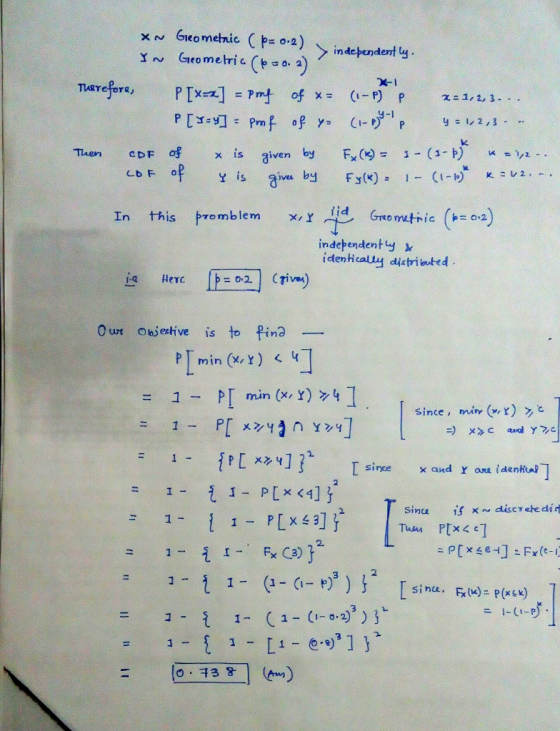
Supposed both X and Y are independent and distributed according to Geo(0.2). Compute P(min {X,Y} < 4). Hint: if x tilda Geo(P), then Fx (k) = 1 - (1 - p)^k.
Homework Answers
Add Answer to:
Supposed both X and Y are independent and distributed according
to Geo(0.2). Compute P(min {X,Y} <...
Suppose both X and Y are independent and distributed according to Geo(0.2). Compute P(min{X,Y} < 4)....
Suppose both X and Y are independent and distributed according to Geo(0.2). Compute P(min{X,Y} < 4). Hint: If X ~Geo(p), then FX(k) = 1 -(1 -p)k.
o Additional Problem 3: Suppose both X and Y are independent and distributed according to Geo(0.2)....
 o Additional Problem 3: Suppose both X and Y are independent and distributed according to Geo(0.2). Compute P(min (X, Y Hint: If X ~ Geo(p), then FX (k) = 1-(1-pt. < 4).
Suppose both X and Y are independent and distributed according to Geo(0.2). Compute P(min{X,Y} < 4).
Suppose both X and Y are independent and distributed according to Geo(0.2). Compute P(min{X,Y} < 4).
2. Suppose X and Y are independent continuous random variables. Show that P(Y < X) =...
 2. Suppose X and Y are independent continuous random variables. Show that P(Y < X) = | Fy(x) · fx (x) dx -oo where Fy is the CDF of Y and fx is the PDF of X [hint: P[Y E A] = S.P(Y E A|X = x) · fx(x) dx]. Rewrite the above equation as an expectation of a function of X, i.e. P(Y < X) = Ex[•]. Use the above relation to compute P[Y < X] if X~Exp (2)...
Let random variable X be distributed according to the p.m.f P(a) 0.3 0.5 0.2 · If...
 Let random variable X be distributed according to the p.m.f P(a) 0.3 0.5 0.2 · If Y = 2x, what are ELY Var(Y) If Z = aX + b has E121 = 0 and Var(Z) = 1, what are: .
5. If X and Y are independent and identically distributed with Exponential(A), compute El and 6....
 5. If X and Y are independent and identically distributed with Exponential(A), compute El and 6. Let R be the region bounded by the points (0, 1), (-1,0) and (1,0). Joint pdf of (x, Y) is: 1, if (r,y) e R 0, otherwise. Compute P(X-1, γ 7. If X U(0,1) and Y U(0, 1) independent random variables, find the joint pdf of (X+y,x -Y). Also compute marginal pdf of X+Y 8. If x Ezpomential(0.5) and Y ~ Erponential0.5) independent random...
Let random variable X be distributed according to the p.m.f P( 0.3 0.5 0.2 · If...
 Let random variable X be distributed according to the p.m.f P( 0.3 0.5 0.2 · If Y=2X, what are li E r Var(Y) . If Z = aX + b has EZj-0 and Var(Z)-1, what are: lal
Let X and Y be two independent and identically distributed random variables that take only positive...
Let X and Y be two independent and identically distributed random variables that take only positive integer values. Their PMF is pX(n)=pY(n)=2−n for every n∈N , where N is the set of positive integers. Fix a t∈N . Find the probability P(min{X,Y}≤t) . Your answer should be a function of t . unanswered Find the probability P(X=Y) . unanswered Find the probability P(X>Y) . Hint: Use your answer to the previous part, and symmetry. unanswered Fix a positive integer k...
X and Y are jointly uniformly distributed and their joint PDF is given by: fX,Y(x,y) =...
X and Y are jointly uniformly distributed and their joint PDF is given by: fX,Y(x,y) = {k , 0<=x<=4, 0 <=y <= 8 0 , otherwise } a.) find the value of k that makes the joint PDF valid b.) compute the probability P[(X-2)^2 + (Y-2)^2 < 4] c.) compute the probability P[Y > 0.5X + 5]
Let X tilda U(0,3) and Y = X^3. Compute P(5 < Y < 12).
Let X tilda U(0,3) and Y = X^3. Compute P(5 < Y < 12).
 o Additional Problem 3: Suppose both X and Y are independent and distributed according to Geo(0.2). Compute P(min (X, Y Hint: If X ~ Geo(p), then FX (k) = 1-(1-pt. < 4).
 2. Suppose X and Y are independent continuous random variables. Show that P(Y < X) = | Fy(x) · fx (x) dx -oo where Fy is the CDF of Y and fx is the PDF of X [hint: P[Y E A] = S.P(Y E A|X = x) · fx(x) dx]. Rewrite the above equation as an expectation of a function of X, i.e. P(Y < X) = Ex[•]. Use the above relation to compute P[Y < X] if X~Exp (2)...
 Let random variable X be distributed according to the p.m.f P(a) 0.3 0.5 0.2 · If Y = 2x, what are ELY Var(Y) If Z = aX + b has E121 = 0 and Var(Z) = 1, what are: .
 5. If X and Y are independent and identically distributed with Exponential(A), compute El and 6. Let R be the region bounded by the points (0, 1), (-1,0) and (1,0). Joint pdf of (x, Y) is: 1, if (r,y) e R 0, otherwise. Compute P(X-1, γ 7. If X U(0,1) and Y U(0, 1) independent random variables, find the joint pdf of (X+y,x -Y). Also compute marginal pdf of X+Y 8. If x Ezpomential(0.5) and Y ~ Erponential0.5) independent random...
 Let random variable X be distributed according to the p.m.f P( 0.3 0.5 0.2 · If Y=2X, what are li E r Var(Y) . If Z = aX + b has EZj-0 and Var(Z)-1, what are: lal
Most questions answered within 3 hours.
-
Where is the error in this code sequence?
String s1 = "Hello";
String s2 = "ello";...
asked 11 months ago -
Financial data for Joel de Paris, Inc., for last year
follow:
Joel de Paris, Inc.
Balance...
asked 11 months ago -
Consider this reaction:
Al2(SO4)3 (aq)+ BaCl3
(aq) Al2Cl6 (aq)- +
3BaSO4(s) . What is the...
asked 11 months ago -
Suppose that Savneet is considering increasing her
recent random sample from 20 car rentals to 40...
asked 11 months ago -
Trucks arrive at an unloading terminal at an average rate of 120
per hour.
Trucks arrive...
asked 11 months ago -
Why are methanol and ethanol completely soluble in water while
octanol is not very little soluble....
asked 11 months ago -
A facilities manager at a university reads in a research report
that the mean amount of...
asked 11 months ago -
When the CuSO4 is rehydrated by adding water to the anhydrous
compound, is this an endothermic...
asked 11 months ago -
A ray of sunlight is passing from diamond into crown glass; the
angle of incidence is...
asked 11 months ago -
A block of mass 0.249 kg is placed on top of a light, vertical
spring of...
asked 11 months ago -
how do the kidneys compensate in the presences of acidosis
a) trigger hyperventilate
b) reserve acid...
asked 11 months ago -
Question 501 pts
The rental rate of capital to the firm increases. Which of the
following...
asked 11 months ago