
Homework Answers
Add Answer to:
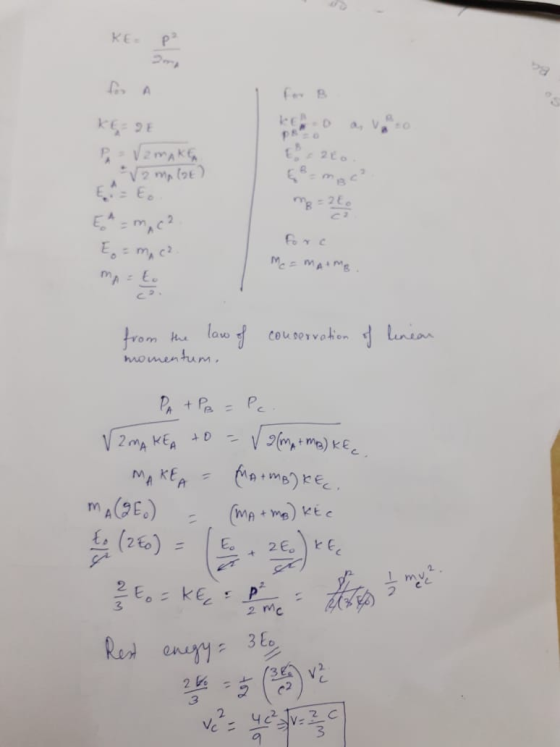
4. Two particles A and B collide and stick together to form a new particle. Particle...
Two pieces of clay are moving directly toward each other. When they collide, they stick together...
Two pieces of clay are moving directly toward each other. When they collide, they stick together and move as one piece. One piece having mass 300 g is moving to the right at a speed of 1 m/s. The other piece has mass 600 g and is moving to the left at a speed of 0.75 m/s. a) Use momentum conservation to determine the velocity of the combined clay piece after they collide. (Note: you can treat this as a...
Two objects collide and stick together. Which of the following is correct? (A) Neither momentum nor...
Two objects collide and stick together. Which of the following is correct? (A) Neither momentum nor kinetic energy is conserved, (B) Both momentum and kinetic energy are conserved, (C) Momentum is conserved, but kinetic energy is not conserved, (D) Kinetic energy is conserved, but momentum is not conserved
Two hockey players are skating on the ice when they collide and stick together. Before the...
Two hockey players are skating on the ice when they collide and stick together. Before the collision the 111 kg defensive player is moving at 1.50 m/s in the West direction, and the 93 kg right wing player is moving at 5.90 m/s at an angle of 27.0° South of Westward. a. What type of collision occurs? Will energy be conserved? b. Find the final velocity of the joined hockey players. Answer in POLAR form. c. Calculate the % of...
4. Two carts collide and stick together in a lab experiment. Cart 1 has a mass...
4. Two carts collide and stick together in a lab experiment. Cart 1 has a mass of 550 g and a speed before the collision of 2.5 m/s. Cart 2 has a mass of 320 g and a speed of -4.1 m/s. Consider the 2 carts to be the system. A. What is the total momentum of the system before the collision? B. What is the velocity of the 2 carts after the collision? C. If the collision takes 0.15s,...
4. Two carts collide and stick together in a lab experiment. Cart 1 has a mass...
4. Two carts collide and stick together in a lab experiment. Cart 1 has a mass of 550 g and a speed before the collision of 2.5 m/s. Cart 2 has a mass of 320 g and a speed of -4.1 m/s. Consider the 2 carts to be the system. A. What is the total momentum of the system before the collision? B. What is the velocity of the 2 carts after the collision? C. If the collision takes 0.15s,...
Two cars collide at an icy intersection and stick together afterward. The first car has a...
 Two cars collide at an icy intersection and stick together afterward. The first car has a mass of 1200 kg and is approaching at 8.00m/s due south. The second car has a mass of 850 kg and is approaching at 17.0m/s due west. (a) Calculate the final velocity (magnitude and direction) of the cars. (b) How much kinetic energy is lost in the collision? - Please provide a detailed explanation of the solution process.
Two asteroids in outer space collide, then stick together and move as one body afterward. Comment on whether the followi...
Two asteroids in outer space collide, then stick together and move as one body afterward. Comment on whether the following quantities will be conserved: Total Energy, Kinetic Energy, Linear Momentum (assuming no rotation is involved).
1. Two objects collide and stick together. Kinetic energy Select one: a. unable to determine with...
1. Two objects collide and stick together. Kinetic energy Select one: a. unable to determine with the information. b. Kinetic energy is conserved. c. Kinetic energy is not conserved. d. is conserved only if the environment is frictionless. 2. A ball of mass 0.10 kg is dropped from a height of 12 m. Its momentum when it strikes the ground is Select one: a. 2.4 kg·m/s. b. 1.8 kg·m/s. c. 1.5 kg·m/s. d. 4.8 kg·m/s. 3. If you double the...
Two cars, both of mass m, collide and stick together. Prior to the collision, one car...
 Two cars, both of mass m, collide and stick together.
Prior to the collision, one car had been traveling north at speed
2v, while the second was traveling at speed v at
an angle ϕ south of east (as indicated in the figure).
After the collision, the two-car system travels at speed
vfinal at an angle θ east of north. (Figure
1)
Find the speed vfinal of the joined cars after the
collision.
Express your answer in terms of v...
Two cars, both of mass m, collide and stick together.
Prior to the collision, one car had been traveling north at speed
2v, while the second was traveling at speed v at
an angle ϕ south of east (as indicated in the figure).
After the collision, the two-car system travels at speed
vfinal at an angle θ east of north. (Figure
1)
Find the speed vfinal of the joined cars after the
collision.
Express your answer in terms of v...
Suppose in a reference frame S, two objects collide elastically. Particle 1 of mass m1 =...
Suppose in a reference frame S, two objects collide elastically. Particle 1 of mass m1 = 2m is initally at rest, and particle 2 of mass m2 = m is moving with an initial velocity of u2i = −0.75c (negative means moving in the −x direction). The two particles collide elastically. Using classical momentum and energy conservation, an observer in frame S calculates the velocities after collision to be u1f = −0.5c, u2f = 0.25c. (a) Verify that the kinetic...
 Two cars collide at an icy intersection and stick together afterward. The first car has a mass of 1200 kg and is approaching at 8.00m/s due south. The second car has a mass of 850 kg and is approaching at 17.0m/s due west. (a) Calculate the final velocity (magnitude and direction) of the cars. (b) How much kinetic energy is lost in the collision? - Please provide a detailed explanation of the solution process.
 Two cars, both of mass m, collide and stick together.
Prior to the collision, one car had been traveling north at speed
2v, while the second was traveling at speed v at
an angle ϕ south of east (as indicated in the figure).
After the collision, the two-car system travels at speed
vfinal at an angle θ east of north. (Figure
1)
Find the speed vfinal of the joined cars after the
collision.
Express your answer in terms of v...
Two cars, both of mass m, collide and stick together.
Prior to the collision, one car had been traveling north at speed
2v, while the second was traveling at speed v at
an angle ϕ south of east (as indicated in the figure).
After the collision, the two-car system travels at speed
vfinal at an angle θ east of north. (Figure
1)
Find the speed vfinal of the joined cars after the
collision.
Express your answer in terms of v...
Most questions answered within 3 hours.
-
Where is the error in this code sequence?
String s1 = "Hello";
String s2 = "ello";...
asked 10 months ago -
Financial data for Joel de Paris, Inc., for last year
follow:
Joel de Paris, Inc.
Balance...
asked 10 months ago -
Consider this reaction:
Al2(SO4)3 (aq)+ BaCl3
(aq) Al2Cl6 (aq)- +
3BaSO4(s) . What is the...
asked 10 months ago -
Suppose that Savneet is considering increasing her
recent random sample from 20 car rentals to 40...
asked 10 months ago -
Trucks arrive at an unloading terminal at an average rate of 120
per hour.
Trucks arrive...
asked 10 months ago -
Why are methanol and ethanol completely soluble in water while
octanol is not very little soluble....
asked 10 months ago -
A facilities manager at a university reads in a research report
that the mean amount of...
asked 10 months ago -
When the CuSO4 is rehydrated by adding water to the anhydrous
compound, is this an endothermic...
asked 10 months ago -
A ray of sunlight is passing from diamond into crown glass; the
angle of incidence is...
asked 10 months ago -
A block of mass 0.249 kg is placed on top of a light, vertical
spring of...
asked 10 months ago -
how do the kidneys compensate in the presences of acidosis
a) trigger hyperventilate
b) reserve acid...
asked 10 months ago -
Question 501 pts
The rental rate of capital to the firm increases. Which of the
following...
asked 10 months ago