
Homework Answers

Add Answer to:
How do governments borrow funds to finance deficit spending? What is likely to happen to interest...
Q.1 (15 points) Assume that the equilibrium in the loanable funds market is at an interest...
 Q.1 (15 points) Assume that the equilibrium in the loanable funds market is at an interest rate of 5% and the total quantity of loans is $650 billion. In addition, in this initial situation, the government is borrowing $80 billion per year to fund the budget deficit. (a) How much is the private investment in this initial equilibrium? (b) Now the government increases spending by $320 billion per year and finances this spending completely with additional borrowing. (i) Draw a...
4. Assume that the equilibrium in the loanable funds market is at interest rate of 1.25%...
4. Assume that the equilibrium in the loanable funds market is at interest rate of 1.25% and quantity of funds at $20 billion. Suppose the current government deficit is zero so government is not borrowing any money. a) Suppose now government increases spending by $2 billion and finances it entirely by borrowing. This deficit increases equilibrium interest rate to 2% and equilibrium quantity of funds to $21.5. Show the changes on the graph. b) What happens to private investment (I)...
4. Assume that the equilibrium in the loanable funds market is at interest rate of 1.25%...
4. Assume that the equilibrium in the loanable funds market is at interest rate of 1.25% and quantity of funds at $20 billion. Suppose the current government deficit is zero so government is not borrowing any money. a) Suppose now government increases spending by $2 billion and finances it entirely by borrowing. This deficit increases equilibrium interest rate to 2% and equilibrium quantity of funds to $21.5. Show the changes on the graph. b) What happens to private investment (I)...
1. Which of the following is true regarding spending and saving? a. Money that is spent...
1. Which of the following is true regarding spending and saving? a. Money that is spent cannot be saved. b. Spending is good for the economy; saving is bad for the economy. c. Spending money on items that are on sale is the same as saving money. d. Saving money and spending the same dollars has become easier with online banking. 2. If savers were to decrease the level of savings in an economy, what would happen in the loanable...
MPC Spending Multiplier Change in income 100 20 0.99 0.95 0.6 0.5 Change in government spending...
 MPC Spending Multiplier Change in income 100 20 0.99 0.95 0.6 0.5 Change in government spending $15 $100 -$400 $450 $1,500 $2,000 -$1,000 $900 2.5 2.0 4. Assume that the equilibrium in the loanable funds market is at interest rate of 1.25% and quantity of funds at $20 billion. Suppose the current government deficit is zero so government is not borrowing any money. a) Suppose now government increases spending by $2 billion and finances it entirely by borrowing. This deficit...
1. Which is not an effect of increases in gov. deficit spending? a) Capital inflow increase...
1. Which is not an effect of increases in gov. deficit spending? a) Capital inflow increase b)Increase in imports c)Increase in interest rates d)Decrease in exports e)Decrease in the trade deficit 2. The twin deficits effects is used to describe simultaneous deficits in the USA gov. budget and: a)International trade b)Monetary policy c)Gov. expenditures d)unemployment e)None of these 3. If an expansionary monetary policy increases the supply of US dollars, what effect will this have on the US dollar value...
Use the loanable funds model to analyze the effects of a government budget deficit: -Draw the...
 Use the loanable funds model to analyze the effects of a government budget deficit: -Draw the diagram showing the initial equilibrium of the loanable fund market in the below perpendicular axis. 1 point -Determine which curve shifts when the government runs a budget deficit (explain), and draw the new curve on your diagram. I point -What happens to the equilibrium values of the interest rate and investment? Explain. 1 point -Determine the relationship between the crowding-out effect and investment, explain...
6. Suppose there is a surplus in the market for loanable funds. Is the interest rate...
6. Suppose there is a surplus in the market for loanable funds. Is the interest rate above or below its equilibrium level? How do saving and investment at this interest rate be compared? Which one is greater? 7. If at some interest rate desired investment is $400 billion, desired private saving is $600 billion, and the budget deficit is $300 billion, is there a surplus or a shortage in the market for loanable funds? What does this imply would happen...
Figure 16-3 Interest Rate \Do Quantity of Money Figure 16-3 shows the impact of deficit spending...
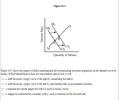 Figure 16-3 Interest Rate \Do Quantity of Money Figure 16-3 shows the impact of deficit spending and the corresponding economic expansion on the demand curve for money. If the Federal Reserve does not want interest rates to rise, it will a. shift the money supply curve to the right by monetizing the deficit b. shift the money supply curve to the left by open market sales of government securities c. maintain the current targets for both M1 and M2 money...
If a government went from a deficit to a surplus, government debt would decrease, the supply...
If a government went from a deficit to a surplus, government debt would decrease, the supply of loanable funds would shift to the right and interest rates would fall. Select one: True False People who buy stock in a corporation such as Honda become part owners of Honda, so the benefits of holding the stock depend on Honda's profits. Select one: True False When large corporations, the federal government, or state and local governments need to borrow to finance their...
 Q.1 (15 points) Assume that the equilibrium in the loanable funds market is at an interest rate of 5% and the total quantity of loans is $650 billion. In addition, in this initial situation, the government is borrowing $80 billion per year to fund the budget deficit. (a) How much is the private investment in this initial equilibrium? (b) Now the government increases spending by $320 billion per year and finances this spending completely with additional borrowing. (i) Draw a...
 MPC Spending Multiplier Change in income 100 20 0.99 0.95 0.6 0.5 Change in government spending $15 $100 -$400 $450 $1,500 $2,000 -$1,000 $900 2.5 2.0 4. Assume that the equilibrium in the loanable funds market is at interest rate of 1.25% and quantity of funds at $20 billion. Suppose the current government deficit is zero so government is not borrowing any money. a) Suppose now government increases spending by $2 billion and finances it entirely by borrowing. This deficit...
 Use the loanable funds model to analyze the effects of a government budget deficit: -Draw the diagram showing the initial equilibrium of the loanable fund market in the below perpendicular axis. 1 point -Determine which curve shifts when the government runs a budget deficit (explain), and draw the new curve on your diagram. I point -What happens to the equilibrium values of the interest rate and investment? Explain. 1 point -Determine the relationship between the crowding-out effect and investment, explain...
 Figure 16-3 Interest Rate \Do Quantity of Money Figure 16-3 shows the impact of deficit spending and the corresponding economic expansion on the demand curve for money. If the Federal Reserve does not want interest rates to rise, it will a. shift the money supply curve to the right by monetizing the deficit b. shift the money supply curve to the left by open market sales of government securities c. maintain the current targets for both M1 and M2 money...
Most questions answered within 3 hours.
-
Where is the error in this code sequence?
String s1 = "Hello";
String s2 = "ello";...
asked 10 months ago -
Financial data for Joel de Paris, Inc., for last year
follow:
Joel de Paris, Inc.
Balance...
asked 10 months ago -
Consider this reaction:
Al2(SO4)3 (aq)+ BaCl3
(aq) Al2Cl6 (aq)- +
3BaSO4(s) . What is the...
asked 10 months ago -
Suppose that Savneet is considering increasing her
recent random sample from 20 car rentals to 40...
asked 10 months ago -
Trucks arrive at an unloading terminal at an average rate of 120
per hour.
Trucks arrive...
asked 10 months ago -
Why are methanol and ethanol completely soluble in water while
octanol is not very little soluble....
asked 10 months ago -
A facilities manager at a university reads in a research report
that the mean amount of...
asked 10 months ago -
When the CuSO4 is rehydrated by adding water to the anhydrous
compound, is this an endothermic...
asked 10 months ago -
A ray of sunlight is passing from diamond into crown glass; the
angle of incidence is...
asked 10 months ago -
A block of mass 0.249 kg is placed on top of a light, vertical
spring of...
asked 10 months ago -
how do the kidneys compensate in the presences of acidosis
a) trigger hyperventilate
b) reserve acid...
asked 10 months ago -
Question 501 pts
The rental rate of capital to the firm increases. Which of the
following...
asked 10 months ago