
Homework Answers
Add Answer to:
Assignment A 77-year-old man is admitted to the intensive care unit (ICU) from the operating room....
Mr. P. F., a 68-year-old man, is admitted to the medical intensive care unit from the emergency department with respira...
Mr. P. F., a 68-year-old man, is admitted to the medical intensive care unit from the emergency department with respiratory failure and hypotension. His history is significant for type 2 diabetes mellitus, steroid-dependent chronic obstructive pulmonary disease, peripheral vascular disease, and cigarette and alcohol abuse. His medications at home include glipizide, prednisone, and Combivent. In the emergency department he received a single dose of ceftriaxone and etomidate for intubation. On medical examination he is intubated, on pressure-controlled ventilation, and receiving...
Mr. Smith, a 77-year-old man who was admitted to the intensive care unit (ICU) post- surgery...
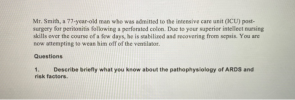 Mr. Smith, a 77-year-old man who was admitted to the intensive care unit (ICU) post- surgery for peritonitis following a perforated colon. Due to your superior intellect nursing skills over the course of a few days, he is stabilized and recovering from sepsis. You are now attempting to wean him off of the ventilator. Questions Describe briefly what you know about the pathophysiology of ARDS and risk factors.
Mr. Smith, a 77-year-old man who was admitted to the intensive care unit (ICU) post- surgery...
 Mr. Smith, a 77-year-old man who was admitted to the intensive care unit (ICU) post- surgery for peritonitis following a perforated colon. Due to your superior intellect nursing skills over the course of a few days, he is stabilized and recovering from sepsis. You are now attempting to wean him off of the ventilator. Questions 1. Describe briefly what you know about the pathophysiology of ARDS and risk factors. Unfortunately, on his way home from the hospital he hits a...
SCENERIO: A 77-year-old man who was admitted to the intensive care unit (ICU) post-surgery for peritonitis...
SCENERIO: A 77-year-old man who was admitted to the intensive care unit (ICU) post-surgery for peritonitis following a perforated colon. Due to your superior intellect nursing skills over the course of a few days, he is stabilized and recovering from sepsis. You are now attempting to wean him off of the ventilator. Unfortunately, on his way home from the hospital he hits a tree and sustains blunt chest trauma. A chest tube was inserted in the ER to treat a...
A 77-year-old man who was admitted to the intensive care unit (ICU) post-surgery for peritonitis following...
A 77-year-old man who was admitted to the intensive care unit (ICU) post-surgery for peritonitis following a perforated colon. Due to your superior intellect nursing skills over the course of a few days, he is stabilized and recovering from sepsis. You are now attempting to wean him off of the ventilator. Unfortunately, on his way home from the hospital he hits a tree and sustains blunt chest trauma. A chest tube was inserted in the ER to treat a pneumothorax...
Mr. A is an 18-year-old 80-kg African American man admitted to the intensive care unit after...
Mr. A is an 18-year-old 80-kg African American man admitted to the intensive care unit after emergency surgery for gunshot wounds to the abdomen. The surgical procedure was extensive and involved repair of a perforated bowel, splenectomy, and hemostasis. Mr. A’s mean arterial pressure (MAP) dropped below 65 mm Hg during resuscitation, and he received 9 units of packed red blood cells and 4 L of lactated Ringer solution intravenously (IV) to achieve hemodynamic stability. Clinical Assessment Within 24 hours...
Brief Patient History Mr. A is an 18-year-old 80-kg African American man admitted to the intensive...
Brief Patient History Mr. A is an 18-year-old 80-kg African American man admitted to the intensive care unit after emergency surgery for gunshot wounds to the abdomen. The surgical procedure was extensive and involved repair of a perforated bowel, splenectomy, and hemostasis. Mr. A’s mean arterial pressure (MAP) dropped below 65 mm Hg during resuscitation, and he received 9 units of packed red blood cells and 4 L of lactated Ringer solution intravenously (IV) to achieve hemodynamic stability. Clinical Assessment...
Brief Patient History Mr. A is an 18-year-old 80-kg African American man admitted to the intensive...
Brief Patient History Mr. A is an 18-year-old 80-kg African American man admitted to the intensive care unit after emergency surgery for gunshot wounds to the abdomen. The surgical procedure was extensive and involved repair of a perforated bowel, splenectomy, and hemostasis. Mr. A’s mean arterial pressure (MAP) dropped below 65 mm Hg during resuscitation, and he received 9 units of packed red blood cells and 4 L of lactated Ringer solution intravenously (IV) to achieve hemodynamic stability. Clinical Assessment...
Brief Patient History Mr. A is an 18-year-old 80-kg African American man admitted to the intensive...
Brief Patient History Mr. A is an 18-year-old 80-kg African American man admitted to the intensive care unit after emergency surgery for gunshot wounds to the abdomen. The surgical procedure was extensive and involved repair of a perforated bowel, splenectomy, and hemostasis. Mr. A’s mean arterial pressure (MAP) dropped below 65 mm Hg during resuscitation, and he received 9 units of packed red blood cells and 4 L of lactated Ringer solution intravenously (IV) to achieve hemodynamic stability. Clinical Assessment...
Mr. C. is 42 years of age and was admitted to the critical care unit from the emergency department with the admitti...
 Mr. C. is 42 years of age and was admitted to the critical care unit from the emergency department with the admitting diagnosis of diabetic ketoacidosis (DKA). He was brought to the emergency department by his wife, who reported that her husband had progressively become more ill with complaints of shortness of breath, abdominal pain, and excessive urination. She became concerned when he started displaying confusion. She reported that the patient fell off a 5-foot ladder 1 weck ago. Ecchymosis...
 Mr. Smith, a 77-year-old man who was admitted to the intensive care unit (ICU) post- surgery for peritonitis following a perforated colon. Due to your superior intellect nursing skills over the course of a few days, he is stabilized and recovering from sepsis. You are now attempting to wean him off of the ventilator. Questions Describe briefly what you know about the pathophysiology of ARDS and risk factors.
 Mr. Smith, a 77-year-old man who was admitted to the intensive care unit (ICU) post- surgery for peritonitis following a perforated colon. Due to your superior intellect nursing skills over the course of a few days, he is stabilized and recovering from sepsis. You are now attempting to wean him off of the ventilator. Questions 1. Describe briefly what you know about the pathophysiology of ARDS and risk factors. Unfortunately, on his way home from the hospital he hits a...
 Mr. C. is 42 years of age and was admitted to the critical care unit from the emergency department with the admitting diagnosis of diabetic ketoacidosis (DKA). He was brought to the emergency department by his wife, who reported that her husband had progressively become more ill with complaints of shortness of breath, abdominal pain, and excessive urination. She became concerned when he started displaying confusion. She reported that the patient fell off a 5-foot ladder 1 weck ago. Ecchymosis...
Most questions answered within 3 hours.
-
Where is the error in this code sequence?
String s1 = "Hello";
String s2 = "ello";...
asked 10 months ago -
Financial data for Joel de Paris, Inc., for last year
follow:
Joel de Paris, Inc.
Balance...
asked 10 months ago -
Consider this reaction:
Al2(SO4)3 (aq)+ BaCl3
(aq) Al2Cl6 (aq)- +
3BaSO4(s) . What is the...
asked 10 months ago -
Suppose that Savneet is considering increasing her
recent random sample from 20 car rentals to 40...
asked 10 months ago -
Trucks arrive at an unloading terminal at an average rate of 120
per hour.
Trucks arrive...
asked 10 months ago -
Why are methanol and ethanol completely soluble in water while
octanol is not very little soluble....
asked 10 months ago -
A facilities manager at a university reads in a research report
that the mean amount of...
asked 10 months ago -
When the CuSO4 is rehydrated by adding water to the anhydrous
compound, is this an endothermic...
asked 10 months ago -
A ray of sunlight is passing from diamond into crown glass; the
angle of incidence is...
asked 10 months ago -
A block of mass 0.249 kg is placed on top of a light, vertical
spring of...
asked 10 months ago -
how do the kidneys compensate in the presences of acidosis
a) trigger hyperventilate
b) reserve acid...
asked 10 months ago -
Question 501 pts
The rental rate of capital to the firm increases. Which of the
following...
asked 10 months ago