
Homework Answers
The cell membrane or the plasma membrane is composed of phospholipids, cholesterol and proteins.
Carbohydrates are a major component of the plasma membrane and they are found on the exterior surface of the cells. They are bound to proteins(forming glycoproteins) and lipids (forming glycolipids). Hence glycoproteins and glycolipids face the cell exterior.
Glycoproteins and glycolipids on the surface of cell plasma membranes determine interactions between cells. What type...
Glycoproteins and glycolipids on the surface of cell plasma membranes determine interactions between cells. What type of chemical bond is most probably used to connect the carbohydrate molecules to the protein or lipid molecules? a. peptide bond b. glycosidic bond c. ester bond d. hydrogen bond e. amide bond
Determine whether the structure, location, and functions describe proteoglycans, peptidoglycan, glycoproteins, or glycolipids. GlcNAc is N-acetylglucosamine;...
 Determine whether the structure, location, and functions describe proteoglycans, peptidoglycan, glycoproteins, or glycolipids. GlcNAc is N-acetylglucosamine; MurNAc is N-acetylmuramic acid. Proteoglycans Peptidoglycan Glycoproteins Glycolipids Structure Location part of proteins at outer surface of plasma membrane, in extracellular matrix, and in blood Functions many functions, including cell adhesion strength for cell envelope Answer Bank glycosaminoglycan covalently joined to a protein at a Ser residue many functions, including acting as hormones bacterial cell wall extracellular matrix; some are integral membrane proteins outer...
Glycan groups of membrane glycoproteins and glycolipids serve as high-specificity binding sites for cell recognition proteins....
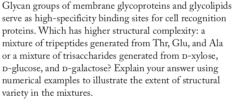 Glycan groups of membrane glycoproteins and glycolipids serve as high-specificity binding sites for cell recognition proteins. Which has higher structural complexity: a mixture of tripeptides generated from Thr, Glu, and Ala or a mixture of trisaccharides generated from D-xylose, D-glucose, and D-galactose? Explain your answer using numerical examples to illustrate the extent of structural variety in the mixtures.
Are the following statements true or false? 1. Membrane carbohydrates occur as either glycoproteins or glycolipids,...
Are the following statements true or false? 1. Membrane carbohydrates occur as either glycoproteins or glycolipids, and most always face away from the cytosol. 2. The melting temperature of a phospholipid bilayer increase with an increased content of unsaturated fatty acid. 3. Molecules which permeate a plasma membrane by facilitated diffusion require cells to use energy (ATP) for their transfer. 4. “Catabolism” refers to synthetic processes that occur inside the cell. 5. Type I collagen has a membrane bilayer-spanning domain....
QUESTION 4 Which of the following molecules are contained in a cell membrane? Check all that...
 QUESTION 4 Which of the following molecules are contained in a cell membrane? Check all that apply. phospholipids triacylglycerides glycolipids nucleic acids glycoproteins cholesterol QUESTION 5
Many cell surface or extracellular proteins are glycoproteins, as are most secreted proteins. List three purposes...
Many cell surface or extracellular proteins are glycoproteins, as are most secreted proteins. List three purposes which the covalently attached oligosacharide portion of glycoproteins serves.
MEMBRANE STRUCTURE AND TRANSPORT ACROSS CELL MEMBRANES 1. An organelle that is characterized by extensive, folded...
 MEMBRANE STRUCTURE AND TRANSPORT ACROSS CELL MEMBRANES 1. An organelle that is characterized by extensive, folded membranes and is often associated with ribosomes 2. Label the following diagram Qutsde of cel LE nside of cell 3. List 4 functions of the plasma membrane c. d. 4. Complete the table below with the role cach component of the plasma membrane plays Plasma membrane components Role in the membrane Phospholipid Bilayer Cholesterol Glycopeoteins Glycolipids Protein Receptor Site Protein channel Protein Carrier 5....
13) Draw a schematic diagram of a cell membrane. Be sure to label the exterior of...
 13) Draw a schematic diagram of a cell membrane. Be sure to label the exterior of the cell, interior of the cell, a membrane protein, a cholesterol molecule and a phospholipid molecule. (6 pts)
Test yourself Many cell surface trans membrane proteins, called glycoproteins, have an attached c...
 Test yourself Many cell surface trans membrane proteins, called glycoproteins, have an attached carbohydrate group, 1. ich faces the extracellular space. This carbohydrate group is attached to the protein when it is still in the rER. Is the carbohydrate attached to the side of the protein that faces the lumen of the rERo the cytosol 2.Explain why the orientation of a transmembrane protein (i.e. which side of the protein faces the inside and which side faces the outside of the...
Question 8 The concentration of K ion within a cell is 120 mM and 45 exterior...
 Question 8 The concentration of K ion within a cell is 120 mM and 45 exterior to the cell if the temperature of the collis 37", what is its equilibrium potential 42.7 my -87.8 mv 112 mv -61.6 mV
 Determine whether the structure, location, and functions describe proteoglycans, peptidoglycan, glycoproteins, or glycolipids. GlcNAc is N-acetylglucosamine; MurNAc is N-acetylmuramic acid. Proteoglycans Peptidoglycan Glycoproteins Glycolipids Structure Location part of proteins at outer surface of plasma membrane, in extracellular matrix, and in blood Functions many functions, including cell adhesion strength for cell envelope Answer Bank glycosaminoglycan covalently joined to a protein at a Ser residue many functions, including acting as hormones bacterial cell wall extracellular matrix; some are integral membrane proteins outer...
 Glycan groups of membrane glycoproteins and glycolipids serve as high-specificity binding sites for cell recognition proteins. Which has higher structural complexity: a mixture of tripeptides generated from Thr, Glu, and Ala or a mixture of trisaccharides generated from D-xylose, D-glucose, and D-galactose? Explain your answer using numerical examples to illustrate the extent of structural variety in the mixtures.
 QUESTION 4 Which of the following molecules are contained in a cell membrane? Check all that apply. phospholipids triacylglycerides glycolipids nucleic acids glycoproteins cholesterol QUESTION 5
 MEMBRANE STRUCTURE AND TRANSPORT ACROSS CELL MEMBRANES 1. An organelle that is characterized by extensive, folded membranes and is often associated with ribosomes 2. Label the following diagram Qutsde of cel LE nside of cell 3. List 4 functions of the plasma membrane c. d. 4. Complete the table below with the role cach component of the plasma membrane plays Plasma membrane components Role in the membrane Phospholipid Bilayer Cholesterol Glycopeoteins Glycolipids Protein Receptor Site Protein channel Protein Carrier 5....
 13) Draw a schematic diagram of a cell membrane. Be sure to label the exterior of the cell, interior of the cell, a membrane protein, a cholesterol molecule and a phospholipid molecule. (6 pts)
 Test yourself Many cell surface trans membrane proteins, called glycoproteins, have an attached carbohydrate group, 1. ich faces the extracellular space. This carbohydrate group is attached to the protein when it is still in the rER. Is the carbohydrate attached to the side of the protein that faces the lumen of the rERo the cytosol 2.Explain why the orientation of a transmembrane protein (i.e. which side of the protein faces the inside and which side faces the outside of the...
 Question 8 The concentration of K ion within a cell is 120 mM and 45 exterior to the cell if the temperature of the collis 37", what is its equilibrium potential 42.7 my -87.8 mv 112 mv -61.6 mV
Most questions answered within 3 hours.
-
Where is the error in this code sequence?
String s1 = "Hello";
String s2 = "ello";...
asked 10 months ago -
Financial data for Joel de Paris, Inc., for last year
follow:
Joel de Paris, Inc.
Balance...
asked 10 months ago -
Consider this reaction:
Al2(SO4)3 (aq)+ BaCl3
(aq) Al2Cl6 (aq)- +
3BaSO4(s) . What is the...
asked 10 months ago -
Suppose that Savneet is considering increasing her
recent random sample from 20 car rentals to 40...
asked 10 months ago -
Trucks arrive at an unloading terminal at an average rate of 120
per hour.
Trucks arrive...
asked 10 months ago -
Why are methanol and ethanol completely soluble in water while
octanol is not very little soluble....
asked 10 months ago -
A facilities manager at a university reads in a research report
that the mean amount of...
asked 10 months ago -
When the CuSO4 is rehydrated by adding water to the anhydrous
compound, is this an endothermic...
asked 10 months ago -
A ray of sunlight is passing from diamond into crown glass; the
angle of incidence is...
asked 10 months ago -
A block of mass 0.249 kg is placed on top of a light, vertical
spring of...
asked 10 months ago -
how do the kidneys compensate in the presences of acidosis
a) trigger hyperventilate
b) reserve acid...
asked 10 months ago -
Question 501 pts
The rental rate of capital to the firm increases. Which of the
following...
asked 10 months ago