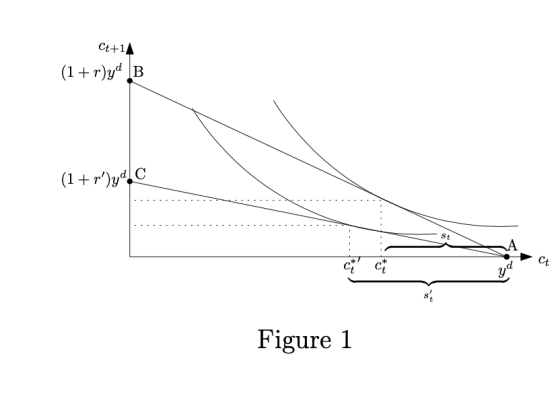
Using a graph similar to the one in Figure 1 prove that when interest rates increase, savings (and investment) decrease. Make sure to provide proper explanations following the argument provided above.
Homework Answers

Add Answer to:
Using a graph similar to the one in Figure 1 prove that when
interest rates increase,...
Using higher interest rates will not affect the future value of the investiment. increase the future...
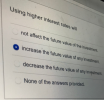 Using higher interest rates will not affect the future value of the investiment. increase the future value of any investment. decrease the future value of any investment. None of the answers provided.
What happens when the price level rises? a. Interest rates rise, so firms increase investment. b. Interest rates...
What happens when the price level rises? a. Interest rates rise, so firms increase investment. b. Interest rates rise, so firms decrease investment. c. Interest rates fall, so firms increase investment. d. Interest rates fall, so firms decrease investment. 44. Which of the following shifts money demand to the left? a. an increase in the price level b. a decrease in the price level c. an increase in the interest rate d. a decrease in the interest rate 45. If the world real interest rate exceeds the Canadian real interest...
A non-callable bond decreases in price by 5% when interest rates increase by 1%. If interest...
A non-callable bond decreases in price by 5% when interest rates increase by 1%. If interest rates decrease by 1%, you would expect an increase in price of more than 5%. an increase in price of less than 5%. an increase in price equal to 5%. a decrease in price equal to 5%. This question is impossible to answer without more information
In February 2014, South Africa had an inflation interest rates in January and is expected to increase or maintain the interest rates through 2014
QUESTION 4 In February 2014, South Africa had an inflation interest rates in January and is expected to increase or maintain the interest rates through 2014. The South African central bank is pursuing rate of 5.9 % and an unemployment rate of 24.1%. The South African central bank raised a(n): contractionary monetary policy to contain inflation. expansionary monetary policy to contain inflation. expansionary monetary policy to fight unemployment. contractionary monetary policy to fight unemployment QUESTION 5 When the economy is sluggish, the Fed will: raise interest rates, which...
1) Suppose interest rates rise in the United States, but they don't rise in other nations....
1) Suppose interest rates rise in the United States, but they don't rise in other nations. As a result of this change, which of the following is true? I. The demand for the U.S. dollar will increase II. The demand for the U.S. dollar will decrease III. U.S. exports will decrease as a result of the changing value of the U.S. dollar. IV. U.S. exports will increase as a result of the changing value of the U.S. dollar. a) I...
Question 1 (1 point) If interest rates increase, how wil his affet planned investment? Planned investment...
 Question 1 (1 point) If interest rates increase, how wil his affet planned investment? Planned investment will decrease. Planned investment will not be affected. Planned investment could increase or decrease. Planned investment will increase. Question 2 (1 point) ere to cut back on their consumption expenditures If the economy were to enter a recession and households w what type of industry would be most affected? Industries selling perishable goods. Industries providing services. Industries selling durable goods. Industries selling non-durable goods...
1.Which of the following is probably the most sensitive to changes in real interest rates? Select...
1.Which of the following is probably the most sensitive to changes in real interest rates? Select one: a. Government purchases b. Exports c. Consumption d. Imports e. Investment 2.When interest rates increase, Select one: a. government purchases will increase to offset the decline in consumption, investment, and net exports. b. expenditures may increase or decrease. c. investment will increase. d. expenditures increase. e. expenditures decrease. 3.If real GDP is greater than potential GDP, Select one: a. the rate of inflation...
Which of the following bond option positions increase in value when interest rates decrease? Select one:...
 Which of the following bond option positions increase in value when interest rates decrease? Select one: O a. Long call; written put O b. Long put; written call O c. Written put; written call O d. Long put; long call
The figure to the right depicts the bond market. Show what will happen to interest rates...
 The figure to the right depicts the bond market. Show what will happen to interest rates if prices in the bond market become more volatile. 1. Using the line drawing tool, show the effect of this shock on the bond market. Properly label your line, 2. Using the point drawing tool, indicate the new equilibrium bond price and quantity. Label the point 2. Carefully follow the instructions above, and only draw the required objects. The effect of this shock will...
We have seen that Federal Reserve Chairman Ben Bernanke has argued that low interest rates in...
 We have seen that Federal Reserve Chairman Ben Bernanke has
argued that low interest rates in the United States during the
mid-2000s were due to a global savings glut rather than to Federal
Reserve policy. In an interview with Albert Hunt of Bloomberg
Television, Alan Greenspan, who was Federal Reserve Chairman from
August 1987 through January 2006 made a similar argument.
Greenspan argued, "Behind the low level of long-term rates: a
global savings glut as China, Russia and other emerging...
We have seen that Federal Reserve Chairman Ben Bernanke has
argued that low interest rates in the United States during the
mid-2000s were due to a global savings glut rather than to Federal
Reserve policy. In an interview with Albert Hunt of Bloomberg
Television, Alan Greenspan, who was Federal Reserve Chairman from
August 1987 through January 2006 made a similar argument.
Greenspan argued, "Behind the low level of long-term rates: a
global savings glut as China, Russia and other emerging...
 Using higher interest rates will not affect the future value of the investiment. increase the future value of any investment. decrease the future value of any investment. None of the answers provided.
 Question 1 (1 point) If interest rates increase, how wil his affet planned investment? Planned investment will decrease. Planned investment will not be affected. Planned investment could increase or decrease. Planned investment will increase. Question 2 (1 point) ere to cut back on their consumption expenditures If the economy were to enter a recession and households w what type of industry would be most affected? Industries selling perishable goods. Industries providing services. Industries selling durable goods. Industries selling non-durable goods...
 Which of the following bond option positions increase in value when interest rates decrease? Select one: O a. Long call; written put O b. Long put; written call O c. Written put; written call O d. Long put; long call
 The figure to the right depicts the bond market. Show what will happen to interest rates if prices in the bond market become more volatile. 1. Using the line drawing tool, show the effect of this shock on the bond market. Properly label your line, 2. Using the point drawing tool, indicate the new equilibrium bond price and quantity. Label the point 2. Carefully follow the instructions above, and only draw the required objects. The effect of this shock will...
 We have seen that Federal Reserve Chairman Ben Bernanke has
argued that low interest rates in the United States during the
mid-2000s were due to a global savings glut rather than to Federal
Reserve policy. In an interview with Albert Hunt of Bloomberg
Television, Alan Greenspan, who was Federal Reserve Chairman from
August 1987 through January 2006 made a similar argument.
Greenspan argued, "Behind the low level of long-term rates: a
global savings glut as China, Russia and other emerging...
We have seen that Federal Reserve Chairman Ben Bernanke has
argued that low interest rates in the United States during the
mid-2000s were due to a global savings glut rather than to Federal
Reserve policy. In an interview with Albert Hunt of Bloomberg
Television, Alan Greenspan, who was Federal Reserve Chairman from
August 1987 through January 2006 made a similar argument.
Greenspan argued, "Behind the low level of long-term rates: a
global savings glut as China, Russia and other emerging...
Most questions answered within 3 hours.
-
Where is the error in this code sequence?
String s1 = "Hello";
String s2 = "ello";...
asked 10 months ago -
Financial data for Joel de Paris, Inc., for last year
follow:
Joel de Paris, Inc.
Balance...
asked 10 months ago -
Consider this reaction:
Al2(SO4)3 (aq)+ BaCl3
(aq) Al2Cl6 (aq)- +
3BaSO4(s) . What is the...
asked 10 months ago -
Suppose that Savneet is considering increasing her
recent random sample from 20 car rentals to 40...
asked 10 months ago -
Trucks arrive at an unloading terminal at an average rate of 120
per hour.
Trucks arrive...
asked 10 months ago -
Why are methanol and ethanol completely soluble in water while
octanol is not very little soluble....
asked 10 months ago -
A facilities manager at a university reads in a research report
that the mean amount of...
asked 10 months ago -
When the CuSO4 is rehydrated by adding water to the anhydrous
compound, is this an endothermic...
asked 10 months ago -
A ray of sunlight is passing from diamond into crown glass; the
angle of incidence is...
asked 10 months ago -
A block of mass 0.249 kg is placed on top of a light, vertical
spring of...
asked 10 months ago -
how do the kidneys compensate in the presences of acidosis
a) trigger hyperventilate
b) reserve acid...
asked 10 months ago -
Question 501 pts
The rental rate of capital to the firm increases. Which of the
following...
asked 10 months ago